
Comprehensive Study Guide: Safety Inspection of In-Service Bridges
$69.00
- Buy to unlock unlimited access to all Quiz questions and Answers in this Quiz.
- After purchase you can print a PDF of the whole quiz at any point. The PDF will contain the questions and the correct answers.
About this Exam
The National Highway Institute (NHI) course, FHWA-NHI-130055 Safety Inspection of In-Service Bridges, is the flagship, comprehensive training course intended to fulfill the specific training requirements of the National Bridge Inspection Standards (NBIS). This certification is designed primarily for Federal, State, and local highway agency personnel, as well as consultants involved in the safety inspection of in-service highway bridges.
It is particularly crucial for individuals aspiring to become Bridge Inspection Team Leaders or looking to validate their technical expertise. The core mission of the course and its final assessment is to ensure all inspectors possess the standardized technical knowledge needed to make accurate condition assessments, ensure uniform reporting across jurisdictions, and, ultimately, protect the safety of the traveling public by identifying potential defects before they become critical.
Ready to test your knowledge?
Buy Now to Access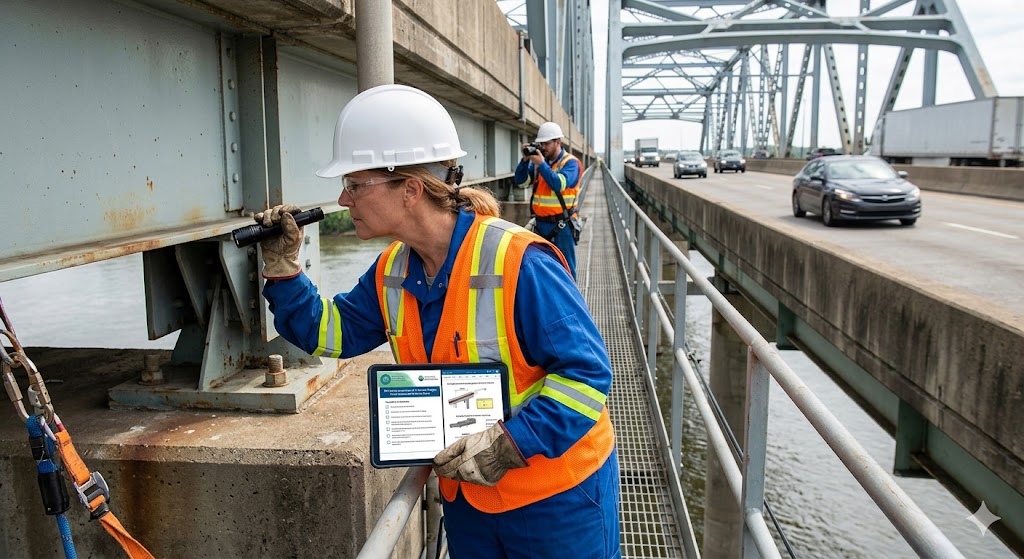
Additional Information
What to Expect in the Final Exam
The NHI 130055 final assessment is a comprehensive test of your knowledge retention and your ability to apply inspection principles to practical scenarios. To receive a certificate of completion for the course, participants must successfully complete mid-term and end-of-course assessments with a cumulative score of 70% or better.
The final assessment is typically presented in a multiple-choice format. It is designed to evaluate your understanding of key concepts, technical terminology, defect identification, and condition rating procedures. Because the BIRM is the foundational document for bridge inspection, this exam is often administered as an open-book test, allowing you to use your reference materials.
It is important to understand that an open-book format does not imply the exam is easy; it simply means you do not need to memorize every single code. The assessment will test your ability to quickly navigate the BIRM and correctly interpret complex structural situations under time constraints. You must be deeply familiar with the BIRM's structure to succeed.
How to Study and Exam Centers
Effective study strategy is paramount for this assessment. Your primary focus must be the Bridge Inspector’s Reference Manual (BIRM). Simply skimming it will not be enough; you must dedicate significant time to understanding its organization. We highly recommend adding sticky notes, bookmarks, or tabs to the BIRM for major sections such as Concrete Defects, Steel Fatigues, Timber Deterioration, and Waterway/Scour evaluation.
Do not overlook the value of the practice questions or assessments provided within your NHI course modules, as these are indicative of the style and difficulty of the final exam. When reviewing these, do not just memorize the correct answer; understand why it is correct and where in the BIRM the rationale can be found.
Pay strict attention during the instructor-led sessions, particularly the review components and the in-the-field exercises. This practical application of condition ratings often highlights the exact scenarios that will be featured on the assessment. Consider forming study groups with fellow participants to quiz each other on defect definitions and specific coding scenarios.
Regarding exam logistics, the NHI course 130055 is usually an instructor-led training (ILT) session hosted by specific organizations, such as State Departments of Transportation (DOTs) or local technology transfer (T2) centers. The mid-term and final assessments are typically administered at the conclusion of the training at these physical host locations. Because these courses are scheduled by host agencies based on demand, you must monitor the official NHI course catalog and contact your local state DOT training coordinator to find available course dates and registration details.
Job Opportunities from the Course
Successfully passing this NHI comprehensive training unlocks critical career paths in the bridge engineering and infrastructure sectors. It is often a mandatory qualification for those aiming to advance into leadership roles within inspection teams.
Below is a non-exhaustive list of job titles and career opportunities unlocked or enhanced by this certification:
Certified Bridge Inspector
Bridge Inspection Team Leader (requiring additional years of experience)
NBIS Bridge Inspection Program Manager
DOT Structural Technician
Highway Engineer (with bridge specialty)
Construction Inspector (for structural projects)
Consulting Engineer (Bridge Evaluation specialty)
Asset Management SpecialistThe course provides detailed curriculum on the inspection and evaluation of every primary bridge component, including decks, superstructures, bearings, substructures, culverts, and waterways. You will learn to identify common defects and deterioration mechanisms across different materials, specifically concrete, steel, and timber. Furthermore, the course includes necessary in-the-field exercises or Virtual Bridge Inspection Computer Based Training (VBI
Frequently Asked Questions
Reviews
5.0
Based on 0 reviews
Leave a Review
No reviews yet. Be the first to review!