
CompTIA Security+ SY0-701 Practice Exam
$69.00
- Buy to unlock unlimited access to all Quiz questions and Answers in this Quiz.
- After purchase you can print a PDF of the whole quiz at any point. The PDF will contain the questions and the correct answers.
About this Exam
The CompTIA Security+ (SY0-701) certification is an internationally recognized, foundational credential that validates the core security skills required for any cybersecurity role. This exam establishes the baseline knowledge necessary to perform essential security functions and pursue a career in IT security. It is specifically designed for IT professionals seeking to validate their knowledge of practical, hands-on security skills, or for those aiming to break into the cybersecurity field from a different sector. Security+ is trusted by organizations globally to ensure their teams have the technical skills to protect systems, networks, and data.
Ready to test your knowledge?
Buy Now to Access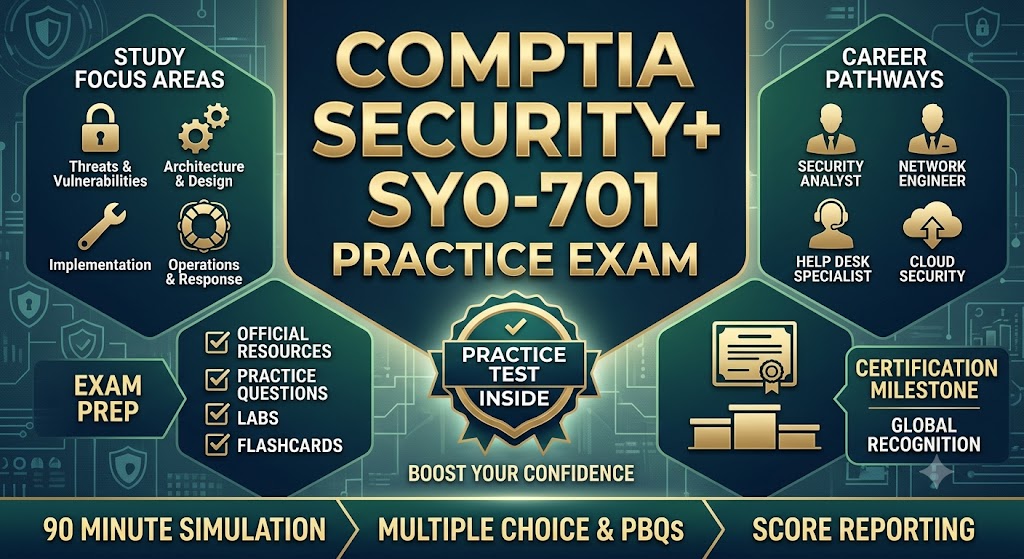
Additional Information
What the Course Entails and Exam Details
The Security+ curriculum is comprehensive, covering a broad spectrum of fundamental cybersecurity concepts across several domains. Understanding these core domains is critical to passing the exam:
Threats, Attacks, and Vulnerabilities (24%): This section focuses on identifying common threat vectors, analyzing various attacks (such as social engineering and malware), and understanding vulnerability management concepts.
Architecture and Design (21%): Candidates must grasp principles of secure network architecture, virtualization, cloud computing, and resilience, as well as the implementation of cryptographic solutions.
Implementation (25%): This crucial section covers hands-on skills like configuring secure networks, managing identity and access controls, and implementing wireless security protocols.
Operations and Incident Response (16%): This area emphasizes the importance of incident response procedures, security monitoring tools, digital forensics, and understanding the incident response lifecycle.
Governance, Risk, and Compliance (14%): Topics include risk management processes, legal and regulatory considerations, and established security controls and frameworks.
What to Expect in the Final Exam
The CompTIA Security+ final exam is challenging and rigorous. Here is what you need to know about the exam format:
Exam Code: Currently, the active version is SY0-701.
Questions: Expect a maximum of 90 questions. The exam uses a mix of multiple-choice questions (which have a single correct answer) and performance-based questions (PBQs), which are simulation-type questions designed to test your hands-on ability to solve problems.
Time Limit: You will have 90 minutes to complete the entire exam.
Passing Score: The exam is graded on a scale of 100-900, and you need a passing score of 750 or higher.
Language: The exam is available in English, Japanese, Portuguese, and Spanish.
Special Rules: The exam is proctored, meaning it is administered by a neutral party who confirms your identity and ensures no cheating occurs. You are not allowed to bring reference materials into the exam, and a strict identification policy is enforced.
How to Study and Exam Centers
Studying for the Security+ exam requires a strategic, multifaceted approach that combines understanding theory with practical practice:
Leverage Official Resources: CompTIA offers a comprehensive suite of study materials, including the official CertMaster Learn e-learning platform and CertMaster Practice practice tests. The CompTIA Security+ Deluxe Study Guide is also widely considered an excellent text for review.
Utilize Third-Party Practice Tests: High-quality practice exams are invaluable for gauging your readiness and identifying areas where you need more focus. Look for practice question sets from reputable sources that mimic the format and difficulty level of the actual SY0-701 exam, ensuring you practice both multiple-choice and PBQ styles.
Get Hands-On Experience: Cybersecurity is an applied skill. Set up a virtual lab environment (e.g., using VirtualBox or VMware) and practice applying the concepts you learn, such as configuring firewalls, analyzing log files, and using command-line security tools.
Join Study Groups: Participating in online forums or local study groups can provide invaluable support, different perspectives, and accountability as you prepare.
How to Take the Exam: The Security+ exam is administered by Pearson VUE. You can take the exam in two ways:
In-Person Testing: You can register to take the exam at a physical Pearson VUE testing center located worldwide.
Online Proctored Exam: You also have the convenient option to take the exam from your own home or office using CompTIA's online testing option, OnVUE. This requires a stable internet connection, a quiet environment, and a reliable webcam.
Job Opportunities from the Course
Achieving your Security+ certification signals to employers that you have the practical skills needed to contribute to a security team. This credential is a direct pathway to many entry-level and intermediate cybersecurity roles. The certification is also often required for certain government contractor positions (e.g., fulfilling DoD 8570/8140 requirements). The career opportunities include:
Security Administrator: Responsible for maintaining the day-to-day operation of security controls, including firewalls, antivirus, and intrusion detection systems.
Systems Administrator (with security focus): Managing and maintaining server environments while applying security patches and ensuring secure configurations.
Network Security Analyst: Focusing on the security aspect of a network, looking for weaknesses, and managing devices such as firewalls and VPNs.
Junior Security Analyst: An entry-level role involved in monitoring security alerts and participating in basic incident investigation and response.
Cybersecurity Analyst: Analysing vulnerabilities, responding to security breaches, and protecting a company’s networks and digital infrastructure.
Help Desk Analyst / Support Specialist (with security specialization): Addressing security-related user issues and maintaining endpoint security.
Cloud Security Specialist (Entry-level): Focusing on implementing and maintaining security controls in cloud-based environments.
Frequently Asked Questions
Reviews
5.0
Based on 0 reviews
Leave a Review
No reviews yet. Be the first to review!