
CompTIA SecurityX CAS-005 Practice Test 2026 | Real Exam Questions
$69.00
- Buy to unlock unlimited access to all Quiz questions and Answers in this Quiz.
- After purchase you can print a PDF of the whole quiz at any point. The PDF will contain the questions and the correct answers.
About this Exam
The CompTIA SecurityX certification, formerly known as CASP+, is the pinnacle of CompTIA’s cybersecurity pathway. It is an expert-level, hands-on certification designed specifically for senior security practitioners—architects and engineers—who wish to remain immersed in the technical aspects of conceptualizing, designing, and implementing enterprise security solutions. This certification validates advanced competency in complex environments, ensuring leaders can defend against sophisticated threats while aligning security with business requirements.
Ready to test your knowledge?
Buy Now to Access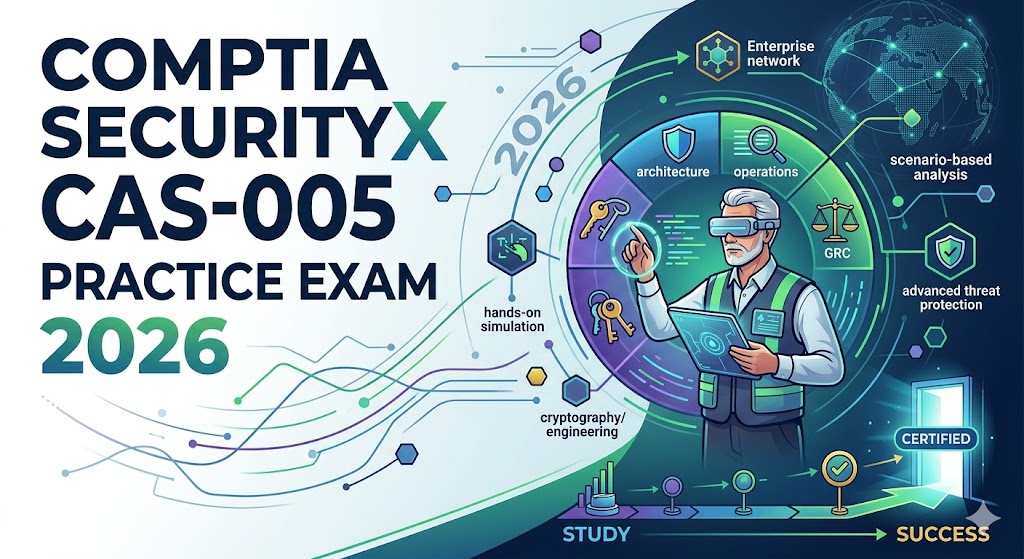
Additional Information
What the Course Ent entails and Exam Details
Preparing for the CompTIA SecurityX (CAS-005) exam requires a mastery of intricate, multifaceted security concepts across hybrid enterprise networks. The course material assumes a foundational understanding equivalent to Network+, Security+, and CySA+.
The core domains covered by the examination include:
Security Architecture (29%): Designing and integrating secure solutions for complex enterprise environments, including cloud, on-premises, and hybrid infrastructures.
Security Operations (19%): Applying advanced monitoring, detection, incident response, and automation techniques to manage continuous security posture.
Governance, Risk, and Compliance (17%): Managing risk through threat modeling, aligning security strategies with organizational goals, and ensuring adherence to legal and privacy regulations.
Security Engineering and Cryptography (23%): Implementing secure systems throughout the life cycle, including application security, hardware assurance, and advanced cryptographic techniques.
Zero Trust and Emerging Technologies (12%): Understanding and applying Zero Trust principles and addressing the security challenges posed by artificial intelligence (AI) and other novel technologies.
What to Expect in the Final Exam
The CAS-005 exam is not merely a test of memorization; it is a rigorous simulation of real-world scenarios designed to assess your ability to apply knowledge. Candidates should expect a challenging, time-pressured environment.
Key details regarding the exam format include:
Number of Questions: A maximum of 90 questions.
Types of Questions: The exam includes a combination of multiple-choice (single and multiple select) and performance-based questions (PBQs).
Performance-Based Questions (PBQs): These are complex, hands-on simulations requiring you to solve technical problems within a virtual environment, such as configuring a firewall or analyzing network traffic.
Time Limit: 165 minutes.
Passing Score: The exam is scored on a Pass/Fail basis only. No numerical score is reported to candidates upon completion.
How to Study and Exam Centers
Successfully passing the SecurityX requires a structured study plan that balances theoretical knowledge with practical application. CompTIA recommends a minimum of ten years of general hands-on IT experience, including at least five years in a broad IT security role.
Actionable Study Strategies:
Analyze the Official Objectives: Download the official CAS-005 exam objectives from CompTIA and use them as your primary study checklist.
Multimodal Learning: Combine resources. Use comprehensive study guides for structured theory, and supplement with instructor-led training or official video courses for complex concepts.
Practice is Crucial: Utilize high-quality practice exams that replicate the scenario-based style and difficulty of the real exam. This builds stamina and helps refine your decision-making under time constraints.
Simulate the PBQs: Focus heavily on performance-based scenarios. Use labs or sandboxed environments to practice hands-on skills, such as threat hunting, cryptographic implementation, and scripting for automation.
How to Take the Exam:
You have two primary options for registering and taking the official exam:
Testing Centers (Physical): You can schedule a proctored exam at any authorized Pearson VUE physical testing center located globally.
Online Testing: You may choose to take the exam remotely from your home or office via the OnVUE online proctoring system. This requires a reliable internet connection, a webcam, and a quiet, private space.
Job Opportunities from the Course
Earning the CompTIA SecurityX certification unlocks senior-level technical roles and often qualifies you for DoD 8140/8570.01-M requirements in government contracting.
These career paths include:
Security Architect
Senior Security Engineer
Cybersecurity Analyst (Expert Tier)
Application Security Engineer
Cloud Security Architect
Security Consultant
SOC Manager
Senior Threat Hunter
Frequently Asked Questions
Reviews
5.0
Based on 0 reviews
Leave a Review
No reviews yet. Be the first to review!