
Connecticut DDS Medication Certification Practice Exam
$69.00
- Buy to unlock unlimited access to all Quiz questions and Answers in this Quiz.
- After purchase you can print a PDF of the whole quiz at any point. The PDF will contain the questions and the correct answers.
About this Exam
The Connecticut Department of Developmental Services (DDS) Medication Administration Certification is a vital credential for unlicensed personnel seeking to work in DDS-licensed or funded facilities. It enables staff to safely "pour and pass" medications to individuals with intellectual or developmental disabilities. This program is specifically designed to ensure that the highest standards of safety and care are met when administering medications in community-based settings, including group homes and other residential programs. Earning this certification is often a mandatory step for direct support professionals who wish to advance their careers and take on additional responsibilities within their agency. It signifies a comprehensive understanding of medical safety, legal documentation, and client rights.
Ready to test your knowledge?
Buy Now to Access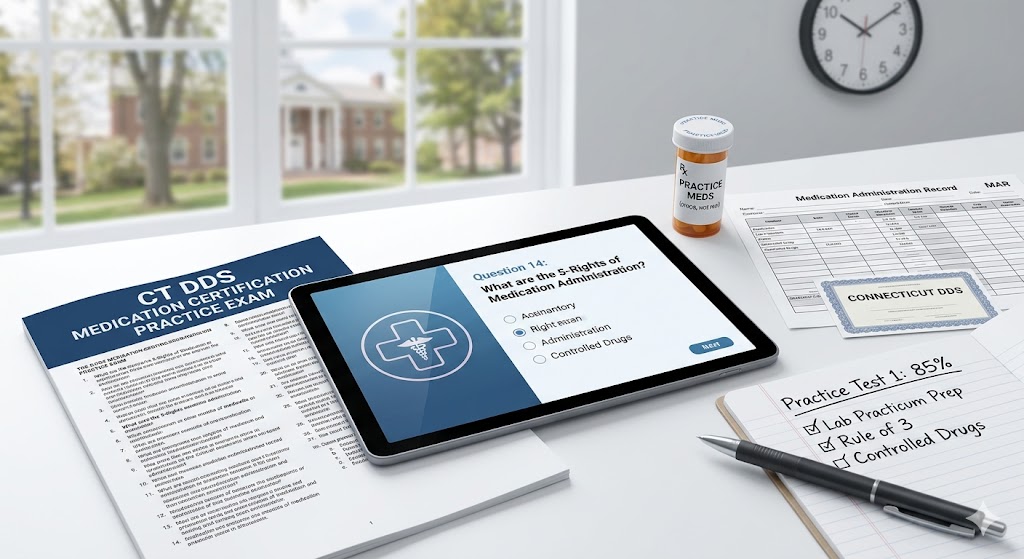
Additional Information
What the Course Entails and Exam Details
The path to certification requires completing a multi-component training program rather than just a single standalone test. To be eligible, candidates must first be employed by a DDS or DDS-provider agency. The course covers foundational knowledge in theory, followed by practical application.
The core of the curriculum involves several key areas:
Theory and Regulations: Understanding the specific Connecticut State Regulations that govern medication administration in DDS settings, the role of the unlicensed staff, and the scope of their authority.
Medical Terminology and Abbreviations: Mastery of the common medical terms, symbols, and abbreviations used in prescriptions and Medication Administration Records (MARs).
The 5-Rights of Medication Administration: The absolute cornerstone of the program. Students are rigorously trained to verify the Right Individual, Right Medication, Right Dose, Right Route, and Right Time for every administration.
Medication Types and Effects: Learning about different classifications of drugs, including controlled substances, and their intended uses, common side effects, and potential adverse reactions.
Documentation: How to accurately and legally complete the MAR, handle medication errors, and document any refusal of medication.
Safe Handling and Administration Techniques: Practical training on preparing (pouring), administering (passing), and storing various medication forms (oral, topical, inhalants, etc.).
The entire process consists of four essential components:
Instruction in Theory: This is a comprehensive classroom or online 21-hour course.
Laboratory Practicum: A hands-on, simulated practice session to develop physical skills.
Written Exam: The primary focus of this guide, which tests all theoretical knowledge.
On-Site Practicum: A final real-world assessment conducted at the student's actual worksite with an agency Registered Nurse (RN) within 90 days of passing the written exam.
What to Expect in the Final Exam
The Final Written Exam for the CT DDS Medication Certification is a comprehensive test designed to measure a candidate’s understanding of the training material. While the core knowledge is consistent, specific details about the written exam format and procedures are managed by authorized testing designees, which often includes local community colleges throughout Connecticut.
Here is a general breakdown of what to expect based on standard DDS guidelines:
Exam Format: The written exam typically consists of 100 questions. These are a combination of multiple-choice and true-false questions, focusing heavily on safety protocols, legal requirements, and the "5-Rights."
Passing Score: The passing score for the written exam is exceptionally high, requiring an 80% or better. The laboratory practicum and the on-site practicum require a perfect 100% passing score, reflecting the zero-tolerance standard for medication errors.
Time Limits: Participants are usually advised to allow 2 hours for the entire exam process. This time slot includes mandatory instruction time and time for questions, with approximately 90 minutes typically allocated to complete the written test itself.
Specific Rules: Candidates must register in advance through their employing agency and a DDS regional coordinator. Identification is required, and only authorized materials are allowed during the test.
How to Study and Exam Centers
Preparation for this high-stakes exam requires a structured approach that combines studying theoretical concepts with practical skill repetition. Because this is a post-employment certification, much of your preparation will be integrated into your initial agency training.
Effective Study Strategies:
Master the Student Manual: The primary study tool is the student curriculum book provided during your initial course. Thoroughly review all chapters, pay attention to emphasized points, and use any review questions provided.
Practice with the 'Rule of 3': Your training will teach you the 'Rule of 3'—comparing the pharmacy label to the Medication Administration Record (MAR) three distinct times. Practice this aloud with prop medications and sample MARs until it is second nature.
Understand, Don't Memorize: Focus on why certain rules exist (e.g., why controlled drugs need two locks, or why abbreviations must be clear). Understanding the rationale for safety rules will help you apply them in complex scenarios on the exam.
Use Practice Tests: Seek out the Connecticut DDS Medication Certification Practice Exam online or from your agency nurse. Simulating the testing environment with timed practice tests will build your confidence and highlight areas that need more review.
Testing and Exam Centers:
The written certification exam is not taken at a private Pearson VUE or Prometric center. By regulation, only the Connecticut Department of Developmental Services (DDS) or its authorized designees can provide the written exam. These authorized sites are typically community colleges located throughout the state to ensure accessibility for agency staff.
To schedule your exam, you must coordinate with your agency director, who will register you through the appropriate DDS regional medication administration coordinator. It is mandatory to register at least five days in advance, as walk-ins are not permitted.
Job Opportunities from the Course
Earning the CT DDS Medication Administration Certification is a crucial step in professional development within the field of developmental services in Connecticut. This certification is a fundamental requirement for Direct Support Professionals (DSPs) to progress and takes on greater responsibilities.
Successful completion of this certification unlocks several specific career paths and job titles:
Direct Support Professional (DSP) - with Medication Administration Authorization
Certified Medication Technician (CMT)
Direct Support Counselor - Med Certified
Certified Medication Aide (CMA)
Medication Liaison (within a group home or day program)
Lead Direct Support Professional
Frequently Asked Questions
Reviews
5.0
Based on 0 reviews
Leave a Review
No reviews yet. Be the first to review!