
Connecticut MPJE Practice Test
$69.00
- Buy to unlock unlimited access to all Quiz questions and Answers in this Quiz.
- After purchase you can print a PDF of the whole quiz at any point. The PDF will contain the questions and the correct answers.
About this Exam
Mastering the nuances of pharmacy law is a critical final step for aspiring pharmacists in the Constitution State.
The Connecticut MPJE (Multistate Pharmacy Jurisprudence Examination) is a jurisdiction-specific exam designed to assess a candidate's knowledge of both federal and state laws governing pharmacy practice.
Passing this rigorous test is mandatory to obtain your pharmacist license in Connecticut.
Whether you are a recent pharmacy school graduate or an experienced pharmacist relocating from another state, this study guide is your starting point for success.
Our purpose is to demystify the exam structure and provide actionable strategies to help you conquer the CT MPJE.
Ready to test your knowledge?
Buy Now to Access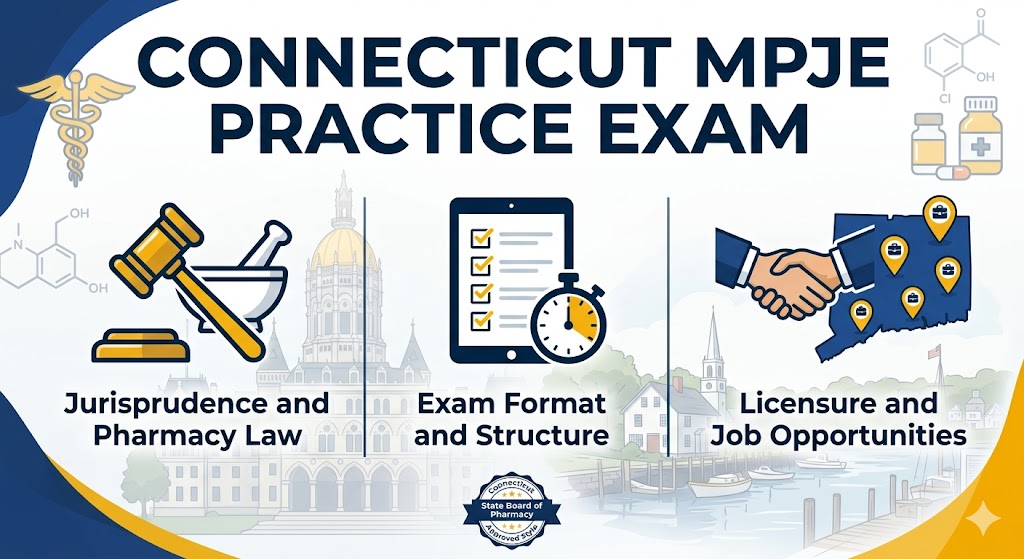
Additional Information
What the Course Entails and Exam Details
The Multistate Pharmacy Jurisprudence Examination is not a generalized legal test; it is a highly focused assessment of how you apply legal principles to real-world pharmacy scenarios.
The exam content is based on the NABP (National Association of Boards of Pharmacy) Competency Statements, which are categorized into four major areas.
Area one focuses on licensure, registrations, and personnel, covering the responsibilities of pharmacists, technicians, and interns in Connecticut.
Area two details pharmacist practice, including requirements for issuing prescriptions, drug orders, and providing patient counseling.
Area three concentrates on dispensing requirements, touching on labeling, packaging, and the legal distribution of restricted drugs.
Area four covers pharmacy operations, such as recordkeeping, ordering controlled substances, and handling inventories.
While federal law provides the foundation, you will be tested heavily on Connecticut-specific statutes and regulations that differ from federal standards.
What to Expect in the Final Exam
Understanding the logistics of the CT MPJE is crucial for managing test-day anxiety.
The actual exam consists of 120 computer-based, multiple-choice questions.
Only 100 of these questions are used to calculate your score; the remaining 20 are pretest questions being evaluated for future use.
You are allotted exactly 2.5 hours (150 minutes) to complete the examination.
The exam is administered in a computer-adaptive format, meaning the difficulty of the questions adjusts based on your performance as you proceed.
You must answer every question presented and cannot go back to change answers.
To pass the Connecticut MPJE, you must achieve a scaled score of 75 or higher.
This score is not a straight percentage but a scaled representation of your proficiency relative to the exam’s difficulty level.
How to Study and Exam Centers
Effective preparation for the CT MPJE requires a dual focus on federal pharmacy law and Connecticut’s unique regulatory framework.
We recommend creating a structured study plan that dedicates initial time to foundational federal laws, such as the Controlled Substances Act.
Next, shift your primary focus to the Connecticut Pharmacy Practice Act and associated regulations found on the official state government websites.
Utilize high-quality CT MPJE practice tests to become familiar with the "select all that apply" and scenario-based question formats.
Many candidates find success using recognized review books and online course providers dedicated to state-specific jurisprudence.
Do not rely solely on memory; practice applying the law to fictional patient cases.
The MPJE is administered by Pearson VUE at their authorized testing centers located across the country.
You can schedule your exam through the NABP e-Profile portal after receiving your Authorization to Test (ATT) from the Connecticut Board of Pharmacy.
Job Opportunities from the Course
Earning your Connecticut pharmacist license by passing the MPJE unlocks a wide array of rewarding career paths throughout the state.
As a licensed professional, you are authorized to practice in diverse healthcare settings, each offering unique responsibilities and challenges.
The investment you make in studying for this exam directly leads to stable, high-paying job opportunities.
Key career paths available to you upon licensure include:
Community Pharmacist (Retail)
Clinical Pharmacist (Hospital)
Pharmacy Manager
Consultant Pharmacist
Long-Term Care Pharmacist
Managed Care Pharmacist
Industrial Pharmacist (Pharmaceutical Manufacturing)
Veterinary Pharmacist
Specialty Pharmacist (e.g., Oncology, Infectious Disease)
Public Health Pharmacist
Frequently Asked Questions
Reviews
5.0
Based on 0 reviews
Leave a Review
No reviews yet. Be the first to review!