
Connecticut Police Use of Force Practice Test
$69.00
- Buy to unlock unlimited access to all Quiz questions and Answers in this Quiz.
- After purchase you can print a PDF of the whole quiz at any point. The PDF will contain the questions and the correct answers.
About this Exam
The Connecticut Police Use of Force Practice Test is an essential, specialized preparatory tool designed for law enforcement recruits, current officers seeking re-certification, and individuals aspiring to join the ranks of Connecticut's police departments.
This comprehensive practice exam is specifically crafted to measure a candidate’s understanding of the State of Connecticut’s Police Officer Standards and Training Council (POSTC) Use of Force Model Policy, alongside relevant state statutes and federal constitutional standards.
Its primary purpose is to ensure that every sworn officer possesses the critical judgment and legal knowledge necessary to make sound, justifiable decisions under pressure, prioritizing de-escalation and the preservation of life while maintaining public safety.
Ready to test your knowledge?
Buy Now to Access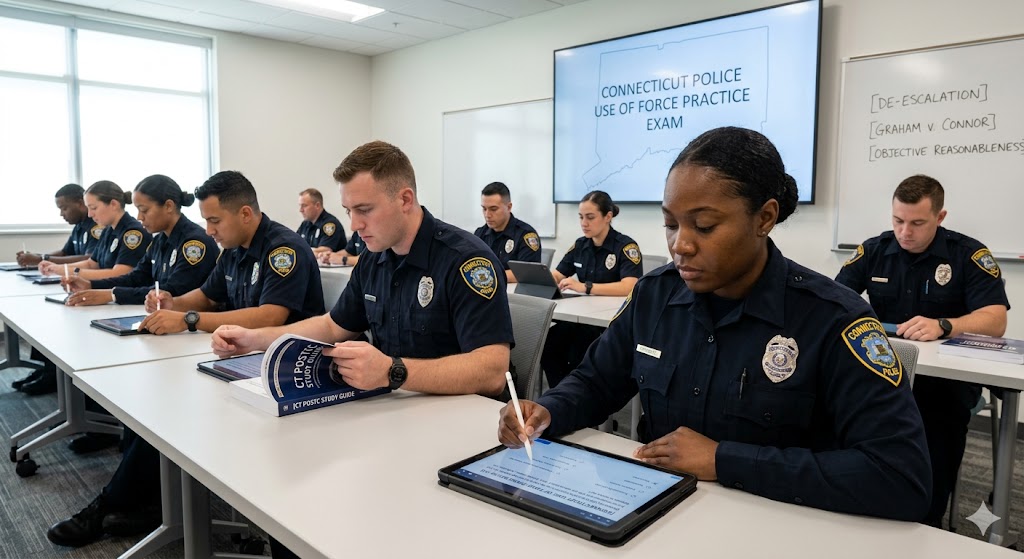
Additional Information
What the Course Entails and Exam Details
This course and its accompanying practice exam provide a deep dive into the legal, ethical, and practical dimensions of a police officer’s authority to use force.
The study material and test questions are based directly on the CT POSTC curriculum and cover four main areas of competence:
Legal Standards and Model Policy: Mastery of the objectively reasonable standard established by Graham v. Connor, Connecticut state law regarding the use of physical and deadly force, and the specifics of the mandatory statewide model policy.
De-escalation and Mitigation: Comprehensive training on techniques to reduce the intensity of a encounter, including verbal communication skills, tactical repositioning, time, distance, and the utilization of specialized resources.
Force Options and Proportionality: Understanding the full force continuum, from officer presence and verbal commands to less-lethal options (like OC spray, batons, and CEWs), and the critical factors that justify the escalation to deadly force as a last resort.
Post-Incident Duties and Accountability: Rigorous instruction on the duty to intervene in unreasonable force, the duty to render immediate medical aid, detailed reporting requirements, and the consequences of illegal or excessive force.
What to Expect in the Final Exam
While formats can vary slightly by authorized training school or agency, the practice test is designed to simulate the final certification exam's rigor.
The final certification exam for Connecticut Police Use of Force is typically a comprehensive written test consisting of multiple-choice and scenario-based questions.
You should expect the final exam to feature approximately 50 to 100 questions.
The time limit for the final exam is usually structured to allow for careful analysis of complex scenarios, often ranging from 90 to 120 minutes.
Candidates are typically required to achieve a minimum passing score of 70% or 80%, depending on the specific academy or agency standards, demonstrating a high degree of proficiency in this critical area.
The exam focuses heavily on applying theoretical knowledge to realistic, high-pressure situations to assess operational judgment.
How to Study and Exam Centers
Effective preparation is key to mastering this difficult subject matter and achieving a passing score.
We recommend a multi-faceted study approach:
Study the CT POST Model Policy: Download and analyze the actual Connecticut POSTC Use of Force Model Policy verbatim. This is your primary source document.
Utilize Scenario-Based Practice: The most effective way to prepare is to practice applying the "objective reasonableness" standard to real-world scenarios. The practice test is excellent for this.
Form Study Groups: Collaborating with fellow recruits or officers to discuss scenarios and debate the justification of force levels is highly effective.
Use Active Recall: Create flashcards for key definitions, legal standards (e.g., Tennessee v. Garner, Graham v. Connor), and prohibited actions.
Regarding exam centers, the Connecticut Police Use of Force final exam is not taken at private testing centers like Pearson VUE.
Instead, the exam is administered within authorized law enforcement academies, such as the Connecticut Police Academy in Meriden, satellite academies, or directly through the training divisions of individual Connecticut law enforcement agencies for in-service training and re-certification.
Practice tests may be accessible through authorized online learning management systems provided by these institutions.
Job Opportunities from the Course
A certified mastery of Connecticut Use of Force standards is not just a regulatory requirement; it is the cornerstone of a successful and respectable career in Connecticut law enforcement.
Successfully passing this exam is a critical component of obtaining and maintaining your Connecticut Police Officer Certification (POST Certification).
This certification is required for nearly all sworn law enforcement positions within the state.
The career paths this knowledge unlocks include:
Municipal Police Officer (Recruit to Certified Status)
Connecticut State Trooper
D.E.E.P. Conservation Police Officer
University or College Police Officer
Capital Police Officer
Advancement to specialized units (e.g., S.W.A.T., K-9, Investigations)
Eligibility for promotion to supervisory roles (Sergeant, Lieutenant, Captain)
Field Training Officer (FTO) or Academy Instructor roles
Frequently Asked Questions
Reviews
5.0
Based on 0 reviews
Leave a Review
No reviews yet. Be the first to review!