
Construction Checkpoint Practice Test
$69.00
- Buy to unlock unlimited access to all Quiz questions and Answers in this Quiz.
- After purchase you can print a PDF of the whole quiz at any point. The PDF will contain the questions and the correct answers.
About this Exam
The Construction Checkpoint Practice Test is a crucial preparation tool designed to simulate the official construction industry competence and safety checkpoint assessments. This resource is engineered to help aspiring construction professionals across all levels—from entry-level laborers to site supervisors and project managers—effectively evaluate their readiness for the mandatory official certification exams required to work on modern construction sites. By using this practice test, candidates can build their confidence, identify critical knowledge gaps, and become familiar with the types of questions and formatting they will encounter in the high-stakes final assessment. Successfully navigating this practice test is a powerful step towards proving one's competence and commitment to safe, professional practices in the construction environment.
Ready to test your knowledge?
Buy Now to Access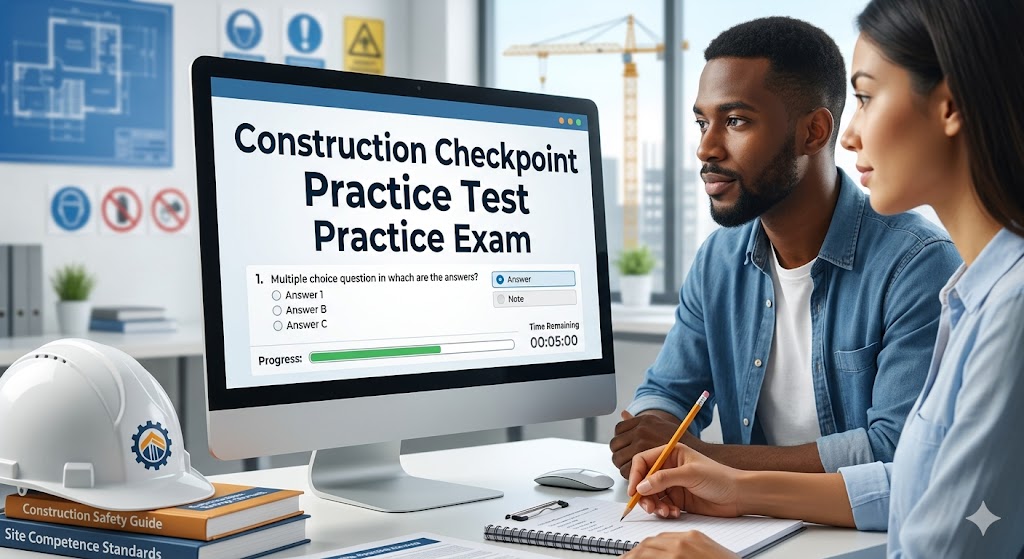
Additional Information
What the Course Entails and Exam Details
This comprehensive Construction Checkpoint Practice Test covers a broad spectrum of core topics, all aligned with the official competency and safety standards prevalent in the global construction industry. The exact structure and topics might vary slightly based on the specific type of construction role or the exact official exam being prepared for, but representative topics typically include:
Health and Safety: Fundamental principles, use of Personal Protective Equipment (PPE), first aid awareness, and fire safety protocols.
Site Safety and Security: Knowledge of safe site access, dynamic risk assessments, and secure work procedures.
Manual Handling and Ergonomics: Best practices for safe lifting, carrying, and reducing the risk of musculoskeletal injuries.
Working at Height: Specific safety measures, relevant equipment (scaffolding, ladders, etc.), and regulatory compliance for elevated work.
Control of Hazardous Substances: Understanding COSHH (if applicable in your region), safe handling, storage, and emergency responses for hazardous materials.
Environmental Awareness: Knowledge of waste management, dust control, and minimizing environmental impact on site.
Role and Responsibility: A clear understanding of the roles of different personnel, reporting lines, and the legal obligations of workers and employers.
The details of the actual official checkpoint exam that this practice tool mimics are critical to understand. The final, non-practice assessment typically involves:
A specific number of questions (often ranging from 40 to 60 multiple-choice or scenario-based items).
A strict time limit (commonly between 45 and 90 minutes).
A computer-based delivery system in a proctored environment, though some components or related tests may be on-site practical assessments.
A high-stakes format where a significant percentage, often above 70-80%, is required to pass.
What to Expect in the Final Exam
When you step into the test center for the official construction industry competency and safety checkpoint, here is what you can expect:
Format: The final exam is often a computer-based, multiple-choice assessment, potentially including scenario-based questions that require you to apply your knowledge to real-world site situations. Some related practical skills assessments may also be part of your overall certification process.
Time Limit: Expect a strict time limit, requiring efficient time management. It’s essential to be prepared to answer each question within the allocated timeframe.
Passing Score: The official pass mark can be high and varies by specific certification and region. Always check the current requirements, but aim for a high standard of preparation, frequently looking at 75% to 90% in key areas.
Specific Rules: On exam day, you will be required to present valid government-issued photo identification. Personal belongings, especially electronic devices, will not be allowed in the testing room. The entire exam will be supervised to ensure academic integrity. Ensure you are familiar with the specific rules of your testing center or body.
How to Study and Exam Centers
Preparation is the absolute key to success on both the practice and official tests.
How to Study Effectively:
Utilize the Construction Checkpoint Practice Test Repeatedly: Take the practice test multiple times to get comfortable with the content, formatting, and time pressure. Analyze every answer, both correct and incorrect, to deepen your understanding of the underlying principles.
Study Official Materials: Consult official course manuals, study guides, relevant safety and construction regulations for your region, and any official practice resources provided by the certification body.
Employ Active Study Methods: Create flashcards for key terms, definitions, and safety rules. Teach the concepts to someone else or vocalize them. Actively recall the information instead of just passive reading.
Focus on Weaker Areas: Use your performance on the practice test to identify specific topics where you need improvement. Spend extra time reviewing these critical sections.
Simulate Real Conditions: For some of your practice attempts, time yourself, minimize distractions, and treat it as the actual exam to build mental stamina and testing discipline.
Exam Centers:
The actual official construction checkpoint or competency assessment is typically taken at authorized testing centers. These centers include:
Dedicated Certification Centers (e.g., Pearson VUE): Major professional certification bodies often use extensive global networks of testing centers.
Specific Construction Industry Training Organizations: Authorized training providers or trade unions may have their own physical testing facilities.
Online Portals (with Proctoring): Some certification schemes may offer secure, proctored online exams that you can take from a suitable location.
Job Opportunities from the Course
Successfully passing the construction industry checkpoint assessment, for which the Construction Checkpoint Practice Test prepares you, opens doors to a wide array of job opportunities and career advancement within the dynamic construction sector. The following specific job titles and paths become highly accessible or are advanced by demonstrating your verified competency:
Construction Laborer
Skilled Trade Assistant (e.g., Carpenter’s Assistant, Electrician’s Apprentice)
Construction Site Supervisor
Assistant Project Manager
Construction Site Manager (with experience and higher-level certifications)
Construction Safety Officer / Health & Safety Advisor
Quality Control Inspector
Skilled Tradesperson (with the necessary trade qualifications, often requiring a competence check like this)
Environmental Advisor (for construction environmental roles)
Frequently Asked Questions
Reviews
5.0
Based on 0 reviews
Leave a Review
No reviews yet. Be the first to review!