
Construction Documentation Practice Test
$69.00
- Buy to unlock unlimited access to all Quiz questions and Answers in this Quiz.
- After purchase you can print a PDF of the whole quiz at any point. The PDF will contain the questions and the correct answers.
About this Exam
The Construction Documentation Practice Test is designed for aspiring and current professionals in the architecture, engineering, and construction (AEC) industry. It serves as a comprehensive tool to validate an individual's understanding of the entire ecosystem of construction documents. This includes the ability to interpret complex 2D drawings, understand written specifications, navigate contractual requirements, and manage critical project communication tools. The test is ideal for architectural documenters, project coordinators, document controllers, construction managers, and anyone responsible for ensuring the accurate transfer of design intent to field execution.
Ready to test your knowledge?
Buy Now to Access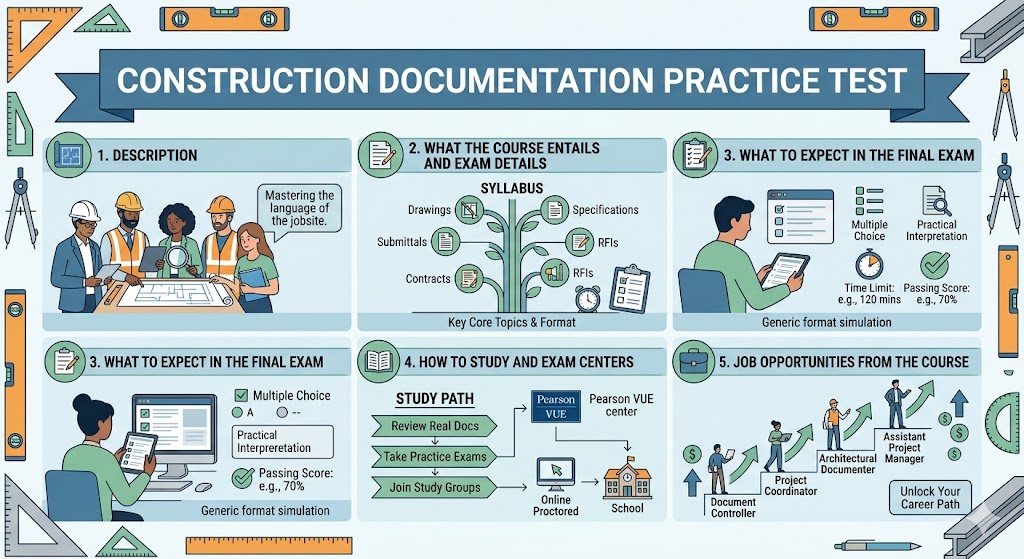
Additional Information
What the Course Entails and Exam Details
This examination covers a broad range of critical topics that form the foundation of a successful construction project lifecycle. While specific curricula vary, you can expect a rigorous evaluation across these core areas:
Interpretation of Construction Drawings: Detailed analysis of architectural, structural, civil, mechanical, electrical, and plumbing (MEP) plans, including floor plans, elevations, sections, schedules, and details.
Understanding Project Specifications: MasterFormat and other standard formatting conventions for technical specs; how specifications interact with and supersede drawings.
Construction Contracts and Delivery Methods: Knowledge of standard contractual relationships, including Design-Bid-Build, Design-Build, and Construction Management, along with key legal and ethical principles in construction.
Project Communication and Documentation: Proper workflows and legal significance of Requests for Information (RFIs), change orders, submittals, shop drawings, site observation reports, and meeting minutes.
Regulatory Compliance: Understanding of building codes, zoning laws, accessibility requirements, and permitting processes, and how they are reflected in project documentation.
What to Expect in the Final Exam
While not based on a single standardized exam, a professional-level Construction Documentation certification typically follows a structured, rigorous format. Be prepared for:
Exam Format: The primary format is usually computer-based, multiple-choice questions. It may also include situational judgment questions, practical drawing interpretation (e.g., "Find the detail for...") and contract scenario analysis.
Number of Questions: Standard exams range from 100 to 150 questions.
Time Limit: Expect a strict time limit, typically 2 to 3 hours.
Passing Score: Most professional certifications require a score of 70% or higher to pass.
Practical Component: Some versions may include a section that requires you to actively use digital tools to locate and interpret data from a sample set of blueprints and project specifications.
How to Study and Exam Centers
Effective preparation requires a combination of self-study, academic resource review, and practical application.
Actionable Study Strategies:
Analyze Real Documents: The most valuable study method is to obtain a complete set of construction documents (drawings and specifications) for a completed project. Practice "reading" them from start to finish. Connect details across different sheets and relate them to the specific sections in the written specs.
Master Industry Standards: Study foundational texts such as the Construction Specifications Institute’s (CSI) Project Delivery Practice Guide. Familiarize yourself with MasterFormat for classifying specifications.
Take Practice Tests: Regularly use timed practice exams to simulate the pressure of the final test. This will help you identify weak areas and improve your time management.
Form Study Groups: Collaborating with peers preparing for the exam allows you to discuss complex concepts, such as contract law or coordination issues.
Where and How to Take the Exam:
Online Proctored Exams: Many organizations offer the option to take the exam remotely through a secure, online proctored portal, which requires a computer, webcam, and stable internet connection.
Physical Testing Centers: Standard delivery methods include authorized third-party testing networks such as Pearson VUE, Prometric, or PSI. These centers provide a controlled environment for the examination.
Authorized Schools and Institutions: Many local community colleges, technical schools, and universities offer construction documentation courses and can administer the certification exam upon course completion.
Job Opportunities from the Course
A certification in construction documentation significantly enhances your career prospects in the AEC industry. It signals to employers that you have the precise technical and administrative knowledge required to manage complex project data.
Specific Job Titles Unlocked by This Skill Set:
Architectural Documenter / Technical Drafter
Construction Document Controller / Manager
Project Coordinator / Assistant Project Manager
CSI Certified Construction Contract Administrator (CCCA)
Construction Specifications Writer
Field Engineer / Assistant Superintendent
Facility Manager (interpreting "as-built" documentation)
By mastering these areas and utilizing this guide, you will be well-prepared to excel in your Construction Documentation Practice Test and take the next step in your professional journey.
Frequently Asked Questions
Reviews
5.0
Based on 0 reviews
Leave a Review
No reviews yet. Be the first to review!