
Construction Manager-in-Training (CMIT) Practice Exam
$69.00
- Buy to unlock unlimited access to all Quiz questions and Answers in this Quiz.
- After purchase you can print a PDF of the whole quiz at any point. The PDF will contain the questions and the correct answers.
About this Exam
Launching a successful career in construction management requires a combination of education, experience, and the right credentials.
The Construction Manager-in-Training (CMIT) designation is the premier entry-level certificate offered by the Construction Management Association of America (CMAA).
This certification is designed specifically for college students in accredited programs, recent graduates, and professionals transitioning into the construction field who want to demonstrate their foundational understanding of professional Construction Management.
Achieving the CMIT credential signals to prospective employers that you are committed to professional development and have mastered the core standards of practice early in your career.
Utilizing a comprehensive CMIT practice exam is a crucial step in this process, helping you build confidence and identify knowledge gaps before taking the official evaluation.
Ready to test your knowledge?
Buy Now to Access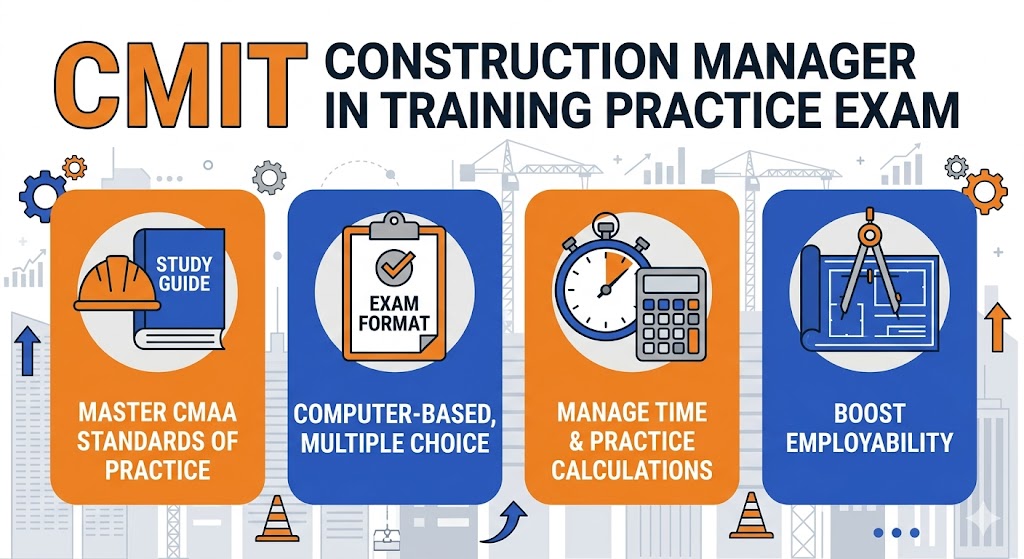
Additional Information
What the Course Entails and Exam Details
While "CMIT" refers to the certificate itself, preparing for it involves studying the official body of knowledge provided by the CMAA.
The preparation curriculum focuses heavily on the CMAA Construction Management Standards of Practice, which serve as the foundation for both the practice exam and the actual certification test.
Candidates must master key domains that cover the entire lifecycle of a construction project.
The core syllabus and skills covered on the exam include:
Professional Practice: Understanding the definition of Construction Management, roles and responsibilities of a CM, professional ethics, and business practice.
Program and Project Management: Concepts of pre-design, design, and construction phases, including procurement strategies and contract administration.
Cost Management and Estimating: Fundamentals of project budgeting, project funding, various estimating techniques at different phases, and cost control processes.
Time Management and Scheduling: Understanding project planning, scheduling methods (like Critical Path Method), progress monitoring, and float management.
Quality Management: Implementing quality planning, assurance, and control procedures throughout the project.
Safety and Risk Management: Identifying, analyzing, and mitigating risks, as well as understanding safety regulations (like OSHA) and creating a culture of safety on site.
What to Expect in the Final Exam
It is important to understand that the "CMIT Practice Exam" is designed to simulate the experience and content of the official final certification exam, which you take to earn the designation.
The actual final CMIT exam is a comprehensive assessment taken entirely online, designed to test your knowledge of the Standards of Practice outlined above.
The exam format consists of multiple-choice questions, requiring you to apply conceptual knowledge to specific construction scenarios.
Currently, the official CMIT exam features approximately 100 questions.
Candidates are given a strict time limit, typically around two hours, to complete the examination.
The passing score requirements are determined by the CMAA based on statistical analysis of question difficulty, but achieving the highest possible score on practice exams is recommended to ensure success.
Because the final exam is a computer-based test with time constraints, simulation through practice exams is vital for managing pacing and reducing anxiety.
How to Study and Exam Centers
Effective preparation for the CMIT requires a structured approach.
Your primary study resource should be the CMAA’s "Construction Management Standards of Practice" and related Capstone modules, as the exam questions are drawn directly from these documents.
Create a study schedule that dedicates specific time blocks to each of the key domains (Cost, Time, Quality, etc.).
Actionable study strategies include forming study groups with peers, reviewing real-world case studies to apply theoretical knowledge, and, most importantly, engaging in repeated practice.
Taking a high-quality CMIT practice exam multiple times is critical. Do not just look at the score; carefully review the rationale for every correct and incorrect answer to deepen your understanding.
Exam Centers and How to Take the Exam:
Unlike advanced certifications that require testing at physical centers, the process for the CMIT is designed for convenience.
You do not usually need to visit physical testing centers or specific authorized schools for the initial CMIT exam.
Candidates typically register for the exam through the official CMAA online portal.
The exam is delivered as an online proctored or unproctored assessment (depending on current CMAA policy) that you can take from any computer with a stable internet connection.
It is your responsibility to ensure your testing environment is quiet and free from distractions.
Always confirm the current registration procedures, fees, and specific online proctoring requirements directly through the CMAA website before applying.
Job Opportunities from the Course
Earning the CMIT designation provides a significant competitive advantage when entering the construction job market.
It proves to employers that you have a verified understanding of professional standard practices and a proactive approach to your career.
Here are specific job opportunities and career paths this certification helps unlock:
Assistant Project Manager
Construction Inspector
Owner's Representative
Junior Estimator
Site Superintendent Trainee
Field Engineer
Construction Scheduler
Quality Control Coordinator
Safety Officer
BIM Coordinator
Frequently Asked Questions
Reviews
5.0
Based on 0 reviews
Leave a Review
No reviews yet. Be the first to review!