
Construction Wiring 2 Practice Test
$69.00
- Buy to unlock unlimited access to all Quiz questions and Answers in this Quiz.
- After purchase you can print a PDF of the whole quiz at any point. The PDF will contain the questions and the correct answers.
About this Exam
Welcome to your essential stepping stone in the skilled trades! The Construction Wiring 2 certification is a pivotal qualification for aspiring electricians and construction professionals. This exam is designed for individuals who have built a foundational understanding of electrical principles and are ready to validate their intermediate-level knowledge and practical skills. It targets those looking to move beyond basic residential wiring into more complex commercial and industrial applications. This certification demonstrates your competency in interpreting technical diagrams, implementing diverse wiring methods, and, most importantly, adhering to the strict safety protocols required on modern construction sites. For employers, this certification signifies a job-ready candidate capable of contributing effectively to complex electrical installations.
Ready to test your knowledge?
Buy Now to Access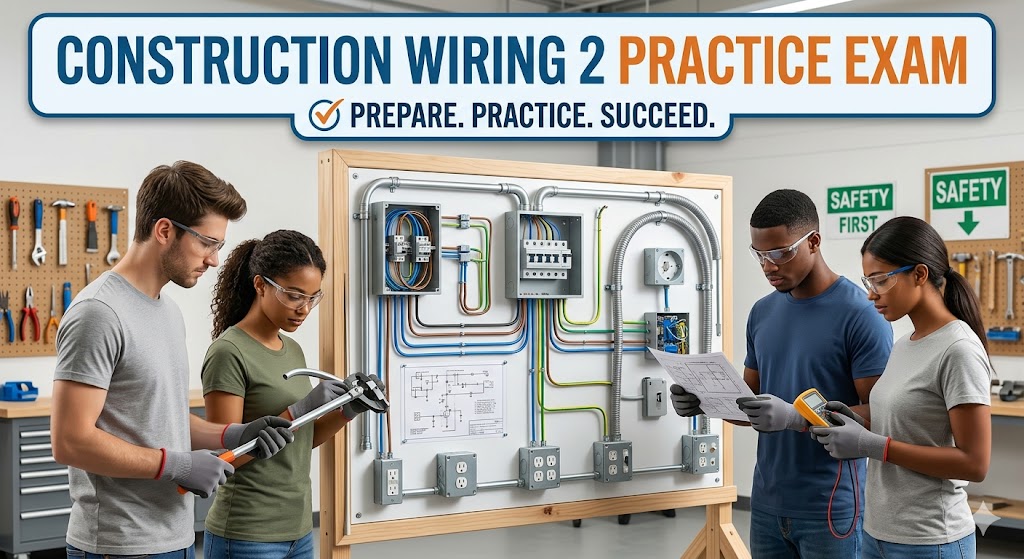
Additional Information
What the Course Entails and Exam Details
This comprehensive course transitions students from theory to advanced application. It focuses on equipping learners with the precise skills demanded by current industry standards. Key areas of focus include a deep dive into electrical theory and its practical application, allowing students to understand not just 'how' to install but 'why' specific methods are used. The syllabus emphasizes health and safety, ensuring every candidate can identify hazards and implement control measures, including safe isolation procedures. Participants will master interpreting intricate electrical schematics and blueprints, a crucial skill for any site worker. A significant portion of the course covers advanced wiring methods, including the installation and termination of specialized cables, trunking systems, and cable trays, as well as the correct procedure for installing distribution panels and earthing systems. Finally, essential testing and inspection techniques are taught to ensure all installations meet regulatory standards.
What to Expect in the Final Exam
The final exam for Construction Wiring 2 is designed to be a thorough and rigorous assessment of both theoretical knowledge and practical capability. To successfully certify, candidates must demonstrate proficiency in both areas, which are often tested separately or in a combined format. The theoretical component typically consists of a closed-book, multiple-choice examination. This part assesses your understanding of electrical science, regulations, and installation theory. The practical component requires you to complete a series of hands-on tasks, such as installing a specific circuit on a simulation board, including bending conduit, pulling wire, and terminating connections, or performing a set of vital testing and inspection procedures. Time limits for each section are strict, often allowing three hours for the practical and a shorter duration for the theory. A passing score, usually around 60% to 70?pending on the specific awarding body, is required for certification.
How to Study and Exam Centers
Preparation is the key to confidence and success. To study effectively for the Construction Wiring 2 exam, adopt a multi-faceted approach. First, master the theoretical content by utilizing this practice test and reviewing your course textbooks, focusing on regulations and electrical science problems. Create flashcards for key terms and symbols. Second, gain as much hands-on experience as possible; practice bending conduit, wiring complex circuits, and using testing instruments until these actions become second nature. Form a study group to discuss scenario-based problems and practice peer assessments. When you are ready, the exam is typically administered through a network of authorized testing centers, which may include dedicated vocational schools, community colleges, or recognized physical testing facilities like Pearson VUE. In some cases, theoretical portions may be offered through secure online portals. You must register in advance and may be required to bring your own personal protective equipment (PPE) for the practical assessment.
Job Opportunities from the Course
Earning the Construction Wiring 2 certification opens a wide array of career paths within the electrical and construction industries. This qualification proves you have the intermediate skills needed for immediately impactful roles. Possible job titles and career paths unlocked by this course include:
Commercial Electrician Apprentice – Install electrical systems in offices, retail, and other commercial buildings.
Industrial Electrician Apprentice – Maintain and repair electrical equipment in factories and plants.
Residential Electrician Journeyman (after fulfilling experience requirements) – Lead installations and repairs in homes.
Solar Installation Technician – Specialize in renewable energy systems, connecting panels and inverters.
Maintenance Electrician – Focus on the upkeep of existing electrical systems in various facilities.
Wireman – Specialize in the wiring and termination of complex circuits.
Electrical Inspector Assistant – Aid in verifying that installations meet legal and safety standards.
Electrical Sales Representative – Use your technical knowledge to sell electrical products and systems.
Frequently Asked Questions
Reviews
5.0
Based on 0 reviews
Leave a Review
No reviews yet. Be the first to review!