
Contact Check Ride Practice Test
$69.00
- Buy to unlock unlimited access to all Quiz questions and Answers in this Quiz.
- After purchase you can print a PDF of the whole quiz at any point. The PDF will contain the questions and the correct answers.
About this Exam
Welcome to your essential first step toward earning your wings. The Contact Check Ride is the pivotal practical examination where student pilots must demonstrate their ability to safely and proficiently control an aircraft using visual references to the ground. This test is designed specifically for aviators in military or rigorous civilian flight training programs who have completed their initial flight instruction block. It represents the transition from learning basic maneuvers to proving you possess the requisite decision-making skills and flight discipline to progress to more advanced solo operations or instrument training. Passing this check ride is not just a requirement; it is a vital confirmation that you have the foundational skills of a pilot.
Ready to test your knowledge?
Buy Now to Access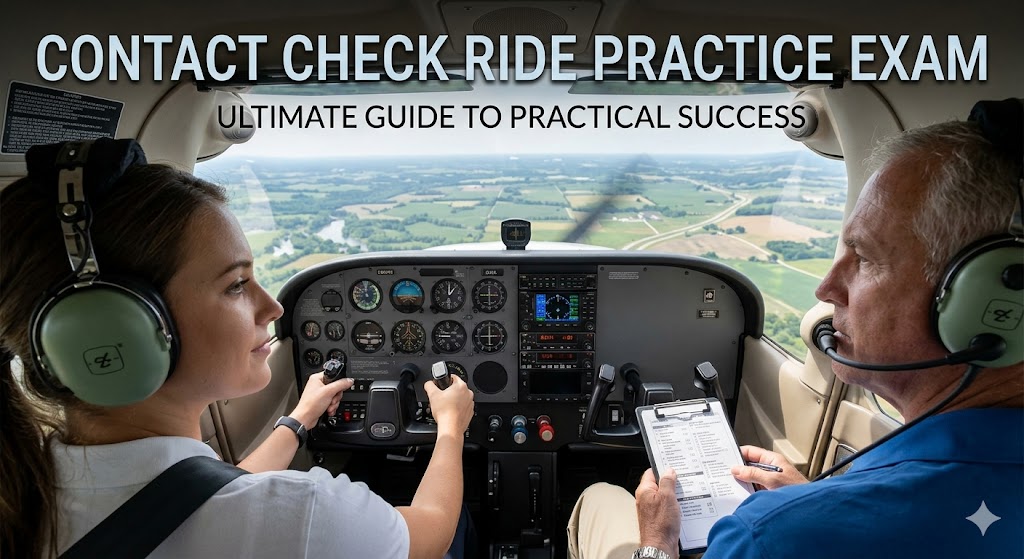
Additional Information
What the Course Entails and Exam Details
This examination does not utilize a rigid classroom syllabus but rather a comprehensive practical application of skills. The Contact Check Ride evaluates your mastery over several critical areas. You will be tested on your ability to maintain situational awareness while navigating by "contact"—using roads, rivers, and landmarks—rather than relying solely on instruments. Core competencies covered include steep turns, slow flight, stalls (recovery and prevention), traffic pattern operations, normal and crosswind takeoffs and landings, and emergency procedures. Additionally, your knowledge of aircraft systems, flight limitations, flight planning, and local weather conditions will be heavily scrutinized during the evaluation process.
What to Expect in the Final Exam
You should expect a rigorous and detailed two-part evaluation conducted by a designated flight examiner or senior instructor. The examination begins on the ground with an intensive oral questioning period. During this phase, the examiner will quiz you on aircraft systems, emergency checklists, and regulatory knowledge. You must pass this portion to proceed to the aircraft. The second phase is the flight portion, where you will physically demonstrate the required maneuvers. You will be graded on your precision, safety, and smoothness. While a numeric score might be used internally, the final result is ultimately Pass or Fail. A passing score requires you to perform all maneuvers within specified tolerances without the examiner needing to take control of the aircraft for safety. The entire evaluation typically lasts between two to four hours.
How to Study and Exam Centers
Effective preparation requires a blend of mental and physical practice. First, study the Flight Training Manual and Aircraft Operating Handbook (POH) until you can recite emergency procedures and limitations from memory. You should utilize "chair flying" techniques, visually guiding yourself through the entire flight in your mind, to build muscle memory and procedural flow. Practice flights with your primary instructor are crucial for honing your skills and identifying weak areas. It is highly recommended that you take several mock check rides to simulate the pressure of the actual exam. Unlike standardized written tests taken at computer centers, the Contact Check Ride is taken "on-site" at your authorized flight school or assigned military airbase, using the specific aircraft and operating procedures you trained on.
Job Opportunities from the Course
Successfully passing your Contact Check Ride is a major achievement that unlocks various prestigious career paths in aviation. It is a necessary milestone for specific job opportunities, including:
Military Aviator (Air Force, Navy, Army, Marine Corps)
Flight Instructor
Commercial Airline Pilot (upon completion of advanced ratings)
Cargo Pilot
Corporate or Charter Pilot
Aerial Surveyor or Photographer
Emergency Medical Services (EMS) Pilot
Frequently Asked Questions
Reviews
5.0
Based on 0 reviews
Leave a Review
No reviews yet. Be the first to review!