
Continuing Care Assistant (CCA) Practice Exam
$69.00
- Buy to unlock unlimited access to all Quiz questions and Answers in this Quiz.
- After purchase you can print a PDF of the whole quiz at any point. The PDF will contain the questions and the correct answers.
About this Exam
The Continuing Care Assistant (CCA) certification is a vital credential for individuals dedicated to providing essential support to patients and clients in various healthcare settings.
This certification validates that a healthcare professional possesses the necessary skills to assist with daily living activities, offer personal care, and provide companionship to those in need.
This qualification is designed for caring individuals who wish to work in long-term care facilities, home care, and hospitals.
Obtaining CCA certification is a crucial step in beginning a rewarding career focused on enhancing the quality of life for seniors, persons with disabilities, and individuals recovering from illness.
Passing the rigorous qualifying exam demonstrates that you have met the standardized provincial or regional requirements to practice safely and effectively.
Ready to test your knowledge?
Buy Now to Access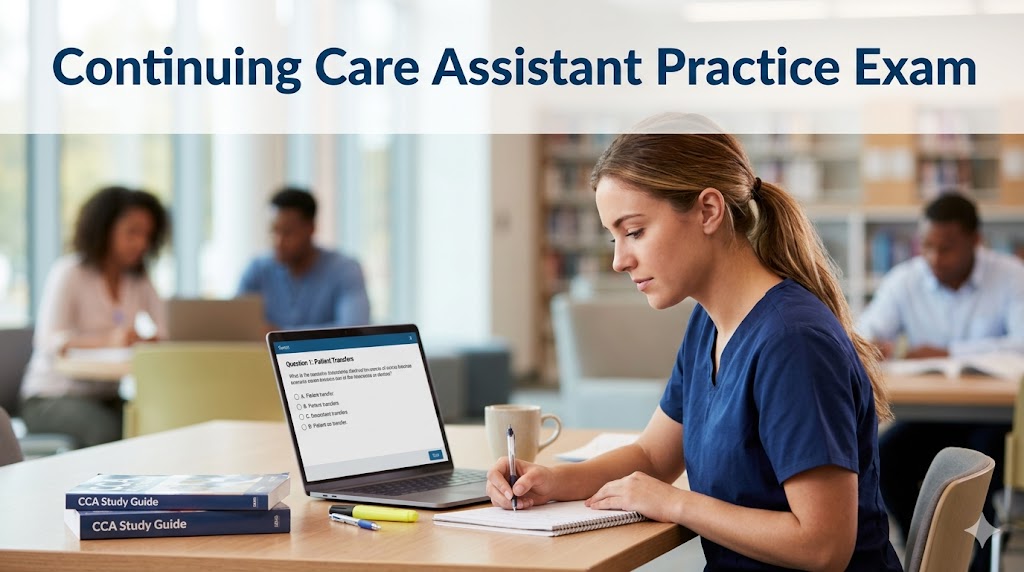
Additional Information
What the Course Entails and Exam Details
A CCA program comprehensively covers the theoretical knowledge and practical skills required to excel in frontline healthcare.
Core topics usually include personal care procedures, such as bathing, dressing, and feeding, as well as assistance with mobility and safe transfers.
Students dive into understanding anatomy and physiology, common medical conditions, nutrition, and standard safety practices.
Strong communication techniques, ethical practice, and respectful interaction with diverse populations are also major pillars of the curriculum.
The underlying CCA course is intense, typically involving hundreds of hours of combined classroom learning and hands-on clinical placement.
The concluding qualifying examination is designed to strictly evaluate your comprehension of these diverse subjects and your ability to apply them in a clinical environment.
What to Expect in the Final Exam
The final qualifying evaluation for CCAs often consists of two critical components: a written theory exam and a practical skills assessment.
The written portion generally utilizes a multiple-choice format, presenting clinical scenarios that test your critical thinking and knowledge application.
This section often has a strict time limit, requiring you to complete approximately 100 questions within a two to three-hour period.
The passing score for the theoretical exam is usually set around 70% or higher, depending on the specific provincial certifying body.
The practical skills assessment requires candidates to perform specific care tasks in front of an evaluator, often using a mannequin or a simulated patient.
You must pass both the written knowledge and the hands-on practical skills sections independently to receive your Continuing Care Assistant certification.
How to Study and Exam Centers
Preparation for the CCA exam must be diligent, starting with a thorough review of your course textbooks, class notes, and clinical care plans.
Engaging deeply with practice exams is highly effective, as this helps familiarize you with the multiple-choice question style and highlights your knowledge gaps.
Consider forming study groups to review complex clinical scenarios and quiz each other on safety protocols and ethical guidelines.
For the practical portion, you should rigorously rehearse physical skills, such as proper body mechanics during transfers, in a lab setting or with a trusted peer.
The final written certification exam is typically administered through authorized regional testing centers or approved post-secondary educational institutions.
Depending on the jurisdiction, candidates might register and complete the theoretical exam online via secure proctored portals or at designated physical assessment centers.
Job Opportunities from the Course
Successfully completing the course and passing the final exam opens the door to numerous fulfilling job opportunities in the healthcare sector.
Graduates with this certification are in high demand and can pursue various roles across different environments.
Some common job titles and career paths available to certified Continuing Care Assistants include:
Long-Term Care CCA: Providing ongoing, comprehensive personal care to residents in nursing homes and assisted living facilities.
Home Care CCA / Home Support Worker: Assisting clients in their private residences to maintain independence with daily tasks.
Acute Care CCA / Hospital Aide: Supporting nursing staff in hospital units by assisting patients with mobility, hygiene, and comfort.
Respite Care Worker: Offering temporary care and relief for families caring for children with special needs or aging adults.
Personal Care Attendant: Working in diverse community settings to support individuals with disabilities in achieving their daily goals.
Dementia Care Specialist: Providing focused, compassionate support tailored to the unique needs of individuals experiencing memory loss.
Frequently Asked Questions
Reviews
5.0
Based on 0 reviews
Leave a Review
No reviews yet. Be the first to review!