
Control and Arrest Tactics Practice Test
$69.00
- Buy to unlock unlimited access to all Quiz questions and Answers in this Quiz.
- After purchase you can print a PDF of the whole quiz at any point. The PDF will contain the questions and the correct answers.
About this Exam
The Control and Arrest Tactics Certification is a vital credential designed for public safety professionals, including law enforcement officers, correctional officers, private security personnel, and military police.
This examination validates a candidate's ability to safely and professionally manage subject confrontations, ensuring the safety of the officer, the subject, and the public.
It is designed for individuals who need to demonstrate mastery of both legal justifications and practical, hands-on techniques required to gain control of a resistant or aggressive subject within the bounds of professional conduct and use-of-force policies.
Ready to test your knowledge?
Buy Now to Access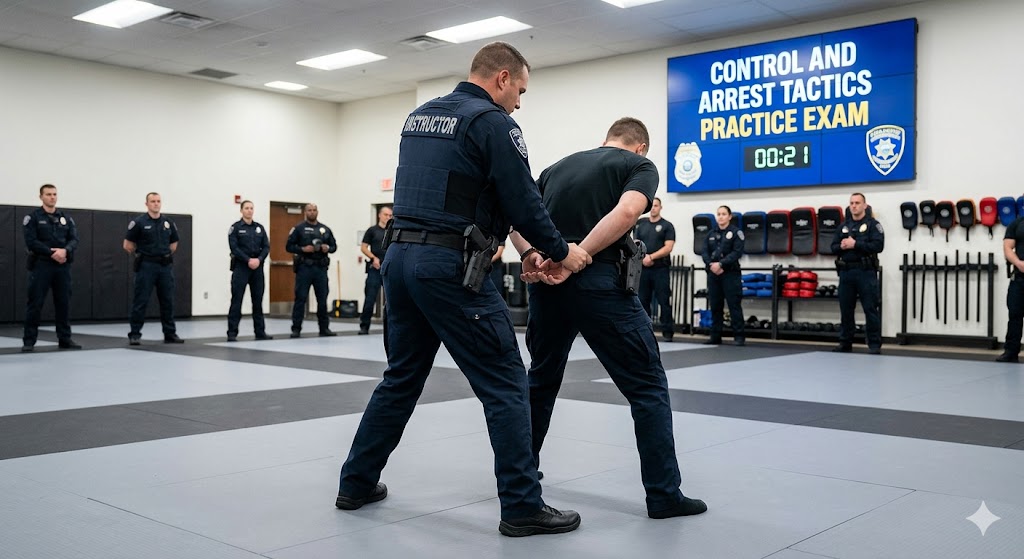
Additional Information
What the Course Entails and Exam Details
This course provides the essential knowledge base and physical skills required for subject control.
It combines classroom instruction on theory and policy with rigorous practical training.
Core topics covered in the curriculum include:
Legal and Ethical Framework
You will study the constitutional standards governing the use of force, state laws, and agency-specific policies. This includes understanding the "reasonableness" standard and proper legal justifications for various levels of control.
Subject Management and De-Escalation
Courses place a heavy emphasis on verbal command presence, conflict resolution, and strategies to de-escalate volatile situations before physical force becomes necessary.
Practical Physical Skills
You will learn a standardized set of physical techniques. These typically include: proper defensive stances and movement patterns; effective search procedures (standing, kneeling, prone); professional handcuffing and restraint device application; various control holds and pain compliance techniques; takedown maneuvers; ground defense strategies; and techniques for weapon retention and retrieval.
What to Expect in the Final Exam
The final certification exam for Control and Arrest Tactics is generally a two-part evaluation process, testing both theoretical knowledge and practical proficiency. Candidates must pass both sections to receive certification.
Written Component
The written exam consists of multiple-choice questions, true/false scenarios, and sometimes short-answer questions. It focuses primarily on: legal terminology; use-of-force continuums or matrices; case law summary; medical considerations regarding restrains (like in-custody death risks); and standard operating procedures.
A typical passing score is 80% or higher. Time limits vary by jurisdiction but are generally around one to two hours for the written portion.
Practical/Skills Component
This is a comprehensive physical test where you must demonstrate the correct application of specific techniques in front of certified evaluators. You will be graded on a pass/fail basis for each technique.
Key evaluation criteria include: proper safety awareness throughout the movement; the ability to maintain balance and control of the subject; the professional application of techniques; and the use of appropriate verbal commands and de-escalation attempts during the scenario.
Failure to demonstrate proper safety or an immediate danger to the evaluator, partner, or subject results in automatic failure of the practical component.
How to Study and Exam Centers
Preparation for this exam requires a balanced approach to academic study and physical repetition.
How to Study
Begin by mastering the material in your student manual or agency policy guide. Pay close attention to definitions of force, the levels of subject resistance, and the legal requirements for a justified arrest.
Practice your verbal commands out loud until they are concise, authoritative, and automatic.
For the physical component, repetition is crucial. Practice the techniques with a qualified partner outside of class hours. Focus on form, balance, and fluid movement rather than speed. Ensure you are double-locking handcuffs every time you practice. Visualizing scenarios mentally can also improve your decision-making speed during the practical exam.
Exam Centers
Control and Arrest Tactics exams are typically administered at specific, authorized locations. They are rarely offered through general third-party portals like Pearson VUE due to the practical testing component.
The primary centers for testing are:
State and Local Police Academies: For sworn law enforcement officers.
Correctional Training Facilities: For correctional officer candidates.
Federal Law Enforcement Training Centers (FLETC): For federal agents and officers.
Authorized Private Security Training Schools: For private security professionals.
Job Opportunities from the Course
A certification in Control and Arrest Tactics is either a mandatory requirement or a significant asset for numerous career paths in public safety and private security. Unlocking this certification directly applies to the following job opportunities:
Police Officer / Sheriff's Deputy
State Trooper
Correctional Officer / Jailer
Military Police Officer
Private Security Specialist (Armed or Unarmed)
Asset Protection and Loss Prevention Officer
Security Team Lead or Supervisor
Corporate Security Officer
Transport Officer
Defensive Tactics Instructor (with advanced certification)
Frequently Asked Questions
Reviews
5.0
Based on 0 reviews
Leave a Review
No reviews yet. Be the first to review!