
COPR Primary Care Paramedic (PCP) Practice Exam
$69.00
- Buy to unlock unlimited access to all Quiz questions and Answers in this Quiz.
- After purchase you can print a PDF of the whole quiz at any point. The PDF will contain the questions and the correct answers.
About this Exam
The Canadian Organization of Paramedic Regulators (COPR)
offers the Primary Care Paramedic (PCP) Practice Exam as a pivotal resource for
aspiring healthcare professionals aiming to secure their national
certification. This meticulously developed practice exam is specifically
tailored for individuals who have successfully completed an approved PCP
educational program in Canada and are preparing to challenge the COPR national
entry-to-practice examination. Achieving a pass on the actual COPR exam is
often a mandatory step toward provincial or territorial licensure and is
crucial for demonstrating that a candidate possesses the essential knowledge
and critical thinking skills required to provide safe, competent care from day
one on the job. By engaging with this practice exam, students can confidently
assess their readiness and fine-tune their study efforts.
Ready to test your knowledge?
Buy Now to Access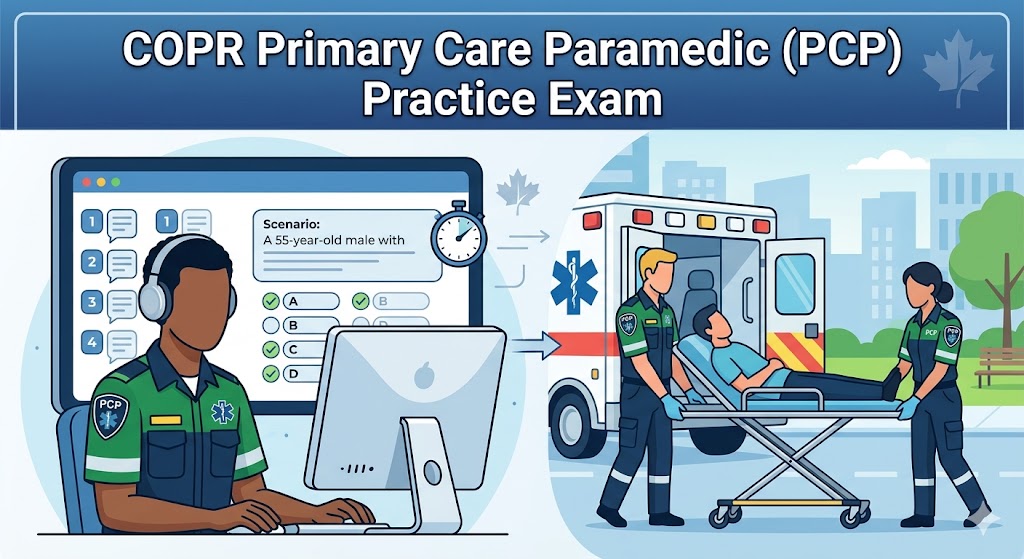
Additional Information
What the Course Entails and Exam Details
As this is a practice exam rather than a full
course, it entails a comprehensive review based on the National Occupational
Competency Profile (NOCP) for Primary Care Paramedics. This comprehensive
blueprint outlines the core competencies that every entry-level PCP in Canada
must master, ensuring nationwide consistency and high standards of care. The
practice exam will test your understanding of and ability to apply concepts
across key domains, including:
- Professional
Responsibilities: Demonstrating ethical conduct, legal knowledge, and
effective communication skills.
- Assessment
& Diagnosis: Applying critical thinking to assess patients accurately,
manage data, and form sound clinical decisions in diverse situations.
- Therapeutics:
Selecting and implementing appropriate medical, trauma, and specific
population (e.g., pediatric, geriatric) interventions, as well as managing
medication administration safely.
- Integration:
Synthesizing complex information under pressure to provide seamless,
holistic patient care.
- Safety:
Ensuring the well-being of the patient, yourself, colleagues, and the
public in dynamic pre-hospital environments.
The practice exam consists of multiple-choice questions
that mirror the actual COPR PCP exam, covering these extensive areas.
What to Expect in
the Final Exam
While individual practice exams may vary slightly, the
official COPR PCP certification exam is a computer-based, multiple-choice
assessment without a practical component. Candidates can anticipate a
challenging and comprehensive test, typically comprising several hundred
questions designed to assess not only recall but, significantly, the
application of knowledge to realistic patient care scenarios.
The exam is typically administered within a strict
timeframe – often spanning several hours, potentially broken down into separate
sittings – demanding both mental stamina and efficient time management. The
questions often present a case scenario or situation, requiring you to
prioritize actions, choose appropriate treatments, or demonstrate sound
clinical judgment based on the provided information. Success requires not only
remembering key concepts but also effectively applying them in dynamic situations.
The scoring is pass/fail based on an established competency standard, and
specific pass marks are not publicly disclosed but reflect a high level of
preparedness.
How to Study and
Exam Centers
Preparation for the COPR PCP exam requires a dedicated,
consistent, and strategic approach. Here are actionable study strategies:
- Analyze
the Blueprint: Deeply understand the COPR exam blueprint and the NOCP
competencies – these are your roadmaps. Allocate your study time
accordingly, focusing more on areas where you are less confident.
- Utilize
Practice Exams Effectively: Take the COPR PCP practice exam early and
treat it seriously to diagnose your weak spots. Later, take it under timed
conditions to practice pacing. Critically review why you got
questions correct and incorrect, ensuring you grasp the underlying
rationale for the best answer.
- Revisit
Core Resources: Study your primary textbooks, course notes, medical
protocols, and pharmacological resources thoroughly. Focus on the why
behind treatments, not just the what.
- Form
Study Groups: Collaborating with peers allows for discussion of complex
scenarios, sharing different perspectives, and testing each other's
knowledge, which is highly beneficial for the clinical application aspect.
- Manage
Stress: Dedicate time to rest, exercise, and stress reduction in the
lead-up to the exam to ensure peak mental performance.
Candidates register for the COPR national exam through
their provincial or territorial regulator, not COPR directly. Once registered,
candidates will be directed to COPR's designated computer-based testing
provider to schedule their specific exam session at an authorized, secure test
center located in cities across Canada. The practice exam itself is typically
accessible online from any computer with internet access.
Job Opportunities
from the Course
Successfully navigating the COPR certification and
obtaining licensure as a Primary Care Paramedic unlocks diverse and rewarding
career paths throughout Canada, including:
- Primary
Care Paramedic (PCP): Working in diverse settings from urban emergency
medical services to rural communities, often with public ambulance
services or private providers.
- Emergency
Medical Services (EMS) Practitioner: Providing essential pre-hospital
emergency care as part of vital healthcare teams.
- Ambulance
Attendant: Ensuring safe transport and vital medical support for patients.
- Paramedic
(Level I or II, depending on provincial classification): Progressing
within paramedic structures, with some jurisdictions classifying PCPs
distinctly.
- Flight
Paramedic: (Requires additional specialized training/certification)
Providing care during fixed-wing or rotary-wing air ambulance operations,
often for critical patients.
- Industrial/Remote
Paramedic: Offering crucial medical support on worksites, resource sector
operations, or remote events where accessibility is limited.
- Clinic/Hospital
Emergency Room Paramedic: Utilizing skills in a different healthcare
environment, collaborating with larger medical teams.
- Paramedic
Educator: Sharing expertise and training the next generation of paramedics
in educational institutions.
- EMS
Supervisor/Manager: (typically after significant field experience)
Progressing into leadership and administrative roles within emergency
services organizations.
Frequently Asked Questions
Reviews
5.0
Based on 0 reviews
Leave a Review
No reviews yet. Be the first to review!