
Coral Restoration Certificate Practice Test
$69.00
- Buy to unlock unlimited access to all Quiz questions and Answers in this Quiz.
- After purchase you can print a PDF of the whole quiz at any point. The PDF will contain the questions and the correct answers.
About this Exam
The Coral Restoration Certificate is designed for passionate divers, marine science students, environmental professionals, and conservation enthusiasts who want to take an active role in protecting and restoring the world's coral reefs. This certification provides the foundational knowledge and practical skills required to support reef resilience in the face of climate change, pollution, and physical damage. By becoming a certified specialist, individuals gain the credibility to participate in coral gardening, outplanting, and monitoring projects globally, transitioning from a recreational observer to a professional "reef saver." This practice test is the essential first step to gauge readiness for the official certification exam.
Ready to test your knowledge?
Buy Now to Access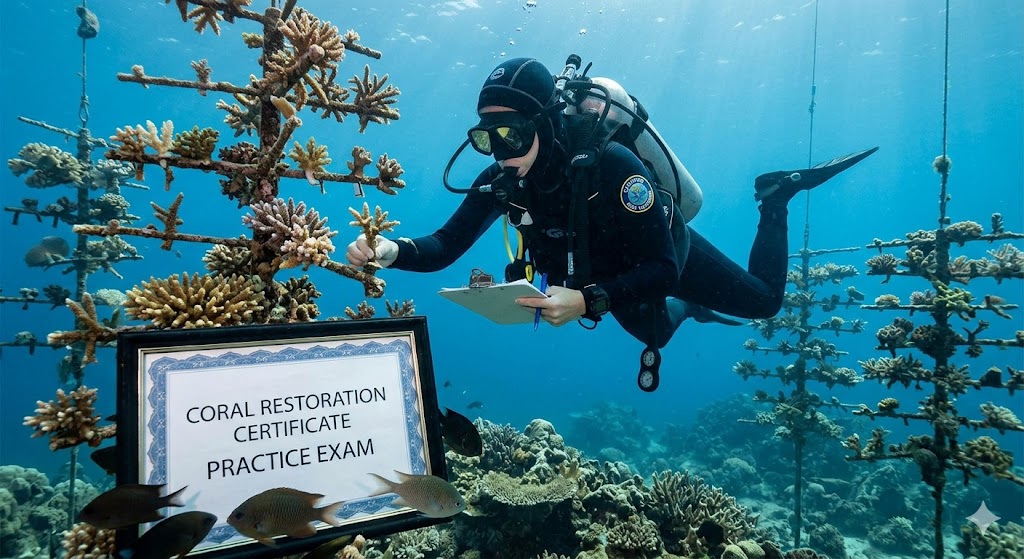
Additional Information
What the Course Entails and Exam Details
A standard Coral Restoration Certificate course comprehensively covers both theoretical knowledge and hands-on practical skills. The core syllabus includes:
Coral Biology and Ecology: Understanding coral anatomy, feeding, reproduction, and the symbiotic relationship with zooxanthellae.
Reef Threats and Resilience: Identifying major stressors (bleaching, disease, storms, anchor damage) and strategies to enhance reef health.
Nursery Setup and Management: Designing and maintaining both land-based and in-water (field) nurseries, including branching coral "trees" or table structures.
Coral Propagation Techniques: Detailed instruction on asexual propagation (fragmentation) and, increasingly, sexual larval propagation methods.
Outplanting Methods: Best practices for moving nursery-reared corals back onto the reef substrate and ensuring survival.
Monitoring and Data Collection: Using scientific survey methods (transects, quadrats, photogrammetry) to track the success of restoration efforts.
The exam details typically mirror the dual nature of the training. Candidates must first pass a written (theoretical) exam, which a practice test specifically simulates. This is followed by a rigorous practical evaluation, where a certified instructor assesses the candidate’s buoyancy, in-water coral handling skills, and outplanting proficiency.
What to Expect in the Final Exam
While the final path to certification involves a hands-on field evaluation, this practice test simulates the critical written component of the examination. The practice exam consists of a series of multiple-choice questions designed to test your mastery of the theoretical syllabus. Candidates should expect questions covering:
Identifying different coral genera.
Explaining the steps of sexual vs. asexual reproduction.
Describing proper sterilization of propagation tools.
Calculating monitoring metrics.
Proposing restoration solutions for specific reef damage scenarios.
In the official written exam, candidates must usually achieve a passing score of at least 75% to 80% to proceed to the practical evaluation. The official practical assessment requires demonstrating flawless buoyancy control and executing restoration techniques safely and efficiently under instructor supervision. There is often a specified time limit for both the written and practical components to test efficiency alongside knowledge.
How to Study and Exam Centers
Effective preparation for the Coral Restoration Certificate requires a mix of self-study and practical experience. Students are encouraged to use the following strategies:
Study the Manual: Thoroughly review all course materials provided by your certifying body (e.g., PADI, SSI, or specific conservation organizations).
Use Flashcards: Create digital or physical flashcards for coral identification, anatomical terms, and restoration protocols.
Complete Practice Tests: Take this practice exam and others multiple times to identify knowledge gaps.
Refine Diving Skills: Prioritize improving your buoyancy and situational awareness. Excellent trim is mandatory for working near delicate coral.
Watch Instructional Videos: Utilize online resources from organizations like the Reef Resilience Network or Ocean Gardener to visualize practical techniques.
To take the official exam, candidates must enroll in a program offered by an authorized provider. These can be physical test centers, often attached to specialized dive operations in reef-adjacent locations (such as Florida, the Caribbean, Bali, or Australia), or digital online portals for the initial theoretical portion. Some comprehensive programs, like those by Reef Check, include online learning followed by field-based training and evaluations.
Job Opportunities from the Course
A Coral Restoration Certificate can unlock a range of fulfilling career paths in marine conservation and environmental science. Specific job opportunities include:
Reef Restoration Specialist
Marine Conservationist / Biologist Assistant
Coral Nursery Manager
Marine Educator / Outreach Coordinator
Environmental Consultant
Aquarist / Coral Culturist
Dive Instructor with Specialty
Frequently Asked Questions
Reviews
5.0
Based on 0 reviews
Leave a Review
No reviews yet. Be the first to review!