
Core Certification Healthcare Interpreter (CoreCHI) Practice Exam
$69.00
- Buy to unlock unlimited access to all Quiz questions and Answers in this Quiz.
- After purchase you can print a PDF of the whole quiz at any point. The PDF will contain the questions and the correct answers.
About this Exam
The Core Certification Healthcare Interpreter (CoreCHI) is a valid, national professional standard designed to assess the foundational professional knowledge of healthcare interpreters, regardless of their primary language. Developed by the Certification Commission for Healthcare Interpreters (CCHI), this knowledge credential ensures that interpreters possess the necessary cognitive skills, critical thinking abilities, ethical decision-making capabilities, and cultural responsiveness to function competently in a healthcare setting. This certification is ideal for both aspiring and working healthcare interpreters who wish to prove their mastery of the core concepts of the profession, distinguishing themselves as professionals in the field. For languages without a language-specific performance exam, the CoreCHI serves as the primary credential.
Ready to test your knowledge?
Buy Now to Access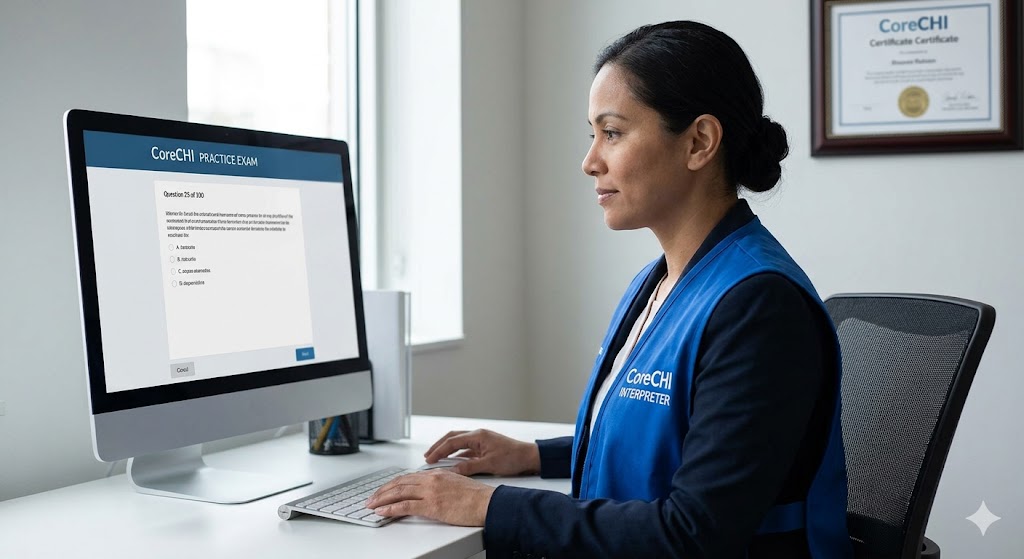
Additional Information
What the Course Entails and Exam Details
The CoreCHI exam is a comprehensive assessment based on a national Job Task Analysis study of practicing interpreters. It evaluates an interpreter's understanding of key areas that distinguish a professional interpreter from a simple bilingual speaker. The exam is divided into several main domains, each carrying a specific weight in the final score:
Professional Responsibility and Interpreter Ethics (23%): This covers the application of established codes of ethics and standards of practice, resolving ethical dilemmas, maintaining professional boundaries and impartiality, assessing the need for advocacy, adhering to safety protocols, and managing personal well-being and professional growth.
Managing the Interpreting Encounter (24%): This domain focuses on the skills required to manage the flow of communication, establish appropriate protocols, use correct interpreting modes, handle unfamiliar terms transparently, and self-monitor for potential linguistic and cultural conflicts during an interaction.
Healthcare Terminology (25%): Candidates must demonstrate current knowledge of a wide range of healthcare terminology and language usage relevant to various medical contexts.
U.S. Health Systems (13%): The exam tests familiarity with the cultures, organizational structures, and relevant legal and socioeconomic environments of the U.S. health system, enabling interpreters to navigate these systems effectively.
Cultural Responsiveness: Integrated throughout the other domains, this measures the understanding of how culture impacts interactions and the ability to bridge cultural gaps in alignment with professional ethics.
The exam itself consists of 100 multiple-choice questions in English. Out of these, 85 questions are scored, and 15 are unscored pretest questions being collected for data.
What to Expect in the Final Exam
When you arrive at the testing phase, you can expect a rigorous but fair process. The CoreCHI exam is entirely computer-based. You will have a total of 2 hours to complete the 100 multiple-choice questions, which each have four options with only one best answer.
Before the official countdown timer begins, you will be given an additional 15 minutes to go through a tutorial to familiarize yourself with the exam interface. This interface allows you to skip questions, mark them for review, and navigate back to any question at any time if you have time remaining. Note that no paper or pencil is permitted during the test session.
The CoreCHI exam uses a scaled scoring system to account for variations in difficulty between different test forms. A raw score (the number of correctly answered questions) is converted to a scaled score ranging from 300 to 600. The passing score is 450. Candidates who achieve 450 or above will receive an immediate preliminary pass/fail result upon submission. Official and final score reports are typically emailed within two weeks.
How to Study and Exam Centers
Preparation is the key to success. To build a solid foundation, focus on developing critical thinking and understanding the national codes and standards. Study the NCIHC National Code of Ethics for Interpreters in Health Care, the National Standards of Practice for Interpreters in Health Care, and regional equivalents like the California Standards for Healthcare Interpreters. Pay close attention to scenario-based questions in practice.
For terminology, use available mini-glossaries to review medical terms by body systems and appointment types, such as prenatal or mental health visits. Create word or mind maps and use digital tools like flashcard apps (e.g., Anki) to commit them to memory. Practice applying your knowledge to different interpreting modalities, including telephonic and video remote, and study standard safety and universal precaution protocols. Join or form a study group to discuss ethical dichotomies and complex, role-based situations.
The most valuable tool in your arsenal is the official CoreCHI Practice Exam, available for a $30 fee on CCHI's online training portal. This 30-question practice test offers correct answers and references, giving you a distinct advantage by providing experience with the actual exam's computer interface and question format, though your score is not predictive of the final exam result.
CCHI offers flexibility in where and how you take the exam, as it is administered year-around. You have two secure, live-proctored options:
In-Person at a Physical Test Center: The exam is delivered through the Prometric network of test centers, which are located throughout the United States. You can search for the nearest center on the Prometric website.
Online via Secure Proctored Platform: You may take the exam from the comfort of your home using Prometric's ProProctor application. This requires a strict, enclosed environment free of distractions, a secure connection, and meeting precise technical requirements, with a remote proctor monitoring you live via video and audio for the duration of the exam.
Job Opportunities from the Course
A CoreCHI certification significantly boosts your career by providing a national knowledge credential that showcases your dedication and adherence to professional standards.
This unlock can open doors to various specialized and general roles within the healthcare system, including:
Medical Interpreter (Freelance or Staff)
Healthcare Interpreter
Video Remote Interpreter (VRI)
Over-the-Phone Interpreter (OPI)
Interpreter Manager or Supervisor (typically requires experience in addition to certification)
Interpreter Educator or Trainer
Subject Matter Expert (SME) for certification test development
Rater for oral performance exams
Frequently Asked Questions
Reviews
5.0
Based on 0 reviews
Leave a Review
No reviews yet. Be the first to review!