
Coronal Polish Certification Practice Test
$69.00
- Buy to unlock unlimited access to all Quiz questions and Answers in this Quiz.
- After purchase you can print a PDF of the whole quiz at any point. The PDF will contain the questions and the correct answers.
About this Exam
The Coronal Polish Certification is a crucial step for dental assistants looking to enhance their professional skills and provide comprehensive preventative care. This specialized certification, generally required by state dental boards for dental assistants who perform this specific procedure, allows practitioners to polish the coronal portions of teeth. The course is designed for currently employed or aspiring dental assistants who seek to increase their expanded function capabilities under the direct supervision of a licensed dentist.
By obtaining this certificate, you demonstrate knowledge in important dental anatomy, clinical procedures, infection control, and patient safety protocols. It is a fundamental achievement in many dental careers, ensuring you meet the required competency standards to perform this task effectively. The ultimate goal of this procedure is to improve patient comfort, dental aesthetics, and overall oral health by removing plaque and extrinsic stains from the tooth's surface.
Ready to test your knowledge?
Buy Now to Access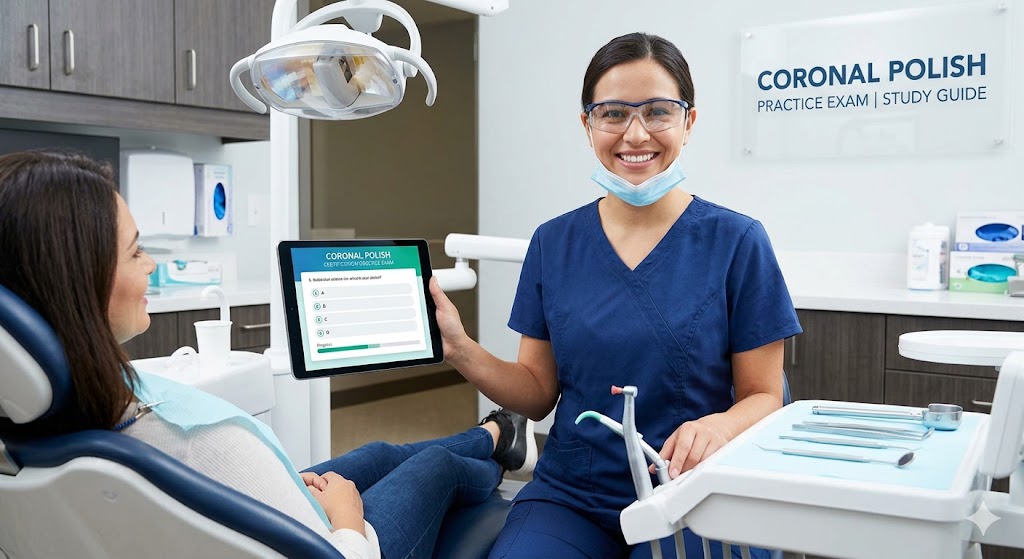
Additional Information
What the Course Entails and Exam Details
This course provides a combination of theoretical and practical training. You will begin by covering the essential foundational knowledge through didactic learning. Key topics typically include dental terminology, tooth anatomy and morphology, types of dentition, and identifying various dental deposits like plaque, calculus, and different stain classifications. Understanding these elements is crucial for safe and accurate procedure execution.
A significant portion of the course involves hands-on, pre-clinical, and clinical training. You will learn the proper use and care of various instruments and materials, including low-speed handpieces, polishing angles, rubber cups, bristle brushes, disclosing agents, and appropriate abrasives. Practical training will cover ergonomics, operator and patient positioning, correct fulcrum placement for stability, and the safe and efficient sequence and pattern for polishing strokes across all areas of the mouth.
Safety is paramount, so the course includes comprehensive training in infection prevention, sterilization protocols, equipment maintenance, and handling potential medical emergencies. You will also learn about legal and ethical responsibilities, proper treatment documentation, and effective patient education strategies. This practice test is designed to evaluate your theoretical knowledge, preparing you to succeed on the final certification exam.
What to Expect in the Final Exam
The final exam for Coronal Polish Certification typically consists of a multiple-choice question format. It is generally a comprehensive, knowledge-based assessment that tests your understanding of all key areas covered in the course syllabus. This computer-based exam is often proctored, which may occur at an authorized testing center or, sometimes, via secure remote online monitoring, depending on the requirements set by the state dental board or certifying body.
The exam focuses on theoretical competence and critical thinking rather than performing the clinical procedure itself. Passing scores vary by state, but a set percentage, such as 70% or difficultly-based score, is typically required. The exam may be timed, with specific time limits, and is designed to ensure you possess the necessary standard of knowledge for safe practice. Keep in mind that a practical clinical competency evaluation is often required alongside the theory exam as part of the full certification process, though this practice test only mirrors the knowledge-based portion. Be sure to check the specific guidelines for your state's certification path.
How to Study and Exam Centers
Effective study techniques are key to your success. Actively reviewing your course materials, textbooks, and detailed class notes is essential. Use this practice exam as a valuable diagnostic tool; it allows you to simulate the testing environment, get comfortable with the types of questions you'll face, and identify specific topics where you need to focus more study time. Create flashcards for dental terminology, anatomy, materials, and safety protocols to reinforce critical concepts. If your course included a practical component, practice clinical skills under direct supervision to solidify your hands-on proficiency and understanding of patient interaction.
When you are ready, you will typically schedule your exam. The official final exam is administered by authorized bodies, state dental boards, or testing centers such as specific accredited dental assisting schools or academies. Some certifications, like those through the Dental Assisting National Board (DANB), offer the knowledge component online with remote proctoring, or at specific physical locations (e.g., Pearson VUE). Always consult your local dental board and course provider for precise information on scheduling your exam, approved testing locations, required documentation (such as current CPR certification), and any specific prerequisites. Preparing with a structured study guide and utilizing reliable practice resources like this test will maximize your preparedness.
Job Opportunities from the Course
Obtaining your Coronal Polish Certification significantly enhances your value in a dental office and opens doors to several rewarding job opportunities. This credential unlocks a career path within dental assisting and preventative care, allowing you to assume expanded functions and a more direct role in patient treatment. Specific job titles and roles associated with this certification include:
Coronal Polish Certified Dental Assistant: A highly valued role in general and specialty dental practices.
Expanded Function Dental Assistant (EFDA): Many states include coronal polishing as a core EFDA skill, potentially leading to diverse responsibilities.
Dental Assistant (with a focus on preventative care): Assisting in the core tasks of patient treatment and education.
Oral Health Educator: Leveraging your certification to teach patients proper oral hygiene and the importance of professional cleanings.
Preventative Care Specialist: Working in practices that emphasize routine check-ups, sealants, and fluoride treatments.
Opportunity for Career Advancement: This certification serves as a stepping stone towards roles such as a clinical supervisor, practice manager, or further specialized certifications, contributing to a meaningful career with potential for growth in the dynamic dental field.
Frequently Asked Questions
Reviews
5.0
Based on 0 reviews
Leave a Review
No reviews yet. Be the first to review!