
Coronal Polishing for Dental Assistants Certificate Practice Test
$69.00
- Buy to unlock unlimited access to all Quiz questions and Answers in this Quiz.
- After purchase you can print a PDF of the whole quiz at any point. The PDF will contain the questions and the correct answers.
About this Exam
The Coronal Polishing for Dental Assistants Certificate Practice Test is designed for current dental assistants looking to expand their scope of practice. This credential validates a dental professional's understanding of the theory, infection control protocols, and clinical techniques required to remove plaque and stains from the visible portion of the tooth (the clinical crown). Successfully completing this certification process allows assistants to perform this valuable clinical duty under the supervision of a dentist, increasing both their office utility and earning potential.
Ready to test your knowledge?
Buy Now to Access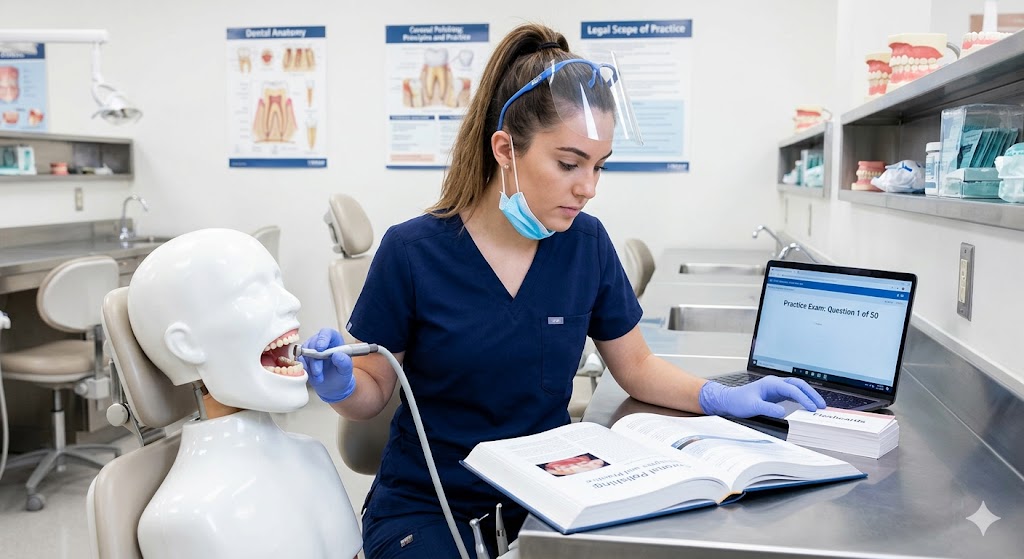
Additional Information
What the Course Entails and Exam Details
To succeed on this exam, candidates must master several core domains common to dental assisting curricula. The primary educational focus covers fundamental dental anatomy, specifically differentiating between the anatomical crown, the clinical crown, and the supporting root structure. Significant emphasis is placed on infection control protocols specific to aerosol-generating dental procedures and the proper sterilization of clinical equipment.
The study materials will detail the identification and classification of extrinsic stains (caused by environmental factors like coffee or tobacco) versus intrinsic stains, ensuring assistants understand which discolorations can be removed. Candidates must also understand the characteristics and abrasivity levels of various polishing agents, the components and maintenance of the slow-speed handpiece, and appropriate clinical techniques, such as proper fulcruming for stability and controlling the applied pressure. Finally, coursework often covers relevant state dental practice acts and the strictly defined legal limitations of the dental assistant's role in coronal polishing.
What to Expect in the Final Exam
The final written examination typically follows a multiple-choice format, requiring candidates to select the single best answer. The number of questions and the time limit vary depending on the state licensing board or the testing organization (such as DANB or specific state institutions), but a typical written exam ranges from 50 to 100 questions.
A common passing score threshold for this credential is approximately 75 percent or higher. In some jurisdictions, this written exam is paired with a clinical, hands-on demonstration, where candidates must successfully polish the teeth of a mannequin or a live patient under the observation of a licensed evaluator. This practical component must be passed in conjunction with the written portion to receive the certificate. It is critical to check the specific requirements outlined by your state's board of dentistry.
How to Study and Exam Centers
The most effective way to prepare for this examination is to combine thorough theoretical review with repetition. Begin by reviewing the official curriculum materials, lecture notes, and textbooks provided by your dental assisting education program.
Leverage the Coronal Polishing for Dental Assistants Certificate Practice Test repeatedly; use these questions to identify areas where your knowledge is weakest and to familiarize yourself with the question phrasing style common to certification exams. Consider creating flashcards for key dental terminology, stain classification, and legal regulations. For the clinical portion, mentally visualize the correct ergonomic principles, patient positioning, and handpiece adaptation techniques.
The final examination is generally administered through specific, recognized channels. Many state boards require the test to be proctored at local community colleges or authorized dental hygiene and dental assisting schools that host approved training courses. Alternatively, some state certifications may be handled by standardized computerized testing providers like Pearson VUE, which offer secure testing locations nationwide. Contact your state board of dentistry or the educational institution where you completed your coursework to find official testing centers and registration procedures.
Job Opportunities from the Course
Obtaining this certificate unlocks new levels of professional responsibility and advancement within the dental field. This credential signals advanced competency to employers, making candidates highly competitive. Potential career paths and job titles include:
Expanded Function Dental Assistant (EFDA): Highly qualified assistants who have obtained special certifications to perform additional clinical duties beyond basic dental assisting.
Registered Dental Assistant (RDA) with Coronal Polishing: A specific credential often required by state boards to legally perform this duty, marking advanced training.
Preventive Care Specialist: Dental assistants in offices that emphasize hygiene and prevention, where coronal polishing is a primary component of many patient visits.
Clinical Dental Assistant: A general dental assistant who becomes far more valuable to a busy practice by assisting the dentist in managing time-consuming clinical procedures.
Pediatric Dental Assistant: In specialized pediatric offices, assistants frequently utilize coronal polishing as part of routing cleanings and preventive treatments for children.
Oral Health Educator: An experienced assistant with deep knowledge of dental hygiene and stain removal who can take a leadership role in teaching patients proper oral health practices.
Dental Office Manager/Lead Assistant: Assistants with extended functions often transition into leadership or management roles, supervising other assistants and managing clinical operations.
Frequently Asked Questions
Reviews
5.0
Based on 0 reviews
Leave a Review
No reviews yet. Be the first to review!