
Corporate Finance Practice Test
$69.00
- Buy to unlock unlimited access to all Quiz questions and Answers in this Quiz.
- After purchase you can print a PDF of the whole quiz at any point. The PDF will contain the questions and the correct answers.
About this Exam
This practice test is designed for students, finance professionals, and anyone seeking to validate their knowledge of core corporate finance concepts in preparation for a primary exam or for general professional development. It provides a valuable opportunity to assess comprehension across key areas like capital budgeting, financial analysis, valuation methods, and corporate governance. Whether you're a current finance student brushing up on fundamentals or an aspiring corporate finance analyst preparing for a crucial exam, this practice test offers a rigorous simulation to sharpen your skills and build confidence.
Ready to test your knowledge?
Buy Now to Access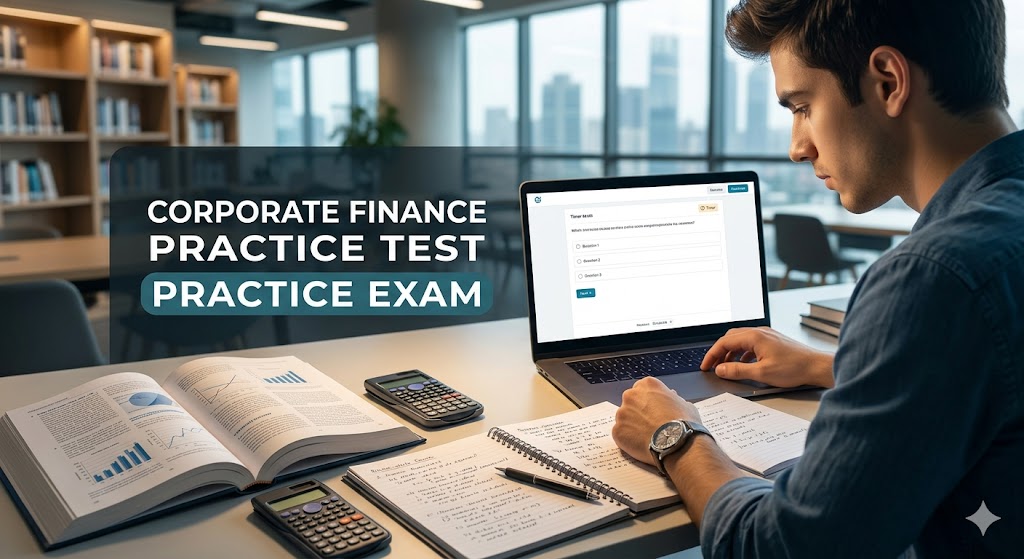
Additional Information
What the Course Entails and Exam Details
While not a direct study course itself, this practice exam encompasses a comprehensive range of topics typically foundational to corporate finance. The test evaluates proficiency in:
Capital Budgeting Techniques: Net Present Value (NPV), Internal Rate of Return (IRR), Payback Period, etc.
Financial Statement Analysis: Interpreting balance sheets, income statements, cash flow statements; key financial ratios.
Cost of Capital & Capital Structure: Understanding WACC, debt vs. equity financing, and their implications.
Valuation Models: Applying various techniques like Discounted Cash Flow (DCF), comparable company analysis, and precedent transactions.
Working Capital Management: Strategies for managing short-term assets and liabilities efficiently.
Corporate Governance & Ethics: Basic principles of effective corporate oversight and ethical considerations in financial decision-making.
Risk Management: Fundamental concepts of identifying and mitigating financial risks.
What to Expect in the Final Exam
The corporate finance practice test is typically structured to closely mimic real exam conditions. Expect a format that often includes:
Question Type: predominantly multiple-choice questions designed to test both theoretical knowledge and practical application across all core topics. Some tests may incorporate brief case studies or calculation-based questions.
Number of Questions: generally varies, but you might typically face anywhere from 50 to 100 questions.
Time Limit: typically allocated around 1.5 to 3 hours, giving you ample but bounded time to complete all sections.
Passing Score: There isn't always a strict passing score for the practice test itself, as its purpose is diagnostic, but a target score (often 70% or higher) is usually recommended to feel adequately prepared for a final certification. Many practice platforms will track your score and provide detailed breakdowns.
Allowed Materials: Typically, no outside resources or formula sheets are permitted unless explicitly stated otherwise by the specific provider or primary exam rules. Calculators might be permitted for certain questions.
Exam Interface: Online platforms often provide a user-friendly interface with features like marking questions for review, time trackers, and section navigation.
How to Study and Exam Centers
How to Study:
Consistent Practice: Utilize this practice test repeatedly. Retake it to identify weak areas and track improvement. Focus on why correct answers are correct and why incorrect answers are wrong.
Targeted Review: After taking the practice exam, prioritize reviewing the topics where you struggled. Consult textbooks, online resources, or reliable study guides specific to those concepts. Don't just focus on answers; understand the underlying principles.
Simulate Exam Conditions: Take the practice test in a quiet environment, free from distractions, and strictly adhere to the time limit. This builds stamina and reduces anxiety.
Understand Calculations: Ensure you are confident with all key corporate finance calculations, from basic ratios to complex DCF models. Work through plenty of example problems.
Utilize Online Study Resources: Complement your practice with video tutorials, forums, and additional quiz platforms.
Exam Centers/Delivery:
Online Access: This specific Corporate Finance Practice Test is typically accessible via dedicated online learning platforms or exam preparation websites. You can log in and take it from anywhere with a stable internet connection.
Primary Exam (Context): Keep in mind that the actual certification or degree exam this test prepares you for will have specific delivery methods. These might include:
Official Exam Portals: The certifying body's own online system.
Pearson VUE or similar professional testing centers worldwide.
Authorized Physical Centers or schools/universities, depending on the specific program.
Job Opportunities from the Course
Successfully mastering the concepts evaluated in this comprehensive corporate finance practice test, and ultimately excelling in your primary exam, opens doors to diverse and rewarding career paths within the finance sector. Potential job opportunities include:
Corporate Finance Analyst: Analyze financial data, build models, assess potential investments, and contribute to strategic financial planning for corporations.
Financial Analyst: Evaluate investment opportunities, research market trends, and provide financial recommendations in various settings (banks, asset management firms, internal corporate departments).
Investment Banking Analyst: Participate in complex transactions like mergers and acquisitions (M&A), initial public offerings (IPOs), and capital raising.
Treasury Analyst: Manage a company's cash flow, investments, and financial risk, ensuring optimal liquidity.
Commercial Banker: Provide financial services and loans to businesses, requiring a strong understanding of corporate credit and financial health.
Management Consultant (Finance Focus): Advise companies on financial strategies, operations, and restructuring.
Frequently Asked Questions
Reviews
5.0
Based on 0 reviews
Leave a Review
No reviews yet. Be the first to review!