
Corporate Income Tax Practice Exam
$69.00
- Buy to unlock unlimited access to all Quiz questions and Answers in this Quiz.
- After purchase you can print a PDF of the whole quiz at any point. The PDF will contain the questions and the correct answers.
About this Exam
Welcome to your essential first step toward mastering the complexities of corporate taxation.
The Corporate Income Tax Practice Exam is a comprehensive, simulation-driven assessment designed to measure and validate your understanding of the regulations, filings, and strategies that govern how corporations are taxed.
This practice exam is specifically created for aspiring CPAs, Enrolled Agents, corporate accountants, finance professionals, and students who have completed their coursework and are preparing for a rigorous final certification or regulatory exam.
It provides a realistic simulation of the final test environment, offering a risk-free way to diagnose knowledge gaps, build testing stamina, and gain the confidence needed to succeed on exam day.
Ready to test your knowledge?
Buy Now to Access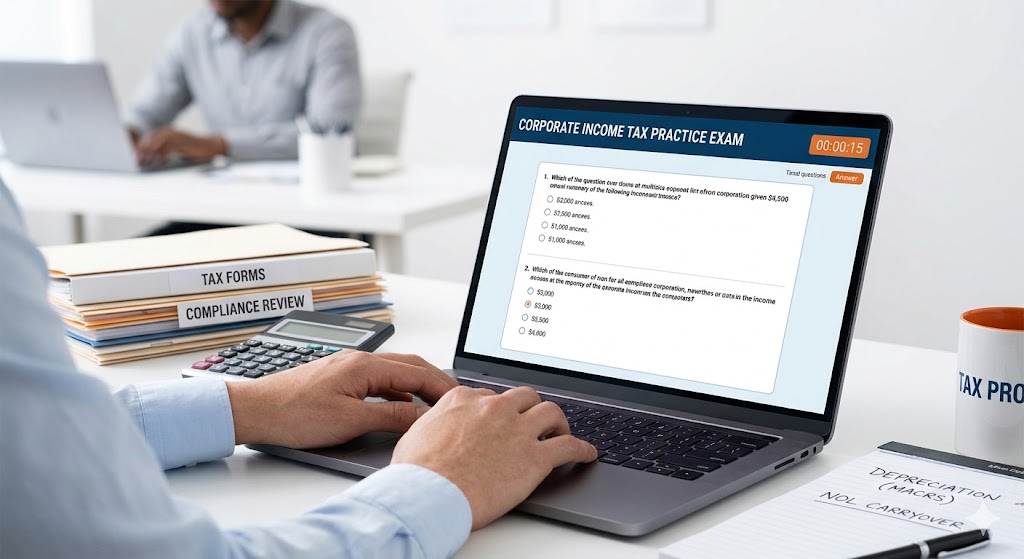
Additional Information
What the Course Entails and Exam Details
This practice exam is not a teaching tool itself, but rather a final check of the knowledge you accrued during your primary Corporate Income Tax course or study program.
A complete Corporate Income Tax course typically covers a comprehensive syllabus designed to make you proficient in both domestic and, often, international tax principles as they apply to entities.
Core topics that you should expect to be assessed on include:
Taxable Entities: Distinguishing between different corporate structures (e.g., C Corporations, S Corporations) and understanding how their tax obligations differ.
Calculating Gross Income: Accurately identifying taxable revenue sources, including sales, interest, dividends, and gains from property transactions.
Allowable Deductions: Mastering the nuances of business expenses, depreciation methods (such as MACRS), net operating losses (NOLs), and specific corporate deductions like the Dividends Received Deduction (DRD).
Tax Credits and Incentives: Recognizing opportunities to reduce tax liability through research and development credits, foreign tax credits, and various investment incentives.
Filing Procedures and Compliance: Understanding key tax forms (e.g., Form 1120 in the U.S.), electronic filing requirements, payment deadlines, and potential penalties for non-compliance.
Special Corporate Topics: Touching upon the complexities of consolidated returns for affiliated groups, international taxation basics like transfer pricing, and the alternative minimum tax (AMT) where applicable.
What to Expect in the Final Exam
The Corporate Income Tax Practice Exam is designed to mimic the format, rigor, and time constraints of the official final assessment you are preparing to take (such as a section of the CPA exam or a university final).
You can expect a challenging and structured testing experience.
Format: The practice exam primarily uses a combination of multiple-choice questions designed to test theoretical knowledge, and calculation-based problems that require applying formulas to real-world scenarios. It may also include short case studies or simulation tasks where you must populate specific lines of a tax form.
Question Distribution: The questions are weighted similarly to the final exam, ensuring significant coverage of high-stakes topics like deduction logic and filing compliance.
Time Limit: You will be under strict time pressure, usually mirroring the 2–4 hour window typical of professional certification exams.
Passing Score: To pass the practice exam and feel confident for the real thing, most learning platforms recommend achieving a score of at least 70% to 75%. The actual passing standard for your final certification will vary by jurisdiction or organization.
How to Study and Exam Centers
Preparation is the absolute key to success in a subject as detail-oriented as corporate taxation.
Your study strategy should be active, repetitive, and focused on diagnostic feedback.
Diagnostic Review: Begin by taking one practice exam to identify your weak areas. Use the immediate feedback to pinpoint specific sections of the tax code or syllabus where your understanding is lacking.
Focused Study Sessions: Don't just re-read the textbook. Focus your study time exclusively on the topics highlighted by your diagnostic test. Create detailed flashcards for complex rules, such as depreciation recapture formulas or consolidation eligibility.
Mnemonics and Form Mockups: Use mnemonic devices to memorize long lists of allowed vs. disallowed deductions. Practice filling out key sections of corporate tax forms by hand to build muscle memory for where data belongs.
Time Management Practice: Once you are comfortable with the content, take subsequent practice exams strictly timed. Learn to pace yourself, ensuring you do not spend too much time on a single, difficult calculation.
Where to Take the Practice Exam: The Corporate Income Tax Practice Exam is typically offered online through the educational platform, university portal, or review course provider (e.g., Becker, Kaplan, Udemy, or a specialized accounting college) where you enrolled for your primary tax course. They are rarely taken at physical testing centers; you take them at your own computer to simulate the environment of many modern, remotely proctored certifications.
Job Opportunities from the Course
Mastering corporate income tax opens doors to specialization within the stable and high-paying fields of accounting, finance, and law.
Completing a course and excelling on its associated exam unlocks diverse career paths:
Corporate Tax Accountant: Preparing and filing corporate tax returns (Form 1120) and ensuring ongoing compliance for a single corporation or a portfolio of clients.
Tax Manager: Leading a team of accountants, managing complex tax filing deadlines, and overseeing tax planning strategies for large enterprises.
Tax Consultant/Advisor: Providing specialized, project-based advice on the tax implications of business decisions, such as mergers, acquisitions, or international expansion.
Tax Analyst: Reviewing financial data to identify trends, forecast tax liabilities, and support tax planning initiatives.
Revenue Agent/Tax Auditor: Working for a government tax authority (like the IRS or a state Department of Revenue) to audit corporate tax returns and enforce compliance.
CPA (Certified Public Accountant): While not the only requirement, passing a rigorous corporate tax exam is a essential milestone on the path to obtaining a CPA license, which significantly boosts career potential.
Tax Director: Senior-level executive responsible for the entire tax function of a corporation, including global tax strategy, risk management, and reporting to the board.
International Tax Specialist: Focusing exclusively on cross-border tax issues, transfer pricing, and navigating the complexities of global tax treaties.
Frequently Asked Questions
Reviews
5.0
Based on 0 reviews
Leave a Review
No reviews yet. Be the first to review!