
Correctional Administration Practice Exam
$69.00
- Buy to unlock unlimited access to all Quiz questions and Answers in this Quiz.
- After purchase you can print a PDF of the whole quiz at any point. The PDF will contain the questions and the correct answers.
About this Exam
Welcome to your essential study guide for the Correctional Administration Practice Exam. This comprehensive assessment is designed to evaluate the critical knowledge, skills, and judgment required for effective leadership within the complex world of the justice and correctional systems.
This certification is ideal for current correctional officers aspiring to advance into management, individuals with criminal justice degrees seeking specialized roles, and public administration professionals aiming to make a significant impact on rehabilitation and public safety. By passing this exam, you demonstrate your proficiency in the principles and practices that define modern, humane, and efficient correctional administration.
Ready to test your knowledge?
Buy Now to Access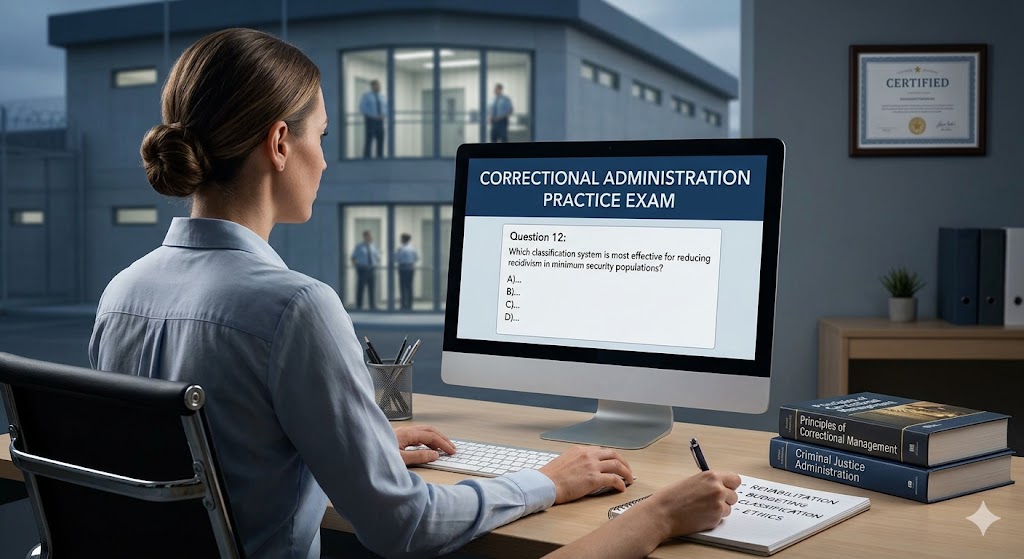
Additional Information
What the Course Entails and Exam Details
This examination does not stem from a single, universal course but rather measures a student’s mastery over a core curriculum associated with correctional management. The knowledge base typically spans several key domains:
Systemic Overview: Understanding the structure of the criminal justice system, including the roles of federal, state, and local agencies, and the philosophies of punishment and rehabilitation.
Inmate Management: Mastering best practices for security classification, housing assignments, disciplinary procedures, and the protection of inmate rights.
Programs and Rehabilitation: Knowing the design, implementation, and evaluation of evidence-based educational, vocational, mental health, and substance abuse programs.
Operational Administration: Navigating facility logistics, including human resources, budget and finance management, and crisis de-escalation protocols.
Legal and Ethical Frameworks: Applying relevant constitutional law, state statutes, and international standards of care within a secure environment.
What to Expect in the Final Exam
While the exact structure can vary by certifying body or state agency, most Correctional Administration exams share a common set of expectations:
Format: You can typically expect a computer-based, multiple-choice examination. Some advanced certifications might include situational judgment components or essay questions to assess critical thinking.
Time Limit: Exams are generally timed, ranging from 90 minutes to 3 hours, depending on the number of questions and the test complexity. A typical exam might contain 80 to 120 questions.
Passing Score: The passing threshold is set by the specific administering organization but generally falls between 70% and 80%. It is crucial to review the specific requirements of your testing authority.
Rules: These are high-stakes exams administered under strict proctoring guidelines. Standard rules include prohibiting external aids such as textbooks, cell phones, or notes. Calculators may be allowed if the exam includes a finance or math component.
How to Study and Exam Centers
Effective preparation for this exam requires a proactive and multifaceted approach. Do not rely solely on memory; focus on understanding the application of principles. Actionable strategies include:
Utilize Authorized Materials: Start with the official study guides, resource lists, and recommended reading provided by your certifying body.
Engage in Focused Practice: Use practice exams, such as the one described in this guide, to familiarize yourself with the question style, difficulty, and time constraints. These are an excellent way to identify and improve weak knowledge areas.
Form Study Groups: Collaborating with peers allows for the discussion of complex administrative scenarios and diverse perspectives on policy application.
Regarding exam centers, the administration of these tests is often highly formal:
Testing Centers: Many large-scale or national certifications are delivered through established third-party testing networks, such as Pearson VUE. These provide secure, professional testing environments across the globe.
Agency Portals: For state-specific correctional administration positions, the exam may be administered directly through the department of corrections' internal online portals or at specific regional training academies.
Authorized Schools: In some cases, community colleges or universities with authorized criminal justice programs serve as physical testing centers for their students or local professionals.
Job Opportunities from the Course
A certification in Correctional Administration is a powerful differentiator, signaling to employers that you possess the advanced knowledge necessary to lead. This credential unlocks a variety of career paths within and adjacent to the correctional system:
Correctional Captain / Major
Jail Administrator
Warden / Assistant Warden
Probation and Parole Supervisor
Correctional Program Director
Correctional Treatment Specialist Manager
Policy Analyst for Justice Agencies
Criminal Justice Administrator (within broader public safety departments)
Reentry Program Coordinator
Frequently Asked Questions
Reviews
5.0
Based on 0 reviews
Leave a Review
No reviews yet. Be the first to review!