
Cosmetology Clinical Practice Exam
$69.00
- Buy to unlock unlimited access to all Quiz questions and Answers in this Quiz.
- After purchase you can print a PDF of the whole quiz at any point. The PDF will contain the questions and the correct answers.
About this Exam
The Cosmetology Clinical Practice Exam, often referred to as the State Board Practical Exam, is the defining, hands-on licensure test for aspiring beauty professionals in the United States. This rigorous, proctored examination is designed to verify that candidates possess the minimal technical skills and safety knowledge required to enter the workforce as a licensed cosmetologist. It is a mandatory requirement for licensure in nearly every state, serving as the final barrier to entry after completing required school hours. The exam is designed for students who have finished their formal cosmetology education and are ready to demonstrate proficiency in core services—from haircutting and chemical texture to infection control—under the watchful eye of official examiners.
Ready to test your knowledge?
Buy Now to Access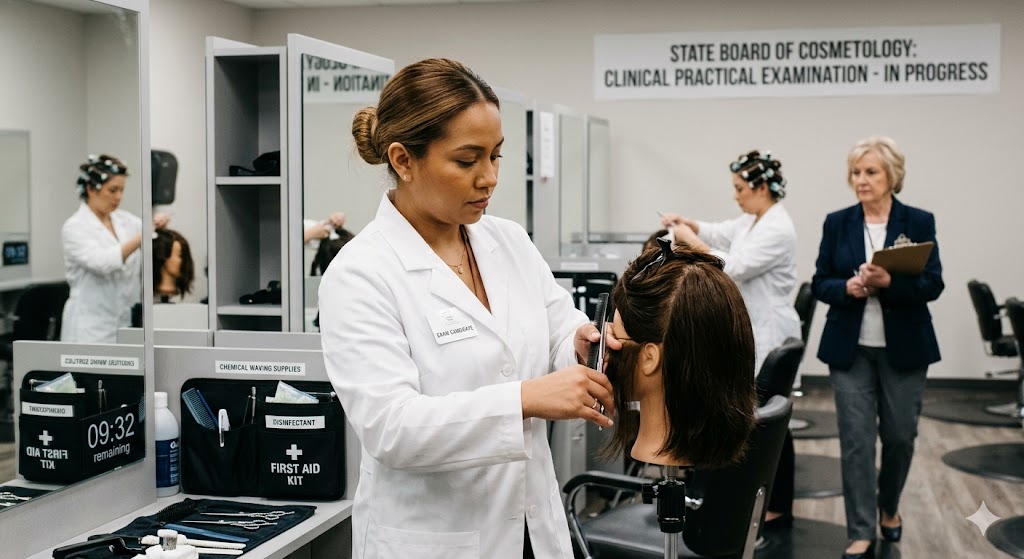
Additional Information
What the Course Entails and Exam Details
This examination is not a theoretical test; it is a live performance of essential cosmetology services. While specific requirements can vary by state, the exam is built upon a foundation of core, universal skills.
The clinical practice exam typically covers the following key domains, each containing a series of mandated tasks:
Work Area Preparation and Set-Up: Candidates must demonstrate the initial, crucial setup of their station using universal precautions and a clean kit.
Infection Control and Safety: This is the most critical component. Sanitation and disinfection must be woven into every service, from hand washing to tool sterilization. Candidates will be assessed on their adherence to state-specific and OSHA regulations.
Haircare and Services:
Haircutting: Performing a specific, predetermined haircut, such as a 90-degree uniform layer cut, within a set time limit on a mannequin.
Chemical Services: Demonstrating precise application techniques for services like permanent waving (including a section of the wrap), chemical relaxing (e.g., virgin application), and hair coloring (e.g., a retouch or a virgin bleach and tone).
Thermal Curling/Styling: Demonstrating proficiency in using tools like Marcel irons for specific curl types.
Skincare and Services: Some exams include basic facials, showing cleansing and manipulations, or eyebrow arching/waxing (often using a simulated product).
Nailcare and Services: Candidates are often tested on a complete manicure or a nail tip application on a designated mannequin hand.
What to Expect in the Final Exam
The final clinical exam is a structured, multi-station event. It is designed to be sterile and standardized.
Format: The exam is proctored live, with candidates moving through distinct "stations" or segments. Each section is timed, ranging from 10 to 45 minutes depending on the complexity of the service (e.g., set up is fast, a haircut is longer). Official examiners, who are experienced licensed professionals, observe and score candidates on a checklist basis. Each task is a step-by-step procedure that must be followed.
Mannequins vs. Models: The vast majority of state practical exams use mannequin heads and hands. These must meet specific criteria regarding hair length and quality. You must provide your own approved mannequins. Very few states now allow or require live models, so you must confirm your state's current guidelines.
Passing Score and Rules: A passing score is typically between 70% and 75% for each overall segment or the entire practical section. However, the exact criteria are complex. It is crucial to understand that failing a single critical sanitation step can often lead to a failing score for that entire section. Common immediate failures include: dropping an item and not disinfecting it, cross-contamination, or a needle stick without immediate correct first-aid. You must confirm your state's current rules.
Time Limit and Packing List: Each service is timed. Going over the time limit can lead to a deduction or a failure. Preparation is key; you must provide a state-approved kit, typically a pre-labeled rolling case, packed precisely with the supplies needed for each station. These supplies must include labeled bottles of generic mock products and a designated "first-aid kit" for simulated injuries.
How to Study and Exam Centers
Preparation for the clinical exam must be a combination of rigorous practical practice and systematic procedural review. You are not just learning a skill; you are learning to perform a choreographed sequence of safety steps.
How to Study:
Review the Candidate Information Bulletin (CIB): This is your Bible. Every state publishes a detailed CIB through their chosen testing vendor (e.g., NIC, PSI). It contains the exact procedures, point values, and rules. Memorize it.
Practice with a Mannequin Daily: Do not practice on humans for this test. Practice your entire routine, from work area prep to final cleanup, on the same mannequin you will use in the exam.
Choreograph Every Movement: Treat the test like a dance. Every movement, every spray, every section must be identical each time you practice. The examiners are looking for systematic consistency.
Time Yourself: Use a stopwatch for every practice session. If you have 30 minutes for a haircut, practice doing it perfectly in 25 to leave a buffer.
Peer Review: Work with classmates. One acts as the candidate, the other as the examiner, holding the CIB and grading against the official checklist. This will reveal hidden habits.
Focus on Sanitation: When you practice, vocalize the sanitation steps. Spray the station, wash your hands, spray the tool, before you ever touch the hair. This muscle memory is vital.
Exam Centers:
You cannot simply show up to a location. You must register through your state board’s authorized testing vendor. This process is usually managed by a private testing company such as PSI Services or Prometric. You must first receive an "Authorization to Test" from your state board upon completion of your hours and approval of your application. You will then schedule your slot at an approved, dedicated testing center or, occasionally, a approved physical cosmetology school site designated for state exams. Very few clinical exams are offered online, but you must verify the location options via your state-approved vendor. Arrive at the test center early with all required identification and your approved kit.
Job Opportunities from the Course
A licensed cosmetologist, having passed the required training and the clinical practice exam, unlocks a wide array of career paths in the lucrative beauty and wellness industry. A licensure is versatile, allowing professionals to specialize in hair, skin, and nails, or focus on a specific niche.
Career paths this certification unlocks include:
Hair Stylist or Stylist Specialist (Cutting, Coloring, Texture)
Barber (Licensure cross-over rules vary)
Salon Manager
Salon Owner or Booth Renter
Platform Artist
Editorial or Fashion Stylist (Film, TV, Print)
Beauty Educator or Instructor (Additional training/licensure often required)
Nail Technician / Specialist
Esthetician (Licensure rules vary on the scope of practice)
Wig and Hair Replacement Specialist
Beauty Brand Representative or Educator
Beauty Writer / Content Creator
Makeup Artist (Depending on state scope of practice regulations)
Medical Aesthetic Assistant (Working under supervision)
Frequently Asked Questions
Reviews
5.0
Based on 0 reviews
Leave a Review
No reviews yet. Be the first to review!