
Council on Law Enforcement Education and Training (CLEET) Law Enforcement Driver Practice Test
$69.00
- Buy to unlock unlimited access to all Quiz questions and Answers in this Quiz.
- After purchase you can print a PDF of the whole quiz at any point. The PDF will contain the questions and the correct answers.
About this Exam
The Council on Law Enforcement Education and Training (CLEET) Law Enforcement Driver component is a foundational element of the Basic Peace Officer Academy, designed to equip cadets and current officers with the specialized skills required to operate emergency vehicles safely and effectively.
This course is engineered specifically for individuals aiming to become certified peace officers in Oklahoma, including city police officers, sheriff's deputies, and state troopers.
It provides critical instruction in both theoretical and practical applications, ensuring participants can handle a patrol vehicle under high-stress conditions while adhering to legal and safety standards.
Understanding vehicle dynamics, collision avoidance, and the complexities of pursuit driving is a necessity, and this training offers the crucial knowledge needed to serve the public effectively while mitigating risks.
Ready to test your knowledge?
Buy Now to Access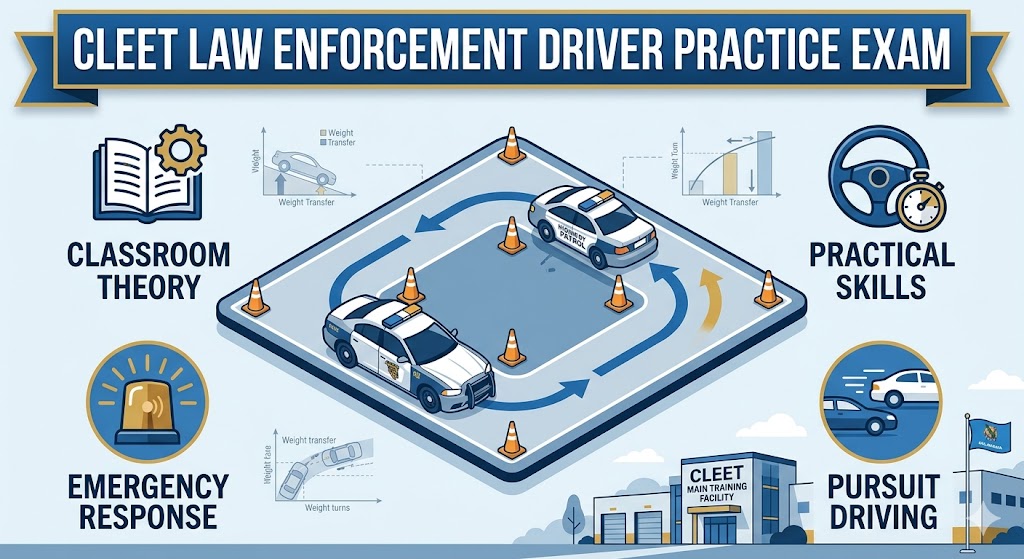
Additional Information
What the Course Entails and Exam Details
The CLEET Law Enforcement Driver course is structured around intensive instruction divided into classroom learning and hands-on practical application on a dedicated training track.
Key topics covered include operational guidance, legal principles concerning officer liability during vehicle operations, and the physical principles of vehicle dynamics such as weight transfer and tire adhesion.
Participants will learn the process of decision-making essential for effective collision avoidance, the physics of turning and braking, and risk management strategies during emergency response.
The practical segment, known as the driving course, focuses on reinforcing these theories through various exercises, including precise handling maneuvers, controlled stops, high-speed vehicle operation, and simulation of pursuit scenarios under direct instructor supervision.
What to Expect in the Final Exam
To successfully complete the driver training module and progress toward peace officer certification, students must pass a final evaluation that typically consists of two distinct components: a written examination and a practical skills test.
The written final exam is a multiple-choice assessment covering the theoretical aspects of the course, such as vehicle maintenance, legal requirements for emergency driving, and the scientific concepts of driving physics.
The practical examination, commonly held on the Law Enforcement Driver Training Course, requires students to demonstrate proficiency in handling the vehicle through a series of timed and scored scenarios.
Candidates are assessed on their ability to execute specific maneuvers without knocking over cones, maintain control during simulated emergency responses, and apply the dynamic principles learned in the classroom.
A minimum cumulative score, often 80%, is typically required on both parts of the assessment, and multiple re-attempts are often permitted within specific guidelines.
How to Study and Exam Centers
Preparation for the CLEET Law Enforcement Driver exam must be approach from both a cognitive and physical perspective.
To study the classroom material, students should diligently review the CLEET student manual and any provided study guides, paying close attention to legal concepts, liability issues, and definitions related to vehicle dynamics.
Using practice quizzes for the multiple-choice portion can help cement these theoretical concepts, enabling quick recall under testing conditions.
For the practical examination, mental visualization of the driving course can be highly effective; visualize yourself correctly executing turns, braking properly, and managing the weight of the vehicle through complex sequences.
The final exams are administered at the CLEET main facility in Ada, Oklahoma, or at authorized satellite training academies where students have been undergoing their basic academy training.
Job Opportunities from the Course
Successful completion of the driver training course is not a standalone certification but a mandatory milestone toward receiving the full CLEET Peace Officer Certification, which opens the door to numerous vital career paths in public safety across the state.
Here is a list of job opportunities this course, as part of the overall certification, unlocks:
Police Officer (Municipal Departments)
Deputy Sheriff (County Sheriff's Offices)
State Trooper (Oklahoma Highway Patrol)
Campus Police Officer (Universities and Colleges)
Tribal Police Officer (Various Tribal Nations within Oklahoma)
Investigator (State Agencies)
Ranger (Oklahoma Tourism and Recreation Department)
Frequently Asked Questions
Reviews
5.0
Based on 0 reviews
Leave a Review
No reviews yet. Be the first to review!