
Counselor Preparation Comprehensive Practice Examination
$69.00
- Buy to unlock unlimited access to all Quiz questions and Answers in this Quiz.
- After purchase you can print a PDF of the whole quiz at any point. The PDF will contain the questions and the correct answers.
About this Exam
The Counselor Preparation Comprehensive Practice Examination, widely known as the CPCE, is a standardized assessment used by counselor preparation programs across the country. It is designed to evaluate a student's synthesized knowledge of foundational counseling principles. Most commonly, counseling students take this exam near the end of their master's degree program as a comprehensive "exit exam" or "comps." The primary goal of the CPCE is to ensure that aspiring counselors have mastered the essential attitudes, skills, and knowledge required for professional practice and eventual licensure. This exam is a significant step, and preparing thoroughly can boost your confidence and demonstrate your readiness for the counseling field.
Ready to test your knowledge?
Buy Now to Access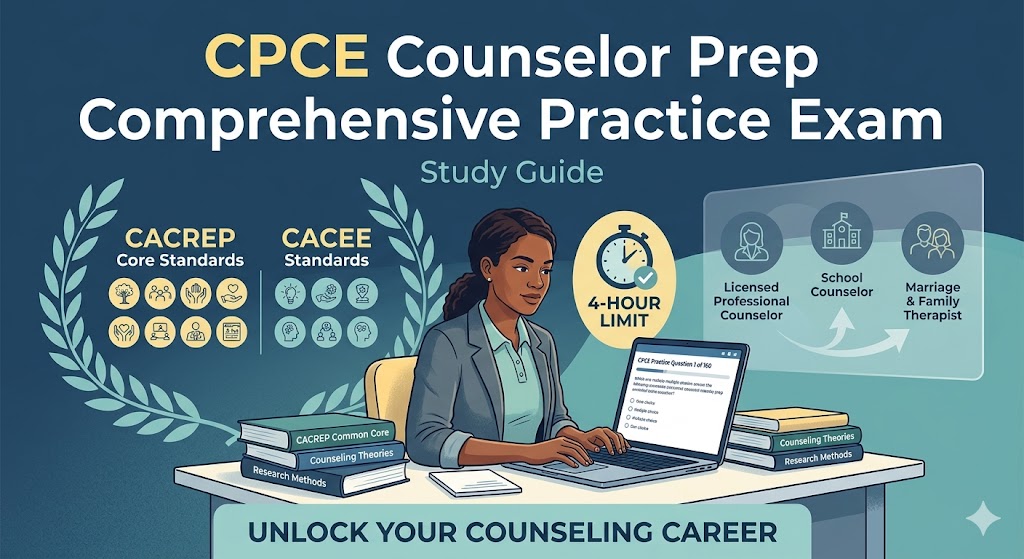
Additional Information
What the Course Entails and Exam Details
The content of the CPCE is not tied to a single specific course, but rather covers the entire common core curriculum for counseling programs. It is meticulously aligned with the standards set by the Council for Accreditation of Counseling and Related Educational Professions (CACREP), which are the benchmark for quality in counselor education.
The exam assesses your mastery in eight core content areas:
Human Growth and Development: Understanding development across the lifespan, including theories of learning and personality development.
Social and Cultural Diversity: Focus on multicultural counseling, advocacy, and understanding diverse populations and systemic barriers.
Counseling and Helping Relationships: Foundational elements of the counseling process, counseling theories, and helping skills.
Group Counseling and Group Work: Theories and stages of group development, group dynamics, and leadership styles.
Career Development: Career counseling theories, decision-making models, and occupational resources.
Assessment and Testing: Principles of assessment, standardized testing, statistical concepts, and ethical considerations in evaluation.
Research and Program Evaluation: Research methods, statistical analysis, and using data to inform counseling practice and program improvement.
Professional Counseling Orientation and Ethical Practice: The history and philosophy of the profession, professional roles, ethical standards, and legal implications.
What to Expect in the Final Exam
The final CPCE is a comprehensive, computer-based exam. You should anticipate a format consisting of multiple-choice questions. It typically includes approximately 160 items in total, with around 20 questions dedicated to each of the eight CACREP core areas. While all questions are administered, not all may be factored into your final score; a small number serve as pre-test or statistical items. You will have a generous time limit, usually four hours, to complete the entire examination. This ensures you have ample time to read, process, and answer each question thoughtfully.
It is important to understand that the center for Credentialing and Education (CCE), which develops the CPCE, does not set a single national passing score. Instead, each individual college or university counseling program determines its own passing score and retake policies based on its specific academic standards. While an unofficial raw score may be available immediately, your official score report is generally accessible through your testing account within 24 to 48 hours, and your academic program will receive the official results to determine your status.
How to Study and Exam Centers
Effective preparation for the CPCE requires a strategic and disciplined study approach. Begin by reviewing your textbooks from across your master's coursework. Pay close attention to definitions, major theories, key figures, and fundamental concepts in each of the eight CACREP areas. Do not neglect research methods and ethical guidelines, as these are critical components. Creating a structured study schedule and dedicating time to each core area is crucial.
Utilizing dedicated practice examinations is an excellent way to prepare. These exams mimic the format and timing of the actual test, helping you identify areas of weakness and become comfortable with the pressure of a timed, multi-hour examination. Consider using specialized test-preparation materials specifically designed for the CPCE.
Regarding examination centers, the CPCE is typically administered in one of a few ways. Many counseling programs host administration dates on campus for their own students. Alternatively, you may be able to register to take the exam at an authorized Pearson VUE testing center. Pearson VUE maintains a large network of specialized testing centers globally. Some institutions also offer the option for online proctoring, allowing you to take the CPCE from a suitable location using OnVUE proctoring services. You must coordinate with your academic program to understand the specific registration and location requirements for your exam.
Job Opportunities from the Course
Successfully completing a master’s in counseling and passing the CPCE is a major milestone. This path leads to a rewarding career dedicated to helping individuals, families, and communities. Here are some of the career paths that this qualification unlocks:
Licensed Professional Counselor (LPC) or Licensed Mental Health Counselor (LMHC)
School Counselor
Licensed Marriage and Family Therapist (LMFT)
Substance Abuse Counselor / Addiction Counselor
Career Counselor
Community Health Counselor
Rehabilitation Counselor
College Counselor / Academic Advisor
Crisis Intervention Specialist
Frequently Asked Questions
Reviews
5.0
Based on 0 reviews
Leave a Review
No reviews yet. Be the first to review!