
Counter-Improvised Explosive Device (CIED) Practice Test
$69.00
- Buy to unlock unlimited access to all Quiz questions and Answers in this Quiz.
- After purchase you can print a PDF of the whole quiz at any point. The PDF will contain the questions and the correct answers.
About this Exam
This article provides a comprehensive study guide for individuals preparing for a Counter-Improvised Explosive Device (CIED) Practice Test. These practice tests are a critical preparatory tool for people striving for operational roles in the high-stakes field of explosive threat mitigation. While there is no single, universally standardized "CIED initial certification" exam, various military, law enforcement, and private security organizations require unique CIED qualifications for their personnel. A high-quality CIED practice test simulates the knowledge and decision-making required by these diverse, official assessments. It is designed for military service members (e.g., EOD technicians, engineers), state and local law enforcement bomb squad officers, first responders, and private security professionals operating in high-threat environments. Mastering this material is not just about passing a test; it is about developing the life-saving skills needed to identify, evade, or counter sophisticated explosive devices.
Ready to test your knowledge?
Buy Now to Access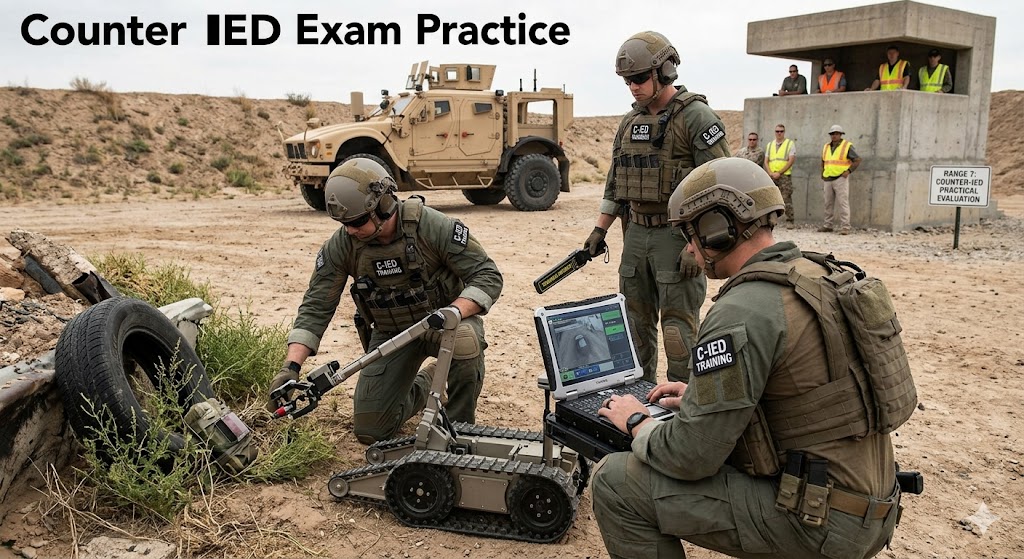
Additional Information
What the Course Entails and Exam Details
As a general preparatory tool, a Counter-IED practice test covers the fundamental knowledge and tactical principles common to most credible CIED training pipelines and certifications. Since it prepares you for a final qualification rather than being the qualification itself, the "course" details reflect the scope of the field.
The core domains and skills covered typically include:
IED Awareness & Identification: Understanding the five basic components of an IED (Switch, Initiator, Main Charge, Power Source, Container) and recognizing the diverse "Ground Signs" (indicators like disturbed earth, unusual wires, or visual markers) that suggest a potential threat.
IED Methods of Attack: Knowing common delivery methods, including person-borne IEDs (PBIEDs), vehicle-borne IEDs (VBIEDs), and static or roadside devices.
Threat and Risk Assessment: The ability to analyze a situation, identify vulnerabilities, and determine the level of threat based on intelligence and operational context.
Basic IED Response Procedures: Mastery of initial action drills, including the "5 Cs" (Confirm, Clear, Cordon, Control, Check), immediate search techniques, and safe evacuation.
Introduction to CIED Tools: Conceptual knowledge of handheld detectors, electronic warfare (CREW) systems, robotic platforms, and basic explosive ordnance disposal (EOD) tools and techniques.
Exploitation Principles: An introduction to the methods of gathering post-blast or technical intelligence from a defeated or detinated IED to prevent future attacks.
The final official exams that these practice tests prepare you for vary enormously depending on the organization. A basic CISA awareness course might have an online multiple-choice test. In contrast, an EOD qualification will involve intensive, weeks-long hands-on testing.
What to Expect in the Final Exam
It is crucial to understand that "CIED Practice Tests" are created by training companies or internal organizations to prepare students for an official certification pipeline. They are not standardized tests you register for through a common portal like Pearson VUE.
The final exam you take will be unique to the program you are enrolled in (e.g., CISA Office for Bombing Prevention, US Military EOD School, state police bomb squad training). However, based on the types of training offered, you should expect a combination of the following:
Theoretical Examination: Multiple-choice or short-answer tests covering knowledge domains, threat awareness, and response protocols, often conducted in a classroom or via an internal secure portal.
Practical Field Evaluations (Performance-Based): This is the most common and vital component of CIED qualification. Candidates are assessed on their ability to perform tasks like:
Conducting a route, area, or facility search under pressure.
Operating specific equipment like handheld detectors or small robots to inspect and defeat a simulated threat.
Leading a small team in an immediate response drill (e.g., dynamic scenario-based assessment).
Grading and Passing Score: There is no uniform passing score. Many CIED practical evaluations are pass/fail based on a standardized checklist. Theoretical exams may require scores of 70%, 80%, or 90%, depending on the program's rigor and criticality. In operational fields, minor errors can have severe consequences, so the standards are appropriately high.
Time Limits and Specific Rules: Both theoretical and practical parts will have strict time limits. During practical scenarios, you must follow established standard operating procedures (SOPs) and safety protocols. Violating a safety rule often results in an automatic failure.
How to Study and Exam Centers
Studying for a CIED practice test, and ultimately your final official qualification, requires a balanced approach of mental and practical preparation.
Study Strategies:
Repetition with Review: Use high-quality practice tests repeatedly. Focus not just on getting the correct answer, but on understanding why every incorrect option is wrong and referencing your training manuals.
Scenario Visualization: Study IED components and ground signs. Close your eyes and visualize a scenario where you encounter each one in a different environment (e.g., an urban street, a vehicle checkpoint, a rural road). What are your immediate actions?
Physical Practice (Critically Important): CIED is a dynamic field skill. Practice search procedures, equipment operation, and team drills physically. Use training aids (like inert simulated IEDs and components) to make your practice realistic. If possible, join study groups to practice hands-on drills.
Stay Current on the Threat: The tactics of adversaries change constantly. Review recent after-action reports or open-source intelligence to understand the latest IED trends and component types.
Exam Centers and Access:
You will not find "CIED" listed at general computerized testing centers. The final official exams are administered at:
Military Installations: Specific training schools (e.g., NAVSCOLEOD for the US military) and ranges.
Law Enforcement and Fire Academies: Local, state, or federal law enforcement training facilities.
Authorized Training Partner Facilities: Organizations like CAT-UXO, FAAC, or other accredited specialized security training companies that provide CIED training.
Online Portals (Basic Levels): Introduction-level awareness certificates from organizations like CISA/OBP may offer the final theoretical test through an online proctored or unproctored portal. Access is typically managed by registering through the organization or a designated point of contact (like a FEMA Student ID).
Job Opportunities from the Course
A CIED qualification, along with related specialization, is a vital credential that unlocks several challenging and respected career paths:
Explosive Ordnance Disposal (EOD) Technician: In military service or a civilian police bomb squad. This is the primary and most direct application of advanced CIED skills.
Civilian Bomb Squad Officer: Within local, state, or federal law enforcement agencies.
First Responder (Specialized Role): Paramilitary or specialized units within fire, police, and EMS that manage pre-blast and immediate post-blast scenarios.
Private Security C-IED Specialist: Working for companies contracted to protect critical infrastructure, convoy security, or VIPs in high-threat environments globally.
Combat Engineer (Military): With specialized training in mobility, counter-mobility, and survivability, including CIED and route clearance operations.
Humanitarian Mine Action (HMA) Operative: Clearing unexploded ordnance and explosive remnants of war (including improvised ones) in post-conflict zones.
Technical Intelligence and Exploitation Analyst: Specialized roles that analyze captured or defeated devices to inform future countermeasures and strategy.
CIED Instructor: Teaching the next generation of operators for governmental, military, or private training providers.
Frequently Asked Questions
Reviews
5.0
Based on 0 reviews
Leave a Review
No reviews yet. Be the first to review!