
Court Interpreter Written Practice Exam
$69.00
- Buy to unlock unlimited access to all Quiz questions and Answers in this Quiz.
- After purchase you can print a PDF of the whole quiz at any point. The PDF will contain the questions and the correct answers.
About this Exam
The Court Interpreter Written Exam is the essential first step toward achieving professional certification as a court interpreter. This examination is designed for individuals who possess a high level of fluency in both English and a non-English language and seek to work within the judicial system. It serves as a prerequisite to determine a candidate's readiness for the complex linguistic and ethical demands of legal interpreting before they proceed to the oral performance exams. By passing this written component, candidates demonstrate the foundational knowledge required to ensure accurate communication and equal access to justice in legal proceedings.
Ready to test your knowledge?
Buy Now to Access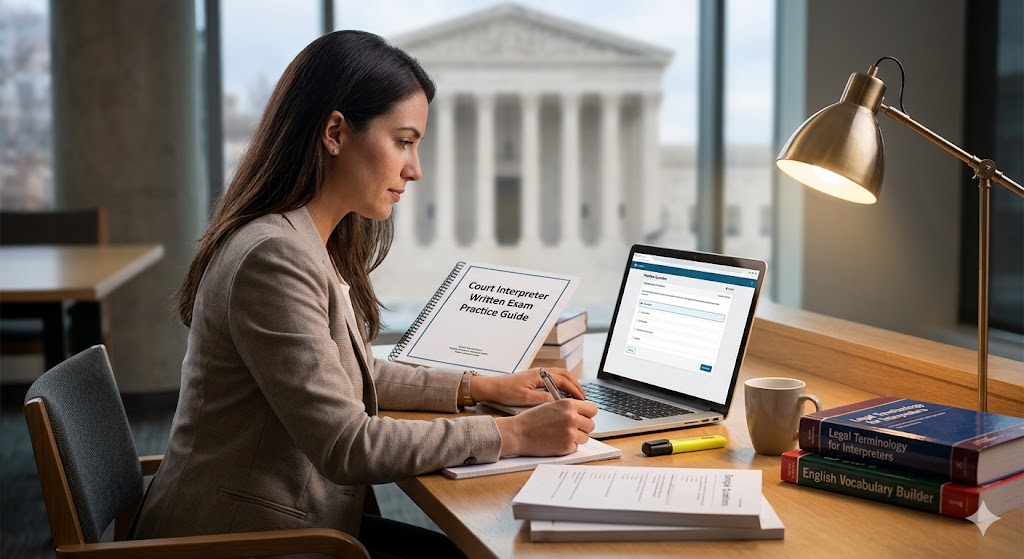
Additional Information
What the Course Entails and Exam Details
This comprehensive study resource is designed to help candidates prepare for the core topics and skills typically covered on the written exam. The examination does not assess interpreting skills directly (which is the focus of the subsequent oral exams), but rather the theoretical and ethical knowledge base. Key areas of focus include:
Legal Terminology and Procedures: Candidates must demonstrate a strong command of basic legal concepts, court terminology (e.g., arraignment, subpoena, felony, civil law), and the typical flow of judicial proceedings in English.
English Language Proficiency: This section rigorously tests English vocabulary, including idioms, synonyms, antonyms, grammar, and sentence structure, ensuring the candidate can understand complex legal discourse.
Professional Conduct and Ethics: A significant portion of the exam is dedicated to the code of professional responsibility for court interpreters. Candidates must understand their duties regarding neutrality, confidentiality, accuracy, and professional boundaries.
What to Expect in the Final Exam
While specific details can vary by state or jurisdiction (many states use exams developed by the National Center for State Courts' Consortium for Language Access in the Courts), the general format of the written exam is consistent.
Candidates should expect a multiple-choice examination. The number of questions usually ranges from 75 to 100.
The time limit for the written exam is typically between 2 to 2.5 hours. It is crucial to manage your time effectively during the test.
The exam is commonly administered on a computer at a designated testing facility, although some jurisdictions may offer proctored paper-and-pencil administrations.
A passing score is generally required to advance to the oral interpreting exams. This passing threshold is often set at around 70% or 80%. Candidates should verify the exact passing score requirements with their state's court interpreter certification program.
Strict rules are enforced during the exam, and no reference materials or dictionaries are permitted in the testing room.
How to Study and Exam Centers
Effective preparation is key to success on the written exam. A structured study approach should include the following strategies:
Utilize Official Resources: Start by reviewing the candidate information packet and any sample questions or study guides provided by your state's court interpreter program or the National Center for State Courts (NCSC).
Master Legal Terminology: Study legal glossaries in English. Create flashcards for common court terms, legal procedures, and slang often heard in legal settings.
Review the Code of Ethics: Thoroughly study the Code of Professional Responsibility for Court Interpreters for your specific jurisdiction. Understand the ethical dilemmas and correct courses of action.
Practice English Skills: Read challenging materials such as legal articles, news publications, and high-level literature to strengthen vocabulary and reading comprehension.
Take Practice Exams: Simulate test conditions by taking timed practice multiple-choice exams focused on legal vocabulary, English proficiency, and ethics.
Exam Centers: The specific method and location for taking the exam are determined by each state’s court system.
In many jurisdictions, the written exam is administered through third-party testing services such as Pearson VUE, which offers convenient computer-based testing centers.
Some state courts manage the examination administration directly through their own personnel or designated training facilities.
Candidates must register for the exam through their state's court interpreter certification office, which will provide details on approved testing dates, locations, and fees.
Job Opportunities from the Course
Passing the Court Interpreter Written Exam is the critical entry point to a rewarding career in legal interpreting. Obtaining certification (by subsequently passing the oral exams) unlocks numerous career opportunities, including:
Official Staff Court Interpreter (employed by state or federal courts)
Freelance Court Interpreter (working for courts, law firms, and agencies)
Depositions Interpreter
Interpreter for Client-Attorney Conferences
Administrative Hearing Interpreter (e.g., immigration, workers' compensation)
Video Remote Interpreter (VRI) for legal proceedings
Language Service Provider (LSP) Contractor
Frequently Asked Questions
Reviews
5.0
Based on 0 reviews
Leave a Review
No reviews yet. Be the first to review!