
Court Officer Academy Practice Test
$69.00
- Buy to unlock unlimited access to all Quiz questions and Answers in this Quiz.
- After purchase you can print a PDF of the whole quiz at any point. The PDF will contain the questions and the correct answers.
About this Exam
The Court Officer Academy Practice Exam is a crucial stepping stone for individuals aspiring to become peace officers within the judicial system. This certification program and its associated final examination are designed for candidates seeking to enforce order, provide security, and ensure the safe and efficient operation of courtrooms and legal facilities. It is ideal for dedicated individuals who are interested in a career combining law enforcement, public service, and the preservation of the judicial process. This comprehensive study guide article will provide you with the essential information to navigate the preparation process and excel on test day.
Ready to test your knowledge?
Buy Now to Access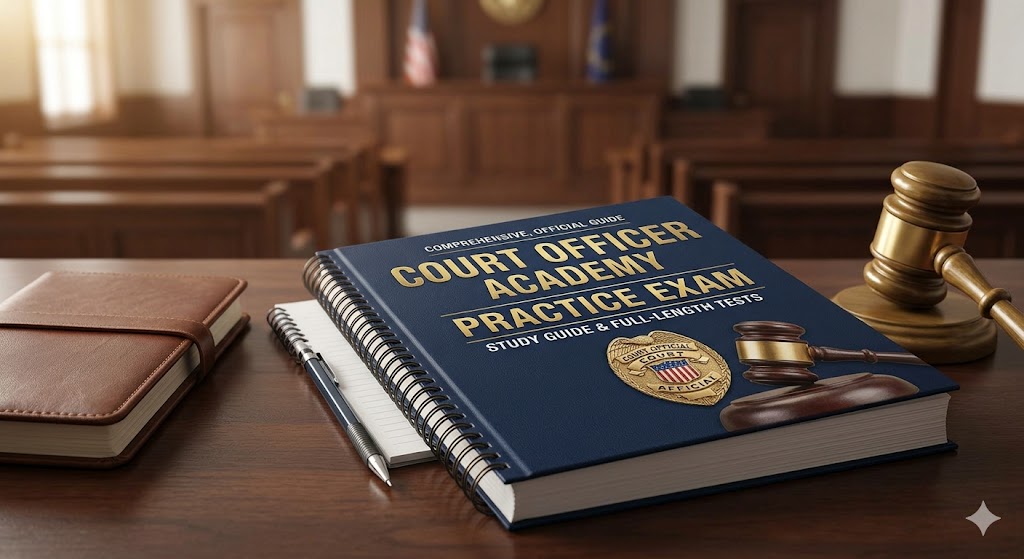
Additional Information
What the Course Entails and Exam Details
The Court Officer Academy curriculum is a rigorous blend of theoretical knowledge and practical skills. While the exact syllabus can vary slightly by jurisdiction, it universally covers several core pillars essential for effective performance on the job. The practice exam aims to measure your aptitude and understanding across these areas.
Candidates must master a broad spectrum of topics, including:
Legal Knowledge and Procedures: This includes a foundational understanding of criminal and civil law, constitutional rights, court procedures, and specific penal codes relevant to their jurisdiction.
Reading, Understanding, and Interpreting Written Material: A crucial skill, this evaluates the ability to comprehend complex legal documents, policies, incident reports, and instructions precisely.
Situational Judgment and Decision-Making: This assesses how a candidate applies facts to realistic, stressful scenarios they may face on the job, such as managing a conflict in a courtroom or responding to an emergency.
Clerical Checking and Record-Keeping: Proficiency in administrative tasks, accurate filing, and the proper handling of sensitive court documents is tested.
Firearms Proficiency and Self-Defense (Often part of a separate academy phase, but conceptual knowledge is often tested): While often practical, understanding the laws regarding force and carrying firearms is tested on the written exam.
What to Expect in the Final Exam
The final qualifying exam is a comprehensive barrier that all candidates must pass. Understanding its format and rules is vital for success.
Here is a breakdown of what to expect:
Format: The primary component of the final exam is typically a computer-based, multiple-choice assessment. Questions are designed to test application rather than just rote memorization.
Time Limit: The exam is strictly timed, often allowing approximately 3 to 4 hours for completion, depending on the number of sections. For example, some large state exams are set at 3 hours and 15 minutes.
Sections: The exam structure frequently divides into five specific sections, including: 1) Remembering Facts and Information (a timed memory segment), 2) Reading Comprehension, 3) Applying Facts and Information, 4) Clerical Checking, and 5) Court Record-Keeping.
Passing Score: A passing score is generally a scaled score of 70. This can vary by specific jurisdiction and exam cycle.
Other Components: Successfully passing the written multiple-choice exam is just the first step. Candidates who score well are then invited to a Physical Ability Test, medical and psychological evaluations, and a background investigation.
How to Study and Exam Centers
Effective preparation requires a multi-faceted approach. Your studying should not be passive; it must be active and structured.
Actionable Study Strategies:
Utilize Practice Exams: Regularly taking full-length, timed practice tests is the single most effective way to identify your weaknesses and build the necessary speed and stamina. Analyze every question you miss.
Study Scenario-Based Questions: Focus heavily on the "Applying Facts and Information" section. Familiarize yourself with standard court operating procedures, as these are often the source material for scenarios.
Enhance Legal Vocabulary: Create flashcards for common legal terms, acronyms, and courtroom roles to avoid confusion during the exam.
Develop Clerical Accuracy: Practice finding errors in names, dates, and numbers. Your speed and precision in this section are crucial.
How and Where to Take the Exam:
The Court Officer Academy entrance and certification exams are administrative functions of state or local government agencies, rather than private certification boards. You will generally take the exam at authorized physical testing centers that provide a secure environment, such as dedicated government facilities or contractor test sites (e.g., specific authorized centers that meet government criteria, analogous to Pearson VUE or Prometric).
To take the exam, you must first monitor the official website of the court system or civil service department of the jurisdiction where you wish to be employed (e.g., the specific State Unified Court System). When the exam is "open for application," you must apply, pay the required fee, and follow the specific instructions provided in the official exam announcement for scheduling your test date.
Job Opportunities from the Course
Successfully completing the Court Officer Academy, including passing the written practice and final exams and all physical components, opens up a range of rewarding and stable career paths within the justice system.
This certification is your primary entry into the following job roles:
New York State Court Officer-Trainee (leading to a career as a Court Officer-Sergeant or beyond)
Court Officer (in various state and municipal systems)
Bailiff
Court Security Officer
Deputy Sheriff (in divisions specifically assigned to courtroom security and judicial protection)
Armed Court Officer (requires additional certifications, which this process initiates)
Correctional Officer (in related law enforcement facilities)
Frequently Asked Questions
Reviews
5.0
Based on 0 reviews
Leave a Review
No reviews yet. Be the first to review!