
Court Reporter Practice Exam
$69.00
- Buy to unlock unlimited access to all Quiz questions and Answers in this Quiz.
- After purchase you can print a PDF of the whole quiz at any point. The PDF will contain the questions and the correct answers.
About this Exam
The Court Reporter Practice Exam is a comprehensive study tool designed for aspiring court reporters preparing for their official state or national certification. This exam simulator is engineered for individuals seeking careers as verbatim shorthand reporters in judicial proceedings, administrative hearings, and legislative assemblies. Whether you are aiming for your Registered Professional Reporter (RPR) designation or a specific state license, this practice exam is an essential resource to build speed, accuracy, and confidence. The ideal candidate is someone who has completed a steno theory program and is currently focused on high-speed dictation and transcription excellence.
Ready to test your knowledge?
Buy Now to Access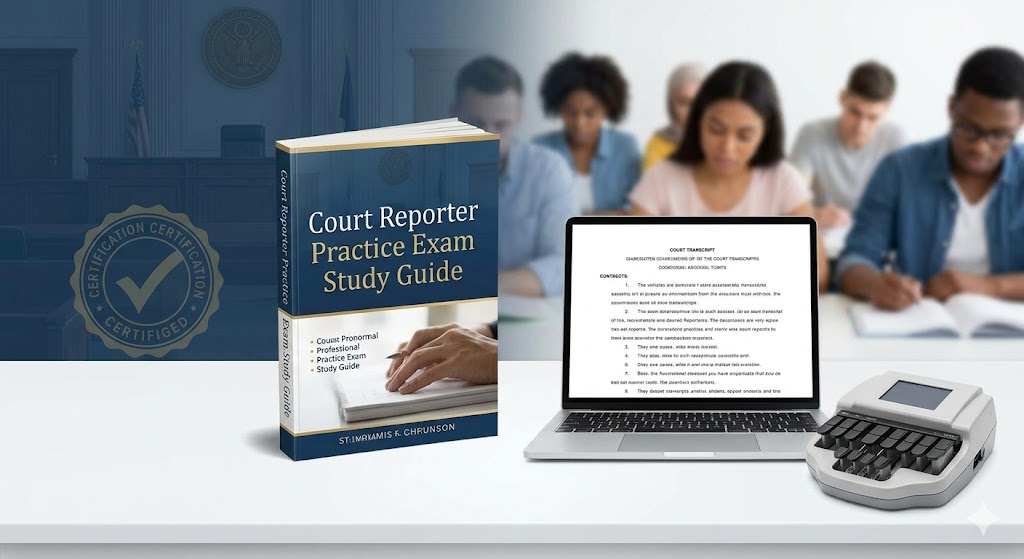
Additional Information
What the Course Entails and Exam Details
The core of any legitimate court reporter preparation focuses on mastering the specialized machine shorthand known as stenography. A robust practice course will provide hundreds of hours of varied dictation materials across different speeds. These materials cover multiple essential areas:
Literary Dictation: This includes speeches, books, and sermons. It tests your ability to capture continuous, flowing language that uses a diverse vocabulary.
Jury Charge Dictation: This section focuses on the technical legal language and specific instructions a judge gives to a jury before deliberation. It is often faster and requires highly accurate punctuation.
Testimony (Q&A) Dictation: This simulates real-time witness testimony, requiring rapid speed shifting between different speakers (the questioning attorney and the witness). The speed requirements are typically the highest in this category, often reaching 225 words per minute.
Practice courses also cover key academic pillars required by major certifying bodies like the National Court Reporters Association (NCRA). These pillars often include legal terminology, medical terminology, and grammar/spelling proficiency.
What to Expect in the Final Exam
While specific certification formats can vary slightly by state (e.g., California’s CSR vs. Texas’s JBCC), the general structure of a court reporting skills exam is standardized. Candidates must demonstrate proficiency in transcription after being exposed to high-speed dictation.
Format: The primary components are practical skills exams. You will bring your own shorthand machine and laptop with CAT (Computer-Aided Transcription) software.
Simulated Dictation: Proctors or audio recordings will deliver dictation in the three main categories: Literary (often around 180 wpm), Jury Charge (around 200 wpm), and Question and Answer Testimony (at least 225 wpm). Each dictation segment usually lasts five minutes.
Transcription Time: Following the dictation phase, candidates are given a strict, limited time window (e.g., 75 minutes per section) to convert their stenographic notes into a clean, accurate final transcript using their CAT software.
Passing Score Requirements: To pass, candidates must achieve a high level of accuracy, typically 95% or higher on each of the three transcribed sections. This means very few dropped words, misstrokes, or punctuation errors are permitted. Many exams also require passing a written knowledge test covering ethics, professional responsibilities, and legal procedures.
How to Study and Exam Centers
How to Study Effectively
Consistent Daily Practice: This is the most critical factor. Treat practice like a job. Dedicate several hours daily to writing on your machine. Short, focused sessions (30–60 minutes) are often more effective than infrequent, marathon sessions.
Use Varied Material: Do not get used to just one dictator’s voice. Practice with male and female voices, different accents, and varying subject matter complexity.
Read Your Steno Notes Back: For every session of dictation, spend time physically reading your raw steno notes on your screen or paper. This reinforces muscle memory and helps you identify and correct common misstrokes or weak theories.
Exam Centers and Registration
Authorized Schools: Many approved court reporting programs host official certification exams for their graduating students.
State Licensing Boards: If you are seeking a state-specific CSR (Certified Shorthand Reporter) license, the exam is often administered directly by that state's court reporting board or judicial branch. They will designate physical test sites (often courtrooms or government buildings).
National Testing Services: For national certifications like the RPR (offered by the NCRA), registration is handled through their official portal. They utilize professional testing center networks, such as Pearson VUE, which have physical locations globally. Always check the specific organization's website for the most current information regarding test dates, locations, and registration deadlines.
Job Opportunities from the Course
Obtaining certification through passing these exams opens doors to a stable, high-demand, and financially rewarding career path. Here is a list of job opportunities unlocked by this qualification:
Official Court Reporter: Working directly for a specific judge or jurisdiction, providing a verbatim record of all courtroom proceedings.
Freelance Court Reporter: Working independently or for an agency, taking depositions for lawyers, reporting for arbitrations, hearings, or stockholder meetings.
CART Provider (Communication Access Realtime Translation): Providing instantaneous translation of spoken word into text for deaf and hard-of-hearing individuals in various settings (e.g., college classrooms, conventions, corporate meetings).
Broadcast Captioner: Providing real-time captioning for live television broadcasts, news, programs, and sporting events.
Frequently Asked Questions
Reviews
5.0
Based on 0 reviews
Leave a Review
No reviews yet. Be the first to review!