
Coxswain Level II Practice Exam
$69.00
- Buy to unlock unlimited access to all Quiz questions and Answers in this Quiz.
- After purchase you can print a PDF of the whole quiz at any point. The PDF will contain the questions and the correct answers.
About this Exam
The Coxswain Level II Practice Exam is designed for individuals seeking to qualify for a commercial maritime career. This certification, often referred to as a Coxswain Grade 2 Near Coastal in many jurisdictions like Australia, is an essential entry-level qualification. It is specifically created for those who intend to command and operate the engines of commercial vessels that are less than 12 meters in length. These vessels can have unlimited outboard engine propulsion or inboard engines with propulsion power under 100 kilowatts (or as defined by local maritime authority regulations, e.g., 500 kW in some refined instances). The qualification limits operation to sheltered waters or a determined distance near the coast, making it the perfect gateway for prospective skippers in tourism, aquaculture, commercial fishing, and port operations.
Ready to test your knowledge?
Buy Now to Access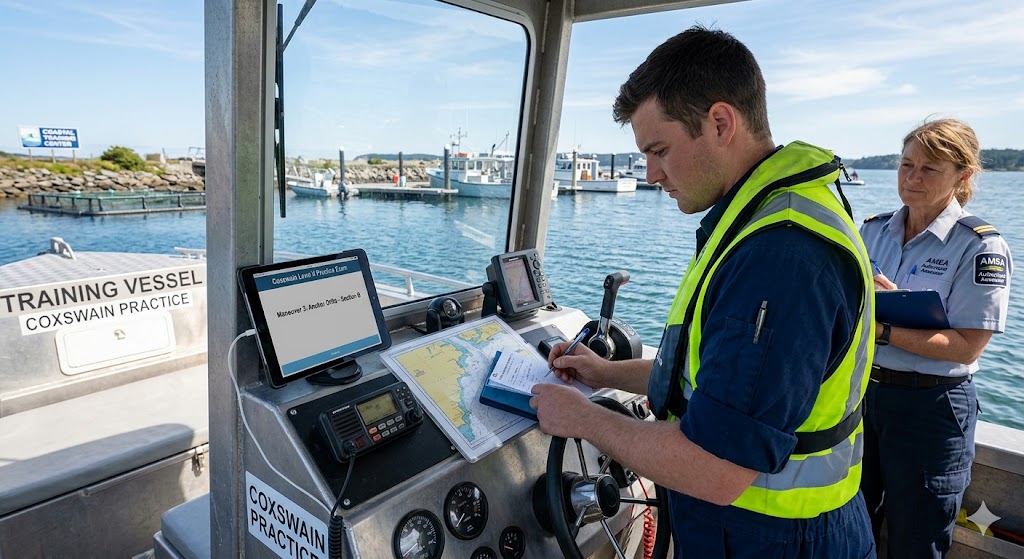
Additional Information
What the Course Entails and Exam Details
Preparing for the final assessment requires completing a structured course of training, typically a Certificate I in Maritime Operations. This course equips students with both foundational knowledge and practical skills across several core domains. Candidates must acquire a current First Aid certificate and submit evidence of qualifying sea service (time spent working on a vessel), the amount of which can be reduced by completing an approved task book. The final assessment, sometimes called the AMPA (AMSA Mandated Practical Assessment), is the culmination of your training, designed to prove your competency to a standard mandated by the maritime authority.
The syllabus covers a comprehensive range of topics, including:
Vessel Navigation and Planning: Using charts, plotting courses, understanding buoys, and using basic electronic navigation tools.
Vessel Handling: Master complex maneuvers, docking, coming alongside, and handling various sea states.
Seamanship Skills: Mastering knots, splicing, anchoring techniques, and towing operations.
Marine Engineering: Basic operation, maintenance, and troubleshooting of inboard and outboard engines and auxiliary systems.
Emergency Procedures: Leading drills for man-overboard, fire, abandoning ship, and using survival craft.
Safety and Environmental Compliance: Following pollution prevention practices and ensuring all safety equipment is serviced and mandatory.
What to Expect in the Final Exam
The final examination for a Coxswain Level II qualification is a two-part assessment, designed to be rigorous yet fair. It ensures every certified coxswain possesses the necessary skills and confidence to operate safely.
The Theory / Written Assessment: This is a closed-book exam consisting of multiple-choice and short-answer questions. It typically lasts several hours and covers all the theoretical components of the course. A high passing score, often in the range of 70% to 100%, is required for each section, particularly for collision regulations (ColRegs), which are non-negotiable for safety. You will need to answer questions on the International Regulations for Preventing Collisions at Sea (Rules of the Road), basic navigational calculations, understanding weather reports, and emergency protocols.
The Practical Assessment: This is an on-water demonstration of your competency. You will be required to command a vessel (often provided by the testing center or your training school) and perform a sequence of tasks directed by an authorized assessor. This assessment replaces the old "orals." The practical exam has no specific time limit, but you must complete all tasks safely and efficiently. You will be evaluated on your ability to perform tasks such as man-overboard recovery, proper anchoring, executing a variety of vessel maneuvers, identifying navigational hazards, and demonstrating proficient check-and-start procedures for engines. A successful candidate must demonstrate confident command and a "safety-first" mindset throughout the process.
How to Study and Exam Centers
Successfully passing the Coxswain Level II Practice Exam requires a blend of focused study and dedicated practical experience. A "practice exam" itself is one of your most valuable study tools, helping you become familiar with the types of questions and the assessment format. Actionable strategies include:
Review Your Course Materials: Study the workbooks, notes, and training guides provided by your Registered Training Organisation (RTO) or maritime school.
Master the ColRegs: Dedicate significant time to memorizing and understanding the International Regulations for Preventing Collisions at Sea. This is the foundation of safe navigation.
Use Practice Quizzes: Regularly take practice quizzes and simulated exams to test your knowledge retention and identify weak areas.
Get Practical Hours: The best way to prepare for the practical assessment is on the water. Maximize your sea service hours and actively practice all required maneuvers, anchoring, and emergency drills. Your task book is a guide for what you must master.
Discuss with Mentors: Talk to experienced masters and engineers on your vessel. Their real-world insights can complement your theoretical learning.
Exam and Testing Centers
You do not take this exam at a general computer-based testing center like Pearson VUE. Instead, all final assessments are conducted by the Registered Training Organisation (RTO) or authorized maritime school where you completed your Certificate I course. You must complete your training with an organization recognized by the national or state maritime authority (e.g., AMSA in Australia, or the relevant Maritime Authority in your country). Upon successful completion of both the training and the final theory and practical AMPA, the training provider will issue a course completion certificate, which you will use to formally apply to the maritime authority for your Certificate of Competency.
Job Opportunities from the Course
A Coxswain Level II qualification opens the door to numerous fulfilling and vital careers on the water. This certificate allows you to operate as a Master of small vessels in defined operational areas. Common job opportunities include:
Commercial Fishing Boat Skipper
Charter Boat Captain (small to medium vessels)
Water Taxi and Ferry Driver
Tour Guide Boat Operator
Aquaculture Support Vessel Master
Dive Operation Boat Coxswain
Port Operations Support Vessel Master
Rescue Boat Crew or Skipper
Marine Science and Research Support Vessel Master
Frequently Asked Questions
Reviews
5.0
Based on 0 reviews
Leave a Review
No reviews yet. Be the first to review!