
CPC Guidelines Practice Test
$69.00
- Buy to unlock unlimited access to all Quiz questions and Answers in this Quiz.
- After purchase you can print a PDF of the whole quiz at any point. The PDF will contain the questions and the correct answers.
About this Exam
The Certified Professional Coder (CPC) certification is
widely recognized as the gold standard for medical coding professionals in
physician office settings.
The CPC Guidelines Practice Test is a targeted diagnostic
tool specifically designed for aspiring coders who are preparing for the
official AAPC CPC exam.
This specific practice exam focuses heavily on testing
your understanding of the essential coding rules and conventions that govern
accurate medical billing.
It is ideal for students enrolled in medical coding
programs and professionals who want to ensure they have mastered the core
principles of diagnosis and procedure coding application.
Successfully navigating this practice exam demonstrates a
strong foundational knowledge of official guidelines, which is critical for
achieving passing scores on the comprehensive certification.
Ready to test your knowledge?
Buy Now to Access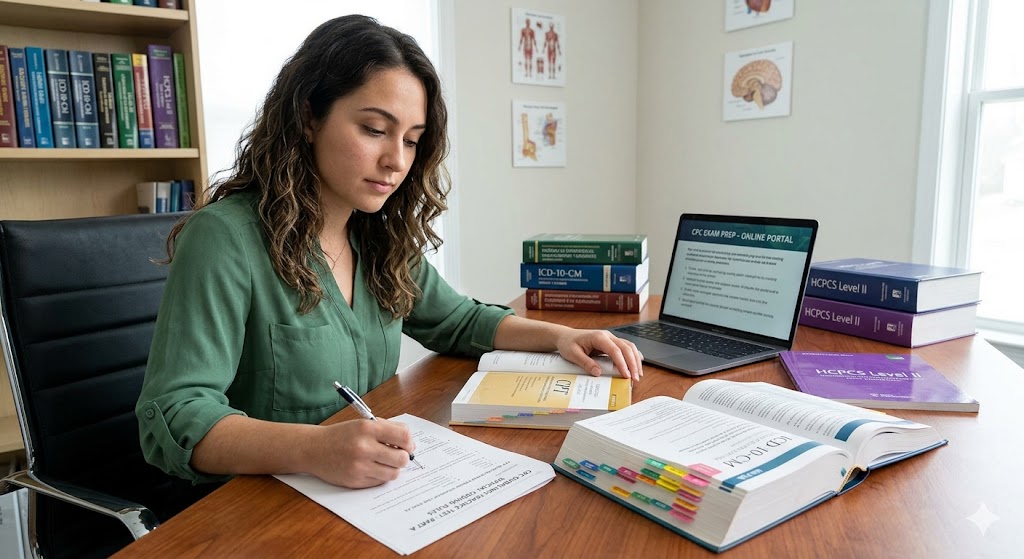
Additional Information
What the Course Entails and Exam Details
This practice test is structured to mirror the structure
and content distribution of the Official Guidelines sections within the full
CPC examination.
The content focuses primarily on the application of
Official ICD-10-CM Guidelines for Coding and Reporting (OGCR) for diagnosis
codes, and key CPT/HCPCS instructions.
You must be proficient in correctly applying guidelines
for sequencing diagnosis codes, combining codes where required, and accurately
utilizing essential modifiers in diverse medical scenarios.
The questions will span all key sections: the Official
ICD-10 Guidelines (including neoplasm, infectious disease, and injury coding
conventions), CPT Guidelines (for Evaluation and Management, surgery, and
anesthesia services), and general medical billing rules.
It is designed to ensure you understand why a
certain code is correct based on rules, not just how to look it up in a manual.
What to Expect in
the Final Exam
While this practice resource is specific, it is vital to
know the structure of the official AAPC CPC exam it prepares you for.
The official CPC certification exam is a comprehensive,
open-book examination taken using updated CPT, ICD-10-CM, and HCPCS Level II
code books.
It consists of a single session with multiple-choice
questions (historically, 100 questions since early 2024 for the online
version).
The questions on the primary exam cover coding
application, medical terminology, anatomy, and reimbursement guidelines, and a
significant portion are scenarios testing guideline compliance.
Candidates must achieve a passing score of 70% or higher.
The entire exam has a strict time limit (typically 4
hours for the 100-question format), making efficient guideline application
essential for success.
How to Study and
Exam Centers
The most effective way to study for the CPC Guidelines is
to practice application repeatedly, using a targeted tool like the CPC
Guidelines Practice Test.
We strongly recommend taking this practice exam multiple
times under realistic timed conditions.
Do not simply check your score; diligently review every
question you answer incorrectly.
Identify the exact Official Guideline section you
misapplied (e.g., Section I.C.1.a.1 for sepsis) and review that specific rule
in your code book until you understand it completely.
Familiarize yourself intimately with the layout of your
coding manuals, as navigation speed is a primary challenge on the final exam.
To take the official CPC exam, you must register
through the AAPC (American Academy of Professional Coders).
The AAPC offers two testing options: an online, proctored
format that can be taken via an online portal from your home, or a physical,
in-person format at various locations.
You can locate a designated physical testing center or
authorized site near you directly through the AAPC website during registration.
Job Opportunities from the Course
Achieving your CPC certification is a pivotal step that
can immediately open diverse and stable career paths in the health information
field.
This certification is highly sought after by physician
practices, hospitals, and medical billing companies.
Your expertise in guidelines and coding application is
critical to proper reimbursement for healthcare providers.
A list of potential job titles and career paths available
to certified professionals includes:
- Certified
Professional Coder (CPC)
- Medical
Coder
- Medical
Billing and Coding Specialist
- Risk
Adjustment Coder (requiring additional specialized guidelines)
- Inpatient/Outpatient
Coder
- Coding
Auditor (analyzing guideline compliance)
- Health
Information Technician (HIT)
- Coding
Manager or Supervisor
- Reimbursement
Specialist
- Compliance
Officer
Frequently Asked Questions
Reviews
5.0
Based on 0 reviews
Leave a Review
No reviews yet. Be the first to review!