
CPL Navigation Practice Exam
$69.00
- Buy to unlock unlimited access to all Quiz questions and Answers in this Quiz.
- After purchase you can print a PDF of the whole quiz at any point. The PDF will contain the questions and the correct answers.
About this Exam
The Commercial Pilot License (CPL) Navigation examination
is a critical hurdle for any aspiring professional pilot. It validates your
competency in safe and accurate aircraft navigation under demanding commercial
conditions. This exam is designed specifically for students who have completed
their CPL ground school training and are moving toward their regulatory body
written examinations. Passing this test signifies you possess the precision
required to transport passengers or cargo safely across complex airspaces and
long distances.
Ready to test your knowledge?
Buy Now to Access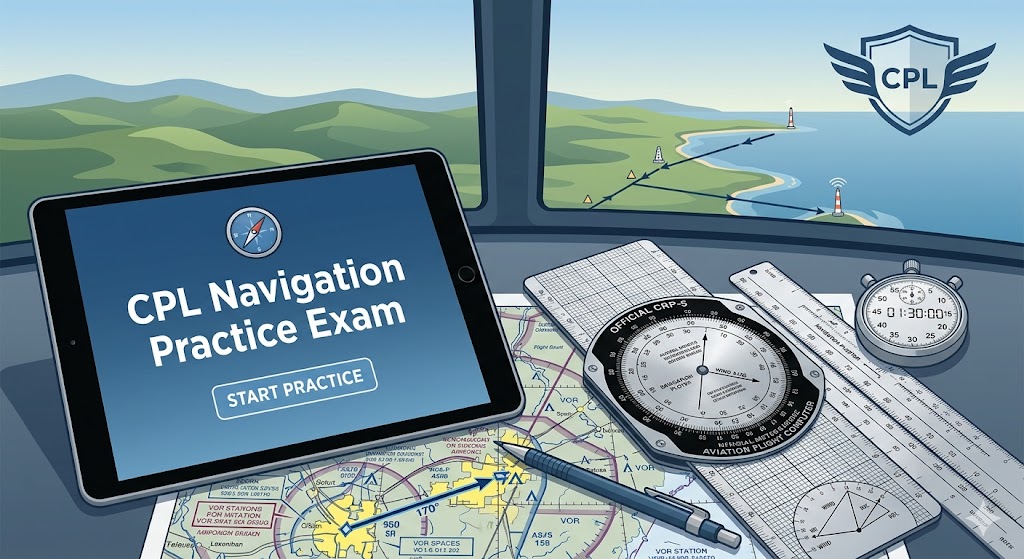
Additional Information
What the Course Entails and Exam Details
To succeed on the CPL Navigation exam, you must master a
combination of theoretical knowledge and practical application. The core
syllabus covers several sophisticated domains of airmanship.
You will become proficient in terrestrial navigation,
including the shape of the earth, latitude/longitude systems, great and small
circle routes, and rhumb lines. A thorough understanding of magnetism is
required, focusing on variation, deviation, and the operation of the magnetic
compass. Chart reading skills are essential, particularly with Lambert
Conformal Conic and Mercator projections, where you must calculate scale,
distances, and grid references accurately.
The heart of the CPL exam is the mastery of Dead
Reckoning (DR) navigation and the wind triangle. You will use a standard
mechanical flight computer, such as the CRP-5 or E6B, to solve complex
triangle-of-velocities problems involving Track, Heading, True Airspeed (TAS),
Ground Speed (GS), and Wind Velocity.
Furthermore, you will be tested on the principles,
operation, errors, and practical application of Radio Navigation aids. These
include VOR (VHF Omnidirectional Range), NDB (Non-Directional Beacon), DME
(Distance Measuring Equipment), and Global Positioning Systems (GPS), which are
foundational for professional en route navigation.
What to Expect in the Final Exam
The final CPL Navigation written examination is a
rigorous assessment of your knowledge and mental stamina. The standard format
consists entirely of multiple-choice questions.
A high standard of proficiency is required, with a
typical passing score of 70% or higher.
The time allocation is strict, usually allowing between 2
and 3 hours to complete the extensive questionnaire, rewarding efficiency and
certainty in your calculations.
This is a closed-book examination. You are only permitted
to bring approved navigational equipment, such as a mechanical flight computer
(CRP-5/E6B), navigation plotters, protractors, and rulers. The use of
electronic calculators, smartphones, or unauthorized reference materials is
strictly prohibited and results in automatic failure.
How to Study and Exam Centers
Systematic preparation is the only route to success on
this technical exam. Air Navigation cannot be crammed; it must be understood
conceptually and practiced methodically.
We recommend beginning with a deep dive into the official
CAA or regulatory body learning objectives. Use approved aviation text series,
such as Jeppesen, Oxford, or CAP, as your primary references.
The most vital study strategy is the daily application of
navigation mathematics. Solve 15 to 20 wind triangle problems every day until
the use of your mechanical flight computer becomes automatic. When using a CPL
Navigation Practice Exam, simulate true exam conditions: sit in a quiet room,
time yourself, and only use approved tools. Practice tests are invaluable for
identifying knowledge gaps and becoming familiar with common question phrasing
and the speed required.
When you are confident and ready to take the official
exam, you must register through your national aviation authority’s online
portal.
The exam is administered at secure, official testing
facilities. These locations are generally either designated regulatory
authority testing centers, approved Pearson VUE or PSI testing stations, or
authorized professional flight training academies.
Job Opportunities from the Course
A strong foundation in navigation is essential for the
longevity of your commercial flying career. A CPL opens the door to numerous
professional pilot pathways. Navigation competency is foundational for the
following job titles:
- Airline
First Officer
- Charter
Pilot
- Cargo
Pilot
- Flight
Instructor (Navigation Specialist)
- Aerial
Surveyor Pilot
- Corporate/Executive
Pilot
- Air
Ambulance/Rescue Pilot
- Agricultural
Pilot (Crop Duster)
Frequently Asked Questions
Reviews
5.0
Based on 0 reviews
Leave a Review
No reviews yet. Be the first to review!