
CPS Node Architecture and Energy Management Practice Exam
$69.00
- Buy to unlock unlimited access to all Quiz questions and Answers in this Quiz.
- After purchase you can print a PDF of the whole quiz at any point. The PDF will contain the questions and the correct answers.
About this Exam
The CPS Node Architecture and Energy Management certification is designed for engineers and IT professionals specializing in the infrastructure of Cyber-Physical Systems (CPS), such as the Internet of Things (IoT), industrial automation, and smart grid technology. This critical domain validates expertise in designing the foundational computational nodes, selecting appropriate hardware-software architectural models, and implementing efficient energy management strategies. This certification is ideal for systems architects, embedded systems engineers, network designers, and energy specialists who are responsible for ensuring the sustainable, long-term operation of distributed, battery-powered, or energy-harvesting devices. The [CPS Node Architecture and Energy Management Practice Exam] is an essential study resource, enabling candidates to simulate the test experience, assess their current knowledge, and identify critical learning gaps before the final examination
Ready to test your knowledge?
Buy Now to Access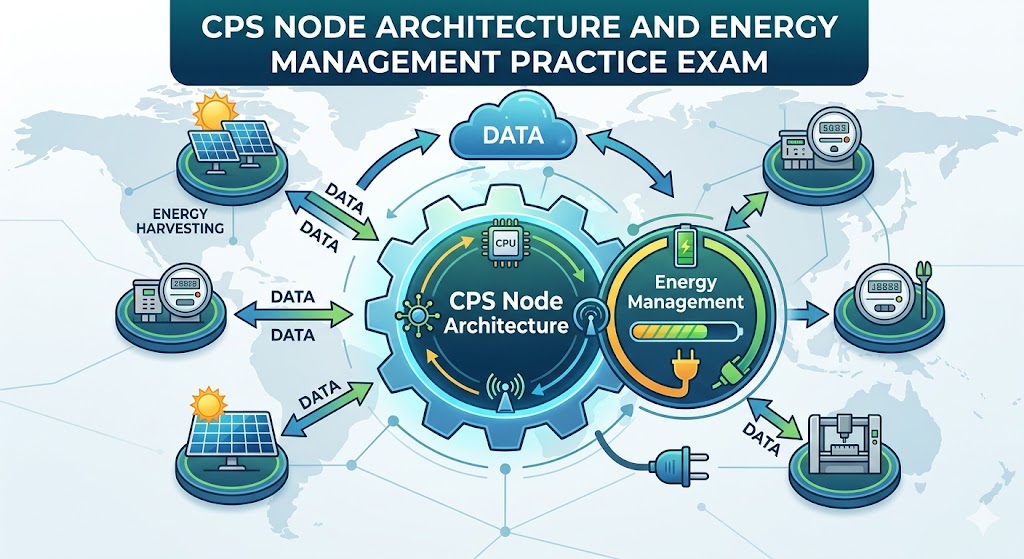
Additional Information
What the Course Entails and Exam Details
The comprehensive curriculum for this domain delves into the
hardware, software, and operational strategies that define a resilient and
efficient CPS node.
Key areas covered include:
- CPS
Node Componentry: Detailed knowledge of node hardware, including
microcontrollers, sensing/actuation interfaces, communication modules, and
power subsystems.
- Architectural
Models and RTOS: Understanding real-time operating systems (RTOS),
middleware, and architectural patterns (like edge-cloud, distributed)
suitable for CPS applications.
- Power
Management Techniques: Mastery of low-power design principles,
including Dynamic Voltage and Frequency Scaling (DVFS), power gating, and
dynamic component shutdown.
- Energy
Harvesting and Storage: Understanding methods for collecting ambient
energy (solar, thermal, kinetic) and managing advanced storage systems
(supercapacitors, high-density batteries).
- Communication
Protocols for Low Power: Evaluation and implementation of
energy-efficient communication standards such as LoRaWAN, Zigbee, BLE, and
NB-IoT.
- Security
and Reliability by Design: Integrating security features and
fault-tolerant mechanisms directly into the node architecture to ensure
continuous operation in challenging environments.
What to Expect in
the Final Exam
The final certification exam is a comprehensive assessment
that validates both theoretical knowledge and practical application skills in
CPS node engineering and optimization.
- Exam
Format: The test primarily consists of multiple-choice and
scenario-based situational questions. Candidates are challenged to apply
architectural principles to solve real-world problems.
- Time
Limit: Candidates typically have 120 minutes to complete the full
examination.
- Passing
Score: To earn the certification, candidates must achieve a minimum
score of 70%.
- Specific
Rules: The examination is typically closed-book and administered in a
proctored environment, either physically or online. Candidates must adhere
to all code of conduct and test security protocols.
How to Study and
Exam Centers
Preparation for this specialized field requires a structured
and dedicated approach to learning complex technical concepts.
Actionable Study Strategies:
Thoroughly Review the Syllabus
and Study Guide: Begin with a methodical review of all official course
documentation and learning objectives.
Practice with the [CPS Node
Architecture and Energy Management Practice Exam]: Utilizing a dedicated
practice exam is essential for building test-taking stamina, identifying
weaknesses, and understanding the phrasing of real questions.
Engage in Hands-On Lab Work:
Gain practical experience with development boards (like ESP32, STM32), power
monitoring tools, and embedded programming environments.
Analyze Real-World Case
Studies: Study successful implementations of CPS in sectors such as smart
energy grids, building automation, or industrial monitoring to see
architectural and energy principles applied.
Join Online Communities:
Participating in forums and discussion groups can provide new perspectives and
collaborative problem-solving opportunities.
Exam Centers: Candidates can take the formal
certification exam through multiple authorized channels. Options frequently
include:
- Online
Proctored Exam: Secure remote testing from your home or office through
an approved platform.
- Authorized
Testing Centers: Scheduling an appointment at a designated physical
center, such as a Pearson VUE facility.
- Accredited
Institutions: Some specialized training partners and educational
institutions may offer authorized testing locations.
Job Opportunities
from the Course
Earning this certification signals to the industry that you
possess advanced knowledge in two critical and high-growth technical fields:
modern distributed node architecture and sustainable energy management.
Successful candidates who pass the [CPS Node Architecture
and Energy Management] exam are well-positioned for numerous advanced career
paths, including job titles such as:
- CPS
Solutions Architect
- Embedded
Systems Engineer (Focus on Energy)
- Smart
Grid Systems Designer
- Industrial
IoT (IIoT) Architect
- Distributed
Systems Engineer
- Energy
Management Specialist for Connected Systems
- Sensor
Network Design Engineer
- Cyber-Physical
System Developer
- Sustainability
and Efficiency Consultant for Smart Infrastructure
Frequently Asked Questions
Reviews
5.0
Based on 0 reviews
Leave a Review
No reviews yet. Be the first to review!