
Craftsman 301 Qualification Practice Exam
$69.00
- Buy to unlock unlimited access to all Quiz questions and Answers in this Quiz.
- After purchase you can print a PDF of the whole quiz at any point. The PDF will contain the questions and the correct answers.
About this Exam
The Craftsman 301 Qualification is a prestigious certification designed for experienced skilled tradespeople ready to demonstrate mastery in their specific field, such as electrical work, HVAC, plumbing, or advanced carpentry. This exam is not for beginners; it is engineered to validate the high-level theoretical knowledge, practical expertise, and problem-solving abilities of individuals who have already completed substantial on-the-job training and foundational coursework. The successful candidate proves they can independently manage complex projects, mentor apprentices, and ensure work consistently meets the highest industry standards for safety and quality.
Ready to test your knowledge?
Buy Now to Access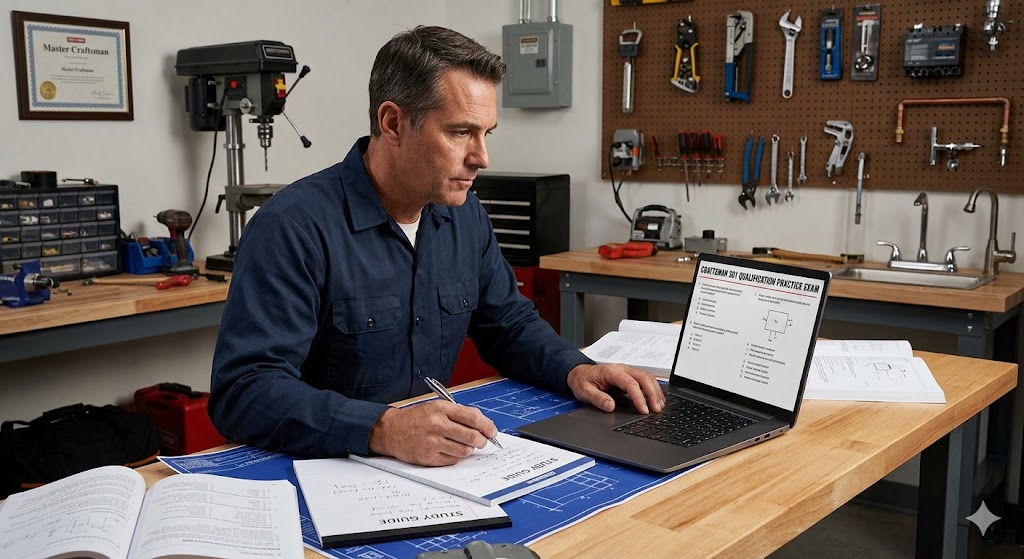
Additional Information
What the Course Entails and Exam Details
This qualification program and the associated exam cover a comprehensive spectrum of advanced competencies essential for a master-level craftsman.
While the exact syllabus varies slightly by specific trade, the core curriculum generally includes:
Advanced Trade Theory and Application: Deep-dive into the complex principles, calculations, and emerging technologies within your specific trade discipline.
Code Compliance and Regulatory Standards: Mastery of current international, national, and local building codes, environmental regulations, and mandatory safety protocols (e.g., OSHA 30 standards).
Blueprint Reading and Plan Interpretation: The ability to decipher complex construction drawings, schematics, and specifications, including material take-offs and estimation.
Project Management and Leadership: Principles of site organization, workflow planning, resource allocation, and the supervision and mentoring of team members.
Quality Assurance and Control: Techniques for inspecting finished work to guarantee precision, functionality, and adherence to all project specifications and industry best practices.
What to Expect in the Final Exam
The Craftsman 301 Qualification Exam is a rigorous, two-part assessment designed to test both your cognitive understanding and your hands-on proficiency.
Theoretical Examination: This part typically consists of multiple-choice questions administered via computer. It focuses on testing your understanding of codes, advanced calculations, blueprint interpretation, and safety protocols. This section often has a strict time limit, typically ranging from two to four hours.
Practical Assessment: This is the core of the 301 level. You will be required to perform a series of complex, timed tasks in a controlled workshop environment. A certified proctor will evaluate your ability to apply your knowledge, use tools correctly, troubleshoot problems, and deliver a final product that meets precise quality standards within a set timeframe.
Candidates must generally achieve a passing score of at least 75% on both the theoretical and practical sections to be awarded the qualification. Specific rules regarding allowed materials (e.g., code books during the theoretical exam) are provided upon registration.
How to Study and Exam Centers
Preparation for the Craftsman 301 exam must be both structured and thorough. Consider these actionable strategies:
Utilize a Structured Study Guide: Invest in the official study guide or recommended textbooks from the certifying body. This ensures your study plan is aligned with the latest exam objectives.
Take Multiple Practice Exams: Simulating the test environment is crucial. Practice exams help you get used to the question format, manage your time, and identify weak points in your knowledge base.
Review Code Books Intensely: Do not simply know the codes; understand how to apply them to complex scenarios. Focus on areas that have recently been updated.
Form a Study Group: Collaborating with other experienced tradespeople can provide new perspectives and help you work through challenging concepts.
Practice Hands-On Tasks: Replicate the types of complex practical tasks you are likely to encounter in the assessment, focusing on efficiency, accuracy, and safety.
The theoretical portion of the exam is typically proctored at Pearson VUE testing centers or other authorized professional computer-based testing facilities located worldwide. The practical assessment is often conducted at certified trade schools, union halls, or specific institutional testing workshops equipped with the necessary tools and materials. Registration for both sections is usually completed through the certifying organization’s online portal.
Job Opportunities from the Course
Earning the Craftsman 301 Qualification unlocks advanced career paths and significantly increases earning potential within the skilled trades industry.
Key job opportunities include:
Master Carpenter / Electrician / Plumber / HVAC Technician
Project Foreman
Construction Superintendent
Quality Control (QA/QC) Inspector
Maintenance Supervisor
Trade Instructor / Mentor
Independent Contractor / Business Owner
Frequently Asked Questions
Reviews
5.0
Based on 0 reviews
Leave a Review
No reviews yet. Be the first to review!