
Creating the Constitution Practice Test
$69.00
- Buy to unlock unlimited access to all Quiz questions and Answers in this Quiz.
- After purchase you can print a PDF of the whole quiz at any point. The PDF will contain the questions and the correct answers.
About this Exam
The Creating the Constitution Practice Exam is designed to evaluate and reinforce your understanding of the pivotal era when the United States transitioned from a loose confederation of states to a unified nation under the Constitution. It acts as a targeted module for students, often within a broader context like AP U.S. History (APUSH), introductory college politics, or high school civics.
This practice test is ideal for anyone seeking to solidify their knowledge of early American history, constitutional law, or preparing for high-stakes standardized assessments. Its purpose is to simulate the types of questions and rigorous analytical skills required to discuss the historical context, the core compromises, and the lasting legacy of the Constitution.
Ready to test your knowledge?
Buy Now to Access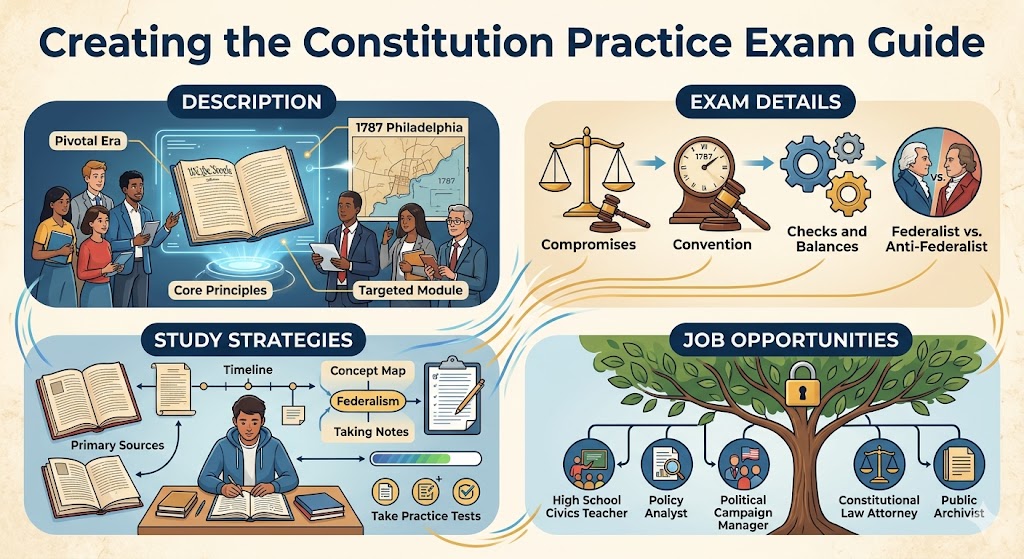
Additional Information
What the Course Entails and Exam Details
This practice exam covers the multi-faceted process of creating the U.S. government. Key areas of focus include:
The Articles of Confederation: Analyzing the strengths and weaknesses of America's first frame of government, and why it ultimately failed.
The Constitutional Convention (1787): Understanding the context of the meeting in Philadelphia, the key delegates (such as James Madison, George Washington, and Alexander Hamilton), and their conflicting visions.
Major Compromises: Detailed knowledge of the Great Compromise (Connecticut Compromise), the Three-Fifths Compromise, and debates over the slave trade and commerce.
Key Constitutional Principles: Explaining the application of separation of powers, checks and balances, federalism, and limited government.
Federalists vs. Anti-Federalists: Mastering the arguments of both sides, including the significance of the Federalist Papers and the demand for a Bill of Rights.
Ratification and Amendments: Understanding the process by which the Constitution was approved and how it can be changed.
What to Expect in the Final Exam
While a "practice exam" is a diagnostic tool, its format is often modelled after the high-stakes tests it mimics. In this case, you should expect a format similar to a rigorous APUSH unit test or a civics final.
Format: The exam predominantly uses a mixture of stimulus-based multiple-choice questions and short-answer questions (SAQs). Multiple-choice questions will often provide a primary source document (like an excerpt from the Federalist Papers, a letter, or a period cartoon) and ask you to analyze it in context. Short-answer questions require you to write concise, paragraph-length responses explaining a historical process or comparison.
Question Distribution: Approximately 70% multiple-choice and 30% short-answer analysis.
Time Limit: Typically 45 to 60 minutes for a targeted unit-specific practice test.
Passing Score: As a practice tool, a "passing score" isn't standardized. However, aiming for 80% or higher indicates a strong mastery of the content.
How to Study and Exam Centers
Preparation is key to succeeding on the Creating the Constitution Practice Exam. Use these actionable strategies to build confidence:
Analyze Primary Sources: Don't just read about the Constitution; read the document itself, along with the Federalist Papers (especially Nos. 10, 51, and 78) and Anti-Federalist essays. Practice identifying the author, context, and purpose of these documents.
Master the Timeline: Create a detailed timeline of events from Shays' Rebellion (1786) to the ratification of the Bill of Rights (1791). Understanding the chronological flow is crucial for SAQs.
Create Concept Maps: Connect key figures, compromises, and principles. For instance, link "Federalism" to specific constitutional provisions (like the 10th Amendment) and historical debates.
Take Multiple Practice Tests: Use targeted quizzes to identify your weak spots. Focus on both speed and accuracy for multiple-choice, and practice outlining responses for short answers.
Exam Centers: Since this is a practice test, it is typically administered through educational portals, learning management systems like Canvas or Blackboard, or authorized online practice platforms (e.g., College Board, Khan Academy, or institutional sites). Consult your instructor or school program for access.
Job Opportunities from the Course
While a single practice exam does not grant a certification, mastering the material within the 'Creating the Constitution' course unlocks essential skills for a wide range of career paths. This knowledge base is fundamental for roles in government, law, education, and advocacy. Here are specific career paths that this course helps build:
High School History or Civics Teacher
Legislative Assistant or Policy Analyst
Political Campaign Manager
Paralegal or Legal Assistant
Public Archivist or Historical Curator
Lobbyist or Advocacy Coordinator
Constitutional Law Attorney (requires further study)
Government Affairs Specialist
Frequently Asked Questions
Reviews
5.0
Based on 0 reviews
Leave a Review
No reviews yet. Be the first to review!