
Crew Duties Drill Practice Test
$69.00
- Buy to unlock unlimited access to all Quiz questions and Answers in this Quiz.
- After purchase you can print a PDF of the whole quiz at any point. The PDF will contain the questions and the correct answers.
About this Exam
A Crew Duties Drill certification is a vital credential in the maritime, offshore, and high-consequence safety industries. This practice test is specifically designed to prepare candidates for the theoretical and procedural assessments that validate their knowledge of essential emergency protocols and their specific roles within a crew. Whether you are an entry-level seafarer seeking your first qualification or a seasoned professional requiring recertification, this exam measures your understanding of safety management systems, communication hierarchy, and practical execution of emergency procedures.
Ready to test your knowledge?
Buy Now to Access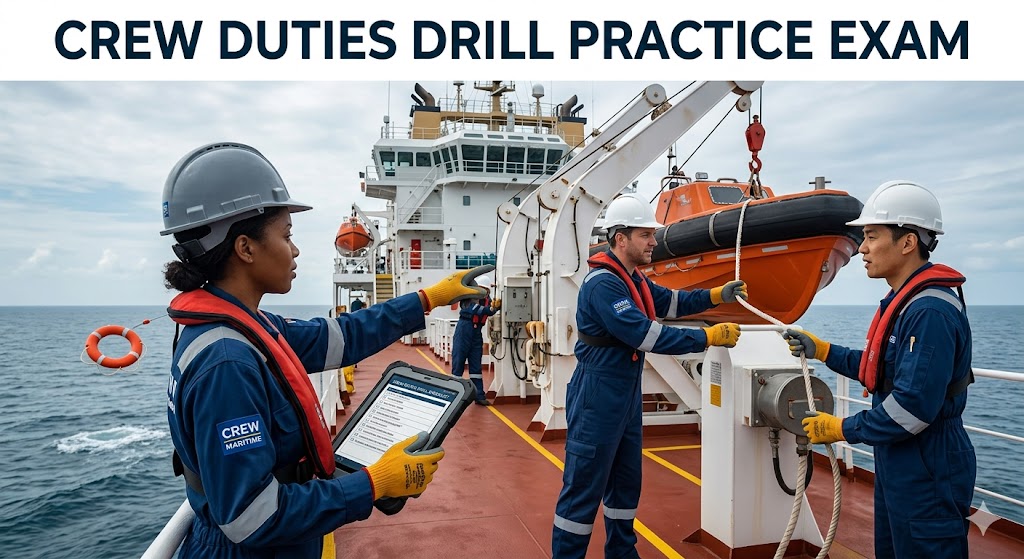
Additional Information
What the Course Entails and Exam Details
The comprehensive course underlying this certification covers a diverse range of critical safety and operational skills. Students must become familiar with multiple types of standard drills, including: Fire Fighting and Prevention, Abandon Ship Procedures, Man Overboard (MOB) recovery, Medical Emergency Response, and Security Threats (e.g., Piracy and Access Control). The syllabus details specific regulatory requirements from bodies such as the International Maritime Organization (IMO) under the STCW (Standards of Training, Certification, and Watchkeeping) Convention. You will learn the exact sequence of alarms, the location and operation of safety equipment, effective damage control, and the critical importance of clear, unambiguous communication under pressure.
What to Expect in the Final Exam
The actual final exam often comprises two primary components: a theoretical test and a practical assessment. This practice exam primarily prepares you for the theoretical portion, which is usually a multiple-choice, proctored test containing between 50 and 100 questions. The time limit typically ranges from 60 to 90 minutes. A high degree of accuracy is expected, with a required passing score often set at 70% to 80% due to the safety-critical nature of the subject matter. Questions test your knowledge of safety regulations, procedural steps, equipment identification, and your ability to correctly identify your specific duties from a Muster List during a simulated scenario. Passing the theoretical test is frequently a prerequisite for taking the practical, scenario-based drill assessment.
How to Study and Exam Centers
Effective preparation requires a mixture of study techniques. Start by thoroughly reviewing your vessel or facility’s Safety Management System (SMS) manuals and the emergency Muster List. Utilize this practice exam to identify your weak areas and to become accustomed to the phrasing of regulatory and procedural questions. Physically walk through your assigned emergency duties and memorize the location of all key safety equipment. For specialized drills, simulation software or table-top exercises can be highly effective. The official final exams are conducted at authorized testing centers, which vary by industry. In the maritime sector, these are typically recognized STCW training schools and national maritime authority facilities. Some theory-only components might be offered through secure, proctored online portals.
Job Opportunities from the Course
This certification is fundamental and often mandatory for a wide array of roles across several sectors. Earning it unlocks career paths such as:
Maritime Deckhand
Able Seafarer (Deck/Engine)
Stewards and Hospitality Staff (on Cruise/Passenger vessels)
Marine Engineer Officer
Marine Superintendent
Offshore Rig Safety Officer
Dynamic Positioning (DP) Operator
Port and Terminal Operational Staff
Search and Rescue (SAR) Crew Member
Frequently Asked Questions
Reviews
5.0
Based on 0 reviews
Leave a Review
No reviews yet. Be the first to review!