
Crime Analysis Practice Exam
$69.00
- Buy to unlock unlimited access to all Quiz questions and Answers in this Quiz.
- After purchase you can print a PDF of the whole quiz at any point. The PDF will contain the questions and the correct answers.
About this Exam
The Crime Analysis Practice Exam is a crucial preparatory tool designed for professionals aspiring to become certified Crime Analysts.
This practice exam serves as the ultimate rehearsal for official certification tests, such as those offered by the International Association of Crime Analysts (IACA) or other recognized law enforcement standards boards.
It is specifically tailored for criminal justice students, current law enforcement personnel transitioning into analytical roles, and data analysts who wish to apply their expertise within a public safety context.
By successfully navigating this practice exam, candidates validate their readiness to support law enforcement operations through data-driven insights and strategic analysis.
Ready to test your knowledge?
Buy Now to Access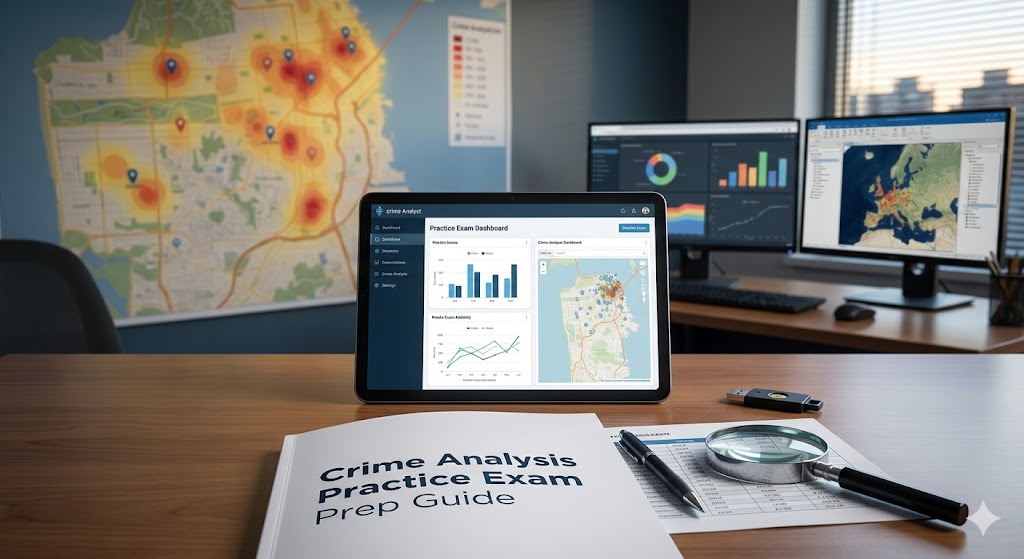
Additional Information
What the Course Entails and Exam Details
This practice exam is not a theoretical course; it is a simulation of the knowledge and application required in the field of crime analysis.
It covers a standard syllabus rooted in the essential core competencies of a professional analyst.
Candidates must demonstrate proficiency across several key domains, including:
Foundation of Crime Analysis: Understanding definitions, history, and the evolution of the profession within contemporary policing.
The SARA Model: A deep understanding of Scanning, Analysis, Response, and Assessment as the framework for problem-oriented policing.
Types of Analysis: Practical knowledge of tactical (immediate patterns), strategic (long-term trends), administrative (resource allocation), and criminal intelligence analysis.
Data Integrity: The ability to collect, clean, and manage large, disparate datasets from police records management systems (RMS).
Pattern Identification: Methods for detecting crime series, sprees, and hot spots using statistical and spatial methods.
Technology & Tools: Familiarity with geographic information systems (GIS) for mapping, statistical software (Excel, SPSS), and specialized analysis programs.
Product Creation: The ability to disseminate findings effectively through standardized reports, bulletins, and briefings suitable for various law enforcement stakeholders.
What to Expect in the Final Exam
While the exact structure of the practice exam may vary slightly depending on the specific practice vendor, it is strictly designed to mirror the actual certification exam's format, rigor, and time constraints.
Here is a breakdown of what candidates can expect from the standard final certification test.
Exam Format: The test is usually divided into multiple sections, containing both multiple-choice questions (testing knowledge and definitions) and scenario-based questions. Scenario questions require the candidate to apply analysis techniques to a mock crime data set, simulating real-world decision-making.
Time Limit: Candidates typically have between two and four hours to complete the examination, requiring excellent time management skills.
Passing Score: A passing grade is generally around 70% to 75%, though candidates are encouraged to aim significantly higher on practice exams to ensure a margin of safety for the actual test.
Practical Component: Often, the exam requires the candidate to use a computer (sometimes their own or sometimes a provided one) to actively demonstrate skills like creating a basic heat map or calculating descriptive statistics.
How to Study and Exam Centers
Preparation for the Crime Analysis Practice Exam, and subsequently the actual certification, must involve a blend of study, practice, and practical software application.
How to Study and Practice Methods
Benchmark with a Practice Exam: Start your studies by taking a full Crime Analysis Practice Exam with zero preparation. Use the detailed score report to identify your weak domains (e.g., GIS, statistics) and build your study plan around those specific areas.
Utilize Authorized Materials: Study primary textbooks such as "Exploring Crime Analysis" (IACA) and other widely recognized academic texts focused on problem-oriented policing and environmental criminology.
Hands-on Software Practice: Do not just read about mapping or data sorting; do it. Practice creating pivot tables in Excel, executing joins in GIS software, and calculating common crime rate statistics using real or mock datasets.
Time-Managed Practice: In the weeks leading up to your real exam, take subsequent versions of the practice exam under strict time constraints to build stamina and speed.
Peer Study Groups: Engage with online forums and professional organizations dedicated to crime analysis to discuss complex topics with peers.
Where to Take the Exam and Exam Centers
The registration and testing logistics depend entirely on the specific certifying body (e.g., IACA, specific university programs, or state-level standard boards).
Online Portals: Many certifications (and almost all practice exams) are offered through secure online testing portals. The official certification test is usually proctored using remote invigilation software or services like ProctorU, allowing you to take the test from home under specific security conditions.
Physical Testing Centers: Some specialized or state certifications are administered at designated testing centers, such as university computer labs, authorized professional academies, or commercial testing sites like Pearson VUE, depending on the rules of the certifying agency.
Authorized Schools: If you are part of a specific crime analysis program, your final certification exam might be administered directly at your university as part of your final coursework.
Job Opportunities from the Course
Successfully completing a crime analysis certification pathway, validated by passing the practice exam, opens numerous rewarding career paths in public safety, government, and even the private sector.
Below is a list of job titles and career paths available to certified analysts:
Crime Analyst (Police or Sheriff Departments)
Tactical Crime Analyst
Criminal Intelligence Analyst (CIA, FBI, or State Fusion Centers)
Data Analyst for Public Safety (Municipal Government)
Investigative Assistant / Criminal Investigator
Fraud Analyst (Banking and Insurance Sector)
Retail Loss Prevention Analyst
Research Analyst (Criminal Justice Research Firms)
Corporate Security Analyst
Frequently Asked Questions
Reviews
5.0
Based on 0 reviews
Leave a Review
No reviews yet. Be the first to review!