
Crime and Criminal Justice Practice Test
$69.00
- Buy to unlock unlimited access to all Quiz questions and Answers in this Quiz.
- After purchase you can print a PDF of the whole quiz at any point. The PDF will contain the questions and the correct answers.
About this Exam
The field of Crime and Criminal Justice is dynamic and essential to a functioning society. It encompasses the understanding of criminal behavior, the operations of law enforcement, the intricacies of the legal system, and the management of correctional institutions. A professional qualification or certification in this area validates your knowledge and readiness for a wide array of impactful roles. The Crime and Criminal Justice Practice Test is an invaluable tool designed for aspiring professionals – from high school graduates and security personnel to those transitioning careers – seeking to demonstrate their understanding of these core principles before tackling a final, career-defining examination. It offers a crucial self-assessment opportunity, allowing you to gauge your strengths, identify areas for improvement, and build the confidence needed for success on the official qualification path.
Ready to test your knowledge?
Buy Now to Access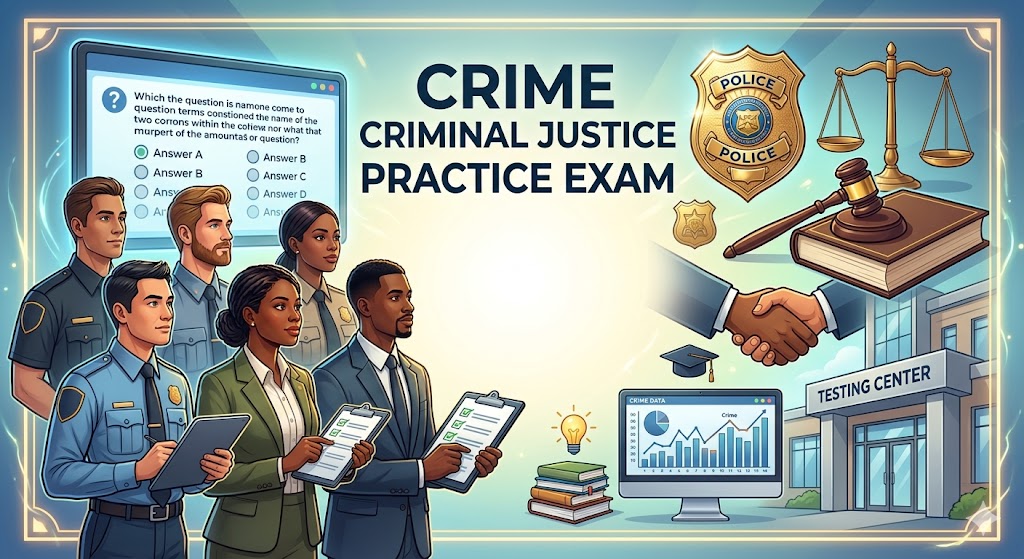
Additional Information
What the Course Entails and Exam Details
While the specific curriculum can vary by institution or certification body, a comprehensive Crime and Criminal Justice course typically covers the following foundational areas, which are then mirrored in key qualification exams and this practice test:
The Criminal Justice System: Understanding the roles and interactions of law enforcement, the court system (local, state, federal), and corrections (prisons, jails, probation, parole).
Criminal Law & Procedure: Key definitions of crime, the principles of due process, rules of evidence, search and seizure laws, and the steps from arrest through to sentencing.
Criminology: Theories explaining criminal behavior, types of crime, crime measurement (like UCR or NIBRS), and data analysis.
Law Enforcement: Police organization, functions, ethics, community policing strategies, and current challenges in modern policing.
The Court System: Court structure, the prosecution and defense roles, the trial process, and judicial functions.
Corrections: The purpose and history of punishment, different types of correctional facilities, prison management, prisoner rights, and community-based corrections.
Crime Prevention & Analysis: Understanding and applying methods to reduce crime, including forensic science basics and modern crime-mapping techniques.
Ethics & Professional Conduct: Crucial ethical principles and legal responsibilities in all criminal justice roles.
The Crime and Criminal Justice Practice Test typically aims to cover a representative cross-section of these topics, often presented as diverse multiple-choice questions to test your comprehensive knowledge.
What to Expect in the Final Exam
While formats can differ, typical final comprehensive qualification exams in the criminal justice field share common characteristics. Expect a rigorous assessment of your theoretical knowledge, procedural understanding, and ethical judgement.
Format: The overwhelming majority of such exams are multiple-choice, which effectively test breadth of knowledge. Some specialized certifications might include case studies, short answers, or practical components.
Questions & Time: A standard final exam often consists of 100 to 150 questions and imposes a strict time limit, typically ranging from two to three hours. Time management is critical.
Passing Score: The required score to pass is usually set around 70% to 75% for introductory certifications, but it can be higher for more advanced or specialised roles. Some institutions may require passing scores in individual topic areas as well.
Rules & Procedures: Expect strict proctoring procedures, whether online or at a physical location. You will need to present valid ID, and electronic devices, study materials, and unauthorized assistance will be strictly prohibited. Online proctored exams often involve screen-monitoring software and room scans.
How to Study and Exam Centers
Preparation is key to succeeding on both the practice test and the final qualification. Approach your studies with a structured, multifaceted plan:
Master the Core Material: Thoroughly review your course textbooks, lecture notes, and any relevant official study guides. Create detailed summaries for each major topic area: Law, Enforcement, Courts, and Corrections.
Create a Study Schedule: Allocate specific time slots each day to different subjects. Consistency over weeks or months is far more effective than cramming.
Use Active Recall & Flashcards: Test yourself regularly on definitions, legal cases, theories, and procedures. Digital flashcard apps are excellent for this.
Take Multiple Practice Tests: Utilise this Crime and Criminal Justice Practice Test multiple times. Treat each attempt like the real exam – set a timer and avoid distractions. Analyze your incorrect answers meticulously to understand why you got them wrong. Identify patterns in your weak areas.
Review Wrong Answers & Explanations: Many practice tests, including this one, provide detailed explanations for each question. Understanding the rationale behind correct and incorrect options is invaluable learning material.
Focus on Understanding, Not Just Memorization: Grasp the why behind a law or the process of a criminal investigation. Apply concepts to real-world scenarios.
Regarding Exam Centers:
Practice Test: This practice test is typically accessible online through educational platforms, certification body websites, or specialized testing services. It is designed for convenient, self-administered access.
Final Qualification Exam: The actual career-defining certification or entry exam is taken through official channels. Common methods include:
Online Proctored Systems: Many modern certifications offer online exams that you can take from a secure location with a computer and reliable internet, utilizing remote proctoring technology.
Physical Testing Centers: Dedicated testing facilities like Pearson VUE, or specific centers affiliated with major schools or government agencies (e.g., Police or DCI Academies in some regions) host these official, supervised exams.
Authorized Training Schools: Accredited colleges or technical schools often administer the final exams for their own associated criminal justice programs.
Always check the specific requirements of the certification or institution you are aiming for to know the exact testing method and locations.
Job Opportunities from the Course
A qualification in Crime and Criminal Justice serves as a vital first step or powerful validation for numerous fulfilling and diverse careers in the public safety and legal sectors. Successful candidates and certified professionals can pursue job titles such as:
Police Officer
Correctional Officer (Prison/Jail Guard)
Probation & Parole Officer
Crime Analyst
Victim Advocate
Criminal Investigator/Detective
Legal Assistant/Paralegal
Court Clerk/Administrator
Emergency Management Coordinator
Loss Prevention Specialist
Juvenile Justice Officer
Private Investigator (requires additional licensing)
Fraud Investigator (Private Sector)
Social Services Coordinator (within the legal/justice system)
Frequently Asked Questions
Reviews
5.0
Based on 0 reviews
Leave a Review
No reviews yet. Be the first to review!