
Crime Prevention Through Environmental Design (CPTED) Practice Exam
$69.00
- Buy to unlock unlimited access to all Quiz questions and Answers in this Quiz.
- After purchase you can print a PDF of the whole quiz at any point. The PDF will contain the questions and the correct answers.
About this Exam
Welcome to your definitive guide to the CPTED Professional Designation, designed for forward-thinking professionals dedicated to creating safer, healthier, and more sustainable human environments. CPTED, which stands for Crime Prevention Through Environmental Design, is a multidisciplinary approach that uses design, management, and the built environment to deter criminal behavior and reduce the fear of crime.
This certification is not just for security personnel; it is a critical credential for architects, city planners, urban designers, law enforcement officers, school administrators, and facility managers. By mastering CPTED principles, you will gain the expertise to analyze spaces, influence human behavior, and implement strategic physical changes that make communities inherently safer. Earning this designation validates your skill in a vital niche that blends psychology, design, and public safety.
Ready to test your knowledge?
Buy Now to Access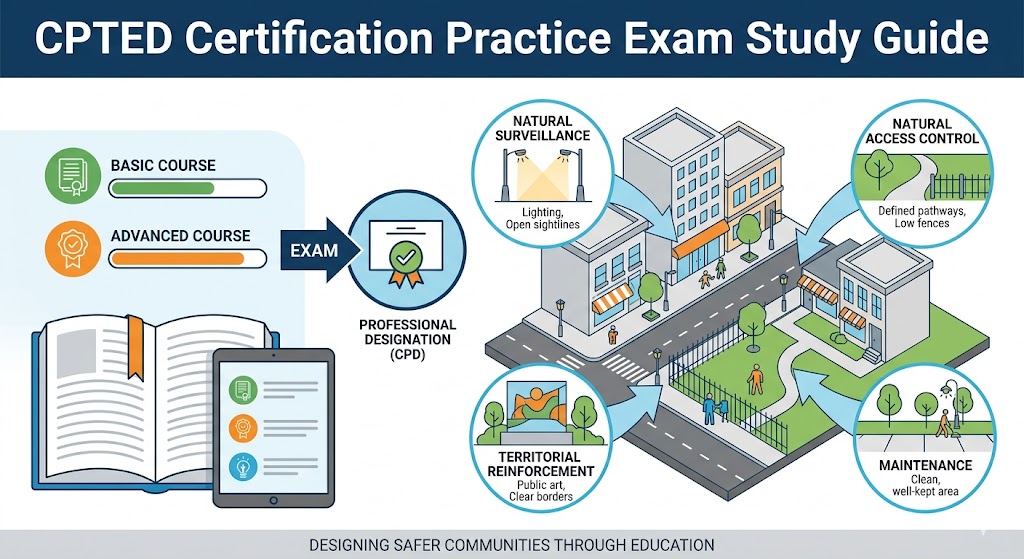
Additional Information
What the Course Entails and Exam Details
To earn the full CPTED Professional Designation (CPD), you must typically complete a series of comprehensive training hours, divided into Basic and Advanced levels. The curriculum is a dynamic blend of theory and practical application. Core areas covered in the practice exam and the certification courses include:
The 3-D Concept: Understanding Designation, Definition, and Design.
Core CPTED Principles: Natural Surveillance, Natural Access Control, Territorial Reinforcement, and Maintenance.
Built Environment Analysis: Lighting concepts, landscaping strategies for safety, fencing, barriers, and wayfinding.
Planning and Zoning: Integrating CPTED into land use, site plan reviews, and community development.
Social Environment: Problem-solving strategies, behavioral management, and participatory design.
Practical Skills: Conducting CPTED field assessments, writing reports, and delivering professional presentations.
The exam serves as the final step in validating that you have absorbed this multi-faceted knowledge and can apply it to real-world scenarios.
What to Expect in the Final Exam
While "practice exam" implies a self-assessment tool, the actual CPTED final examination is the culminating component of the official certification courses, such as those provided by the NICP (National Institute of Crime Prevention). The journey to the professional designation usually involves two primary exams.
For the Basic CPTED Course (40 hours), you must expect:
Format: A final exam comprising approximately 50 multiple-choice or true/false questions.
Assessment Mix: The exam score is often combined with grades from specific hands-on application activities, such as a field assessment.
Passing Score: You typically need a minimum score of 80% on the final exam to pass the course.
The Advanced CPTED Course (24 hours) also concludes with its own graded exam, which is the final requirement for earning the CPD certification. These exams are rigorous but reflect the practical, observational nature of the coursework.
How to Study and Exam Centers
Preparation for the CPTED practice exam and the final certification requires more than just reading a book. Here are actionable study strategies:
Engage in the Training: Because the exam is tied directly to the authorized courses, attending and actively participating in the full training hours is essential.
Master the Field Assessment: The practical assessment is a significant part of the learning. Dedicate time to understanding how to conduct a CPTED site visit, interview stakeholders, analyze crime data, and create a strong presentation of recommendations.
Utilize Course Materials and Quizzes: Thoroughly review the provided course manuals, presentations, and audio-visual materials. Leverage any inter-module quizzes to test your understanding of each topic.
Use Practice Flashcards: Create or utilize existing flashcard sets that focus on defining CPTED vocabulary, key strategies, the 3-D concept, and lighting/landscaping metrics.
Exam Centers and How to Take the Test:
You do not take a CPTED exam at a generic center like Pearson VUE. The exam is administered directly through authorized training providers such as the NICP or specialized entities like the Crime Prevention Center (for Law Enforcement LE-CPTED). When you register for the course, you will receive information on how to access the exam:
For Online Courses: The final exam is taken securely through the training provider’s online educational portal.
For In-Person Courses: The final exam is typically proctored on-site on the last day of training.
Job Opportunities from the Course
A CPTED certification unlocks diverse career paths across multiple sectors. This specialized knowledge is a highly marketable skill that enhances your resume in the following roles:
Urban and City Planner
Architect / Landscape Architect
Crime Prevention Specialist (Law Enforcement)
Police Officer (with specialized assignment)
Facility Manager (Schools, Hospitals, Government)
Security Consultant / Senior Physical Security Consultant
School Safety and Security Coordinator
Property and Real Estate Developer
Loss Prevention Specialist
Risk Manager
Frequently Asked Questions
Reviews
5.0
Based on 0 reviews
Leave a Review
No reviews yet. Be the first to review!