
Criminological Theory Exam 1 Practice
$69.00
- Buy to unlock unlimited access to all Quiz questions and Answers in this Quiz.
- After purchase you can print a PDF of the whole quiz at any point. The PDF will contain the questions and the correct answers.
About this Exam
The Criminological Theory Exam 1 is a foundational assessment designed for students and professionals entering the fields of criminal justice, sociology, or legal studies. This exam, and the practice version we are discussing, serves as the critical first step in understanding why crime occurs from a variety of perspectives. It evaluates your comprehension of major schools of thought, the historical development of criminological thought, and the fundamental frameworks that have shaped modern understandings of criminal behavior and societal responses. Whether you are an undergraduate student or a career changer, achieving a strong score on this practice exam is a key indicator of your readiness for advanced coursework and professional application.
Ready to test your knowledge?
Buy Now to Access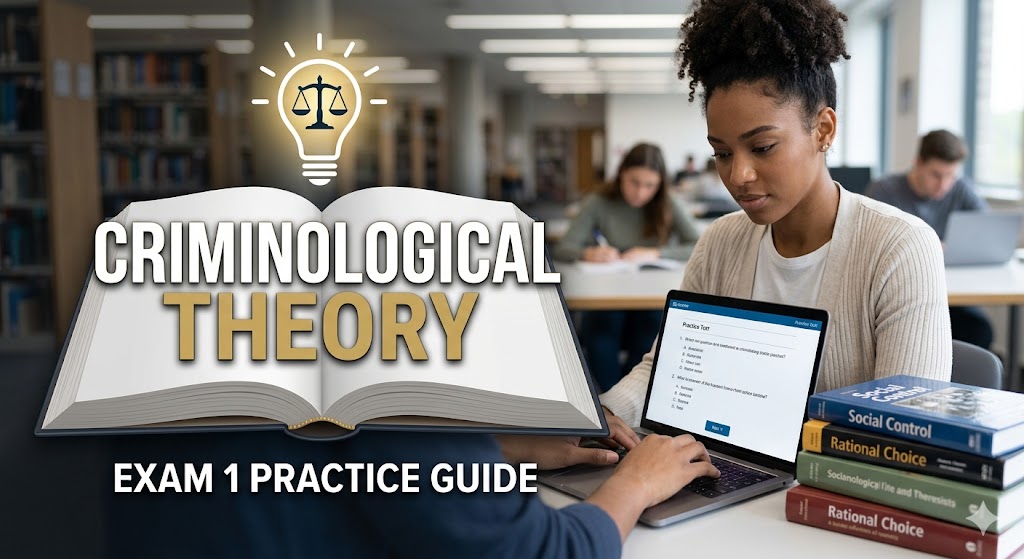
Additional Information
What the Course Entails and Exam Details
The Criminological Theory course provides a systematic overview of the major explanations for criminal behavior. It delves into the evolution of criminological thought, from early philosophical concepts to contemporary empirical theories. This practice exam is specifically structured to mirror the core topics and question styles of the actual Criminological Theory Exam 1.
The core syllabus topics you must master include:
Understanding "Theory": The definitions, components, and evaluation of theoretical frameworks in criminology.
Early Explanations of Crime: Pre-classical views, including spiritual and demonic explanations, and their influence.
The Classical School: Beccaria and Bentham’s rational choice, deterrence, and concepts of free will and utilitarianism.
The Positivist School: The emergence of scientific approaches, including biological, psychological, and social determinism.
Sociological Theories of Crime (Part 1): Early sociological perspectives, such as social disorganization, anomie, and strain theories.
Comparison and Contrast: The ability to analyze and differentiate between competing theoretical viewpoints.
Measurement of Crime: How theories are tested using crime data and research methodologies.
What to Expect in the Final Exam
This practice exam is a simulation, designed to give you a realistic experience of the final test environment. For a standard university or certification level Criminological Theory Exam 1, you can generally expect the following format and parameters. (Please note that the specific platform or institution may introduce slight variations).
Format: The exam predominantly uses Multiple Choice questions to efficiently test broad content knowledge. You may also encounter True/False questions. In some comprehensive settings, a small section of short answer or application-based scenario questions might be included.
Time Limit: A typical course exam is often scheduled for 60 to 90 minutes. It is vital to manage your time effectively, allocating about one minute per multiple-choice question.
Passing Score Requirements: While a 'pass' varies by institution, a strong score is generally above 70%. Achieving a higher score, such as 80-90% on this practice exam, indicates a solid understanding of the material.
Rules: The exam is usually closed-book, timed, and requires single-session completion, emphasizing the need for thorough preparation beforehand.
How to Study and Exam Centers
Effective preparation for this theory-heavy exam requires active engagement with the material, not just passive reading. Implement these actionable strategies to build deep understanding and test-taking confidence:
Actionable Study Strategies:
Create Concept Maps: Criminological theories can be interconnected. Draw large maps connecting different schools of thought, key theorists, central concepts, and primary criticisms.
Practice with Flashcards: Use digital or physical flashcards for definitions, names of key figures (e.g., Cesare Beccaria, Émile Durkheim), and the main tenets of each theory. This is excellent for active recall.
Compare and Contrast Theories: Instead of just memorizing, write out comparisons. For example, explain how the Classical and Positivist schools differ in their view of human nature and free will.
Apply Theories to Real-World Scenarios: Practice applying a theory to explain a specific crime. How would Rational Choice theory explain a dynamic car theft? What about Strain theory? This deepens your practical understanding.
Take Multiple Practice Tests: Utilitize the Criminological Theory Exam 1 Practice as a serious diagnostic tool. Retake it to measure progress, focusing heavily on reviewing the explanations for incorrect answers to fill knowledge gaps.
Exam Centers:
For most students, the Criminological Theory Exam 1 is administered directly through their academic institution, either within an online Learning Management System (LMS) like Canvas, Blackboard, or Brightspace, or in a physical classroom or proctored testing center on campus. If it is part of a specific external certification, it may be hosted on a dedicated online portal or through authorized testing centers like Pearson VUE, depending on the program's requirements. Always confirm the exact location and platform specifications provided by your course syllabus or test administrator.
Job Opportunities from the Course
A strong foundation in criminological theory is not just an academic requirement; it is a critical skill set valued across the criminal justice spectrum. Completing a Criminological Theory course, and demonstrating proficiency through exams like this one, opens doors to a diverse range of impactful careers. Mastery of these theories enables you to understand criminal motivations and predict trends, making you a more effective and insightful professional in these fields.
Your studies in Criminological Theory unlock opportunities for specific job titles and career paths, including:
Police Officer or Detective: Understanding the "why" behind criminal activity improves investigative effectiveness and community interaction.
Probation or Parole Officer: Applying social control and social learning theories to support rehabilitation and reduce recidivism.
Juvenile Justice Worker: Understanding strain, labeling, and development theories to effectively support and redirect at-risk youth.
Crime Analyst: Using theory and data to identify crime patterns and inform proactive policing strategies.
Policy Analyst: Advising governmental or non-profit organizations on the design and effectiveness of criminal justice programs and policies.
Correctional Officer / Counselor: Creating a safer and more rehabilitative environment by applying understanding of inmate behavior.
Victim Advocate: Understanding the social and psychological impacts on victims through a criminological lens.
Researcher / Academic: Conducting empirical studies to test, refine, or develop criminological theories within a university or think tank environment.
Criminal Profiler: (Advanced path) Using deep theoretical knowledge to construct psychological and behavioral profiles of unknown offenders.
Frequently Asked Questions
Reviews
5.0
Based on 0 reviews
Leave a Review
No reviews yet. Be the first to review!