
CRINQ Descriptive, Inferential, Clinical Statistics Practice Test
$69.00
- Buy to unlock unlimited access to all Quiz questions and Answers in this Quiz.
- After purchase you can print a PDF of the whole quiz at any point. The PDF will contain the questions and the correct answers.
About this Exam
The CRINQ Descriptive, Inferential, Clinical Statistics
Practice Test is a comprehensive assessment designed to validate a candidate’s
mastery of fundamental and applied statistical methods within the specialized
domain of clinical research.
This examination is tailored for professionals seeking to
advance their careers in the pharmaceutical, biotechnology, and medical device
industries. It is highly suitable for Clinical Research Coordinators (CRCs),
Clinical Data Managers, aspiring Biostatisticians, and research scientists who
need to demonstrate their competence in handling complex human trial data.
Ready to test your knowledge?
Buy Now to Access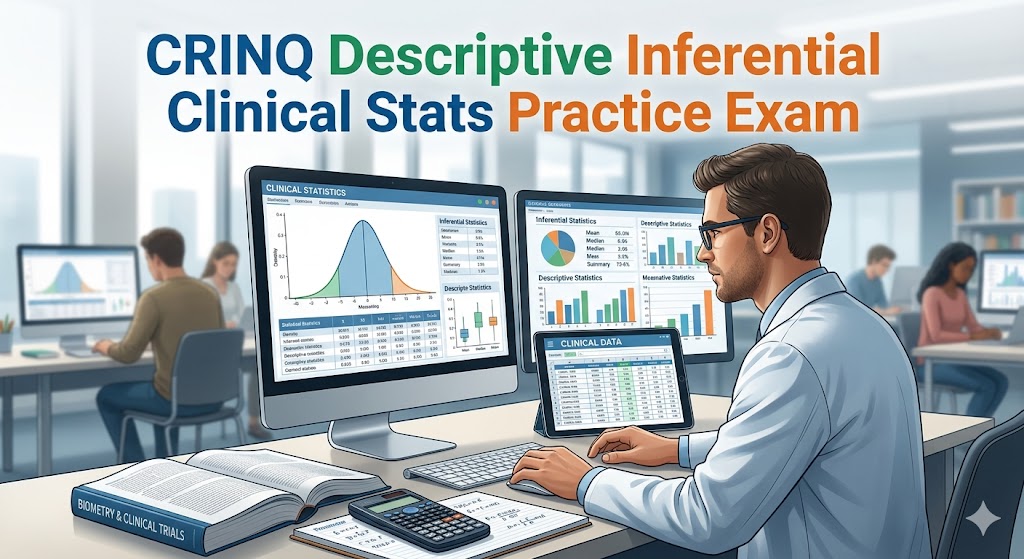
Additional Information
What the Course
Entails and Exam Details
This examination does not represent a beginner-level
introduction; rather, it is a demanding assessment that requires prior
knowledge of mathematical concepts and data handling.
The curriculum and assessment structure are built upon three
main pillars of statistical fluency. You must master each area to succeed:
- Descriptive
Statistics: You must be able to efficiently summarize and organize
clinical data sets. Key skills include calculating and interpreting
measures of central tendency (mean, median, mode) and measures of
dispersion (range, standard deviation, variance).
- Inferential
Statistics: This domain tests your ability to make predictions and
draw conclusions about a larger population based on a sample dataset. You
will be tested on probability theory, hypothesis testing (understanding
p-values and alpha levels), confidence intervals, and various statistical
tests such as t-tests, ANOVA, and regression models.
- Clinical
Statistics Application: The core of the exam applies these methods to
the clinical environment. You must understand study design (randomized
controlled trials, cohort studies), survival analysis (Kaplan-Meier
curves), risk assessment (odds ratios, relative risk), and safety reporting
statistics.
What to Expect in
the Final Exam
While specific formatting might vary slightly depending on
the administrator of your program, the standard final exam is a rigorously
proctored, computer-based assessment. Candidates should prepare for a focus on
practical application rather than rote memorization.
You can expect to encounter between 60 and 90
multiple-choice questions. A significant number of these will be
scenario-based. For example, you may be presented with a snippet of a clinical
trial report and asked to identify the most appropriate statistical test to
analyze the results.
The time limit for the examination is typically two to three
hours. This means managing your time efficiently is vital for success. The
required passing score usually ranges between 70% and 80%, reflecting the high
level of accuracy expected of health data professionals. A calculator is
typically permitted and is often essential for solving the application-based
scenarios.
How to Study and
Exam Centers
Preparation for this exam requires a proactive and practical
approach to learning. We highly recommend that you focus your studying efforts
on active problem-solving rather than passive reading.
First, identify your weakest domains by reviewing standard
textbooks on biostatistics and clinical trial methodologies. Practice
calculating statistical metrics by hand first, and then move on to performing
these operations using standard software such as R, SAS, or Python. Being
comfortable with statistical output tables is a key requirement of the exam.
The most effective way to prepare is to take multiple full-length practice
exams to build your stamina and time-management skills.
Regarding exam delivery, these tests are generally
administered through secure online learning management systems provided by the
authorizing educational institution. If you are completing this as part of a
formal, university-based clinical research certificate, the exam may be
proctored in a dedicated physical testing center on campus. For remote
candidates, online proctoring services are frequently used to ensure the
integrity of the examination.
5. Job Opportunities from the Course
A strong score on this practice exam, leading to the
completion of your official clinical statistics certification, signals to
employers that you possess the analytical rigor required to work with sensitive
human trial data. This expertise is a significant differentiator in the
competitive clinical research field.
Mastering descriptive, inferential, and clinical statistics
unlocks several key career paths, including:
- Biostatistician
I
- Clinical
Research Coordinator
- Clinical
Data Analyst
- Epidemiologist
- Pharmaceutical
Market Analyst
- Medical
Writer (with statistical focus)
- Clinical
Trial Manager
- Healthcare
Data Scientist
- Regulatory
Affairs Specialist
Frequently Asked Questions
Reviews
5.0
Based on 0 reviews
Leave a Review
No reviews yet. Be the first to review!