
Crisis Prevention Intervention (CPI) Practice Test
$69.00
- Buy to unlock unlimited access to all Quiz questions and Answers in this Quiz.
- After purchase you can print a PDF of the whole quiz at any point. The PDF will contain the questions and the correct answers.
About this Exam
The Crisis Prevention Intervention (CPI) certification, often called Nonviolent Crisis Intervention training, is a vital credential for professionals in high-stress, people-oriented fields. It is designed to equip individuals with the skills and confidence to safely defuse, de-escalate, and manage difficult situations and disruptive behaviors. The core philosophy of CPI is to promote the Care, Welfare, Safety, and Security℠ of everyone involved, utilizing non-physical techniques as the first and most preferred line of response. This training is ideal for individuals working in healthcare, education, behavioral health, corporate security, social work, and hospitality, where early intervention can prevent a situation from becoming a full-blown crisis.
Ready to test your knowledge?
Buy Now to Access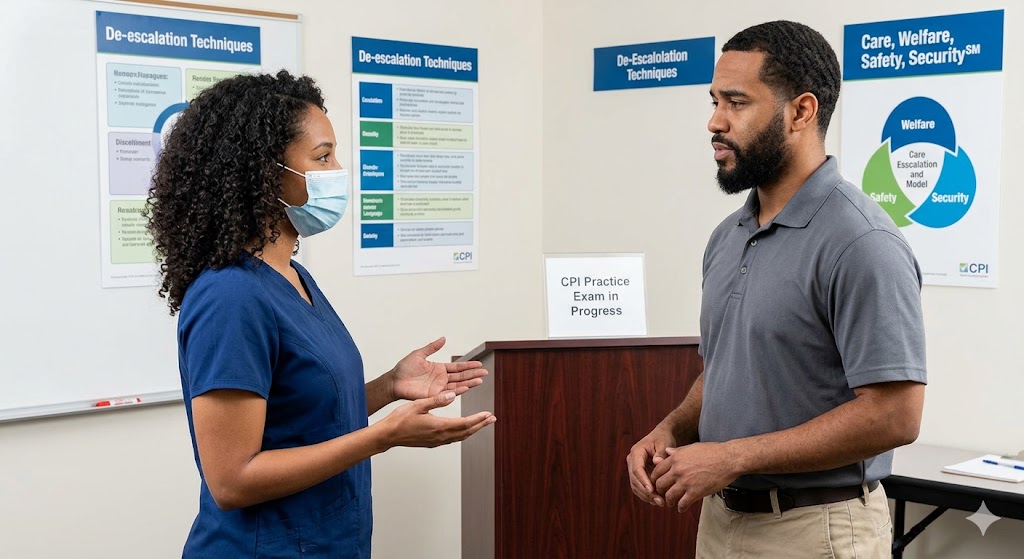
Additional Information
What the Course Entails and Exam Details
The CPI course and subsequent exam cover a comprehensive spectrum of crisis management skills, organized into structured learning modules. Participants are trained in recognizing the early warning signs of escalating behavior and understanding how to tailor their response to the specific level of a person's behavior. Key modules often include:
The CPI Coping Model℠: A framework for guiding individuals through the post-crisis phase, ensuring both staff and service users are safe and supported.
Verbal De-escalation Skills: Mastering communication techniques, active listening, and setting limits to calm an individual.
Assessing Risk: Learning to differentiate between low-, medium-, and high-risk behaviors and responding appropriately.
Disengagement Skills: Practical techniques for staff to safely extricate themselves from physical physical confrontations.
Holding Skills (Optional): While non-physical techniques are primary, some courses include a module on safe, non-restrictive holding as a last resort, emphasizing ethical considerations and dignity.
The final examination validates your understanding and practical application of these core principles. It assesses your ability to think critically, apply the correct intervention hierarchy, and always prioritize the safety of all parties.
What to Expect in the Final Exam
The CPI final exam is a multi-modal assessment that ensures a deep, operational understanding of the course content. It typically consists of a combination of the following:
Theory Assessment
The foundational component of the exam is a written test that evaluates your knowledge of the core concepts, definitions, and models taught. This part is generally comprised of multiple-choice questions, true/false statements, and short-answer responses. Questions focus on the hierarchy of de-escalation, identifying signs of anxiety, and understanding the ethical guidelines surrounding any form of physical intervention.
Scenario-Based Practical
This is often considered the most critical part of the CPI exam. You will be placed in role-playing scenarios with an instructor or other participants, requiring you to apply the de-escalation techniques learned in real-time. Evaluators look for your ability to remain calm, use non-threatening body language, communicate effectively, and adapt your approach to the individual's changing behavior. They will also assess your understanding of safety protocols and post-crisis care. You will be evaluated based on a checklist of performance indicators to ensure mastery of the required skills.
Passing Score and Time Limits
The specific passing requirements and time limits can vary slightly depending on the training format (e.g., standard CPI, advanced, online, or in-person) and the specific version of the curriculum being used. However, a general benchmark for passing the theory assessment is often set between 80% and 85%. The practical component is a pass/fail assessment based on your demonstrated ability to perform the de-escalation skills safely and effectively. You should receive a full breakdown of these details at the start of your training program.
How to Study and Exam Centers
Preparation for the CPI exam requires a dual focus on theory and practice. Here are a few actionable strategies to help you succeed:
Study Strategies
Thoroughly Review Study Materials: Don't just read; engage with the content. Mark key models, definitions, and the specific levels of behavior and corresponding responses.
Practice Verbal De-escalation: With a colleague, family member, or friend, practice role-playing different crisis levels. Work on keeping your voice calm, using simple language, and active listening.
Utilize a CPI Practice Test: Finding a realistic practice test can be a game-changer. It helps you get used to the question types, identify your weak points, and build confidence.
Focus on the Core Principles: Always bring your practice back to the foundation: Care, Welfare, Safety, and Security℠. If you're unsure of an answer, prioritize the response that is least intrusive and most respectful.
Exam Centers
The physical location and format for your CPI exam are determined by the entity administering the training.
On-Site Training: If your employer organizes the training, the entire process, including the final assessments, will often take place at your workplace or a designated training facility.
Public Workshops: For those who register for public workshops, the training and exams are held at physical venues, such as conference centers or educational institutions, overseen by a certified CPI instructor.
Online Portals and Remote Proctoring: CPI offers an online-only or blended learning format. In these cases, the theoretical portion of the exam is completed via a secure online testing portal, sometimes using remote proctoring software to ensure academic integrity.
Always check the details provided by your specific training provider to confirm your assigned test center or the method for online examination.
Job Opportunities from the Course
A CPI certification is a highly sought-after qualification and frequently a prerequisite for numerous roles that involve direct public contact or work with vulnerable populations. Here are specific career paths where this credential holds significant value:
Healthcare Professionals: Including registered nurses, certified nursing assistants, patient care technicians, mental health technicians, and emergency room staff.
Education and School Staff: Spanning teachers, paraprofessionals, school counselors, administrators, and campus security officers.
Behavioral Health and Social Services: Including social workers, case managers, community support workers, and direct support professionals (DSPs) in residential facilities.
Public Safety and Security: Specific job titles include security guards, loss prevention officers, campus police, and law enforcement personnel focusing on de-escalation.
Corporate and Retail Environments: Including human resource professionals, customer service managers, and personnel in retail loss prevention or hospitality security.
Aviation and Transportation: Flight attendants, gate agents, and transit personnel benefit significantly from this training.
Frequently Asked Questions
Reviews
5.0
Based on 0 reviews
Leave a Review
No reviews yet. Be the first to review!