
Critical Care Paramedic Practice Exam
$69.00
- Buy to unlock unlimited access to all Quiz questions and Answers in this Quiz.
- After purchase you can print a PDF of the whole quiz at any point. The PDF will contain the questions and the correct answers.
About this Exam
The Certified Critical Care Paramedic (CCP-C) exam, administered by the International Board of Specialty Certification (IBSC), is a specialized certification designed for experienced paramedics who provide critical care in pre-hospital, inter-hospital, and hospital environments.
It measures a mastery of advanced concepts, targeting individuals ready to excel in the demanding field of critical care transport. This certification is a hallmark of professional distinction, proving a paramedic possesses the advanced knowledge required to manage the most complex patient cases while in transit.
It is for paramedics who want to validate their specialized skillset and advance their careers into critical care, often in flight or specialized ground transport roles.
Ready to test your knowledge?
Buy Now to Access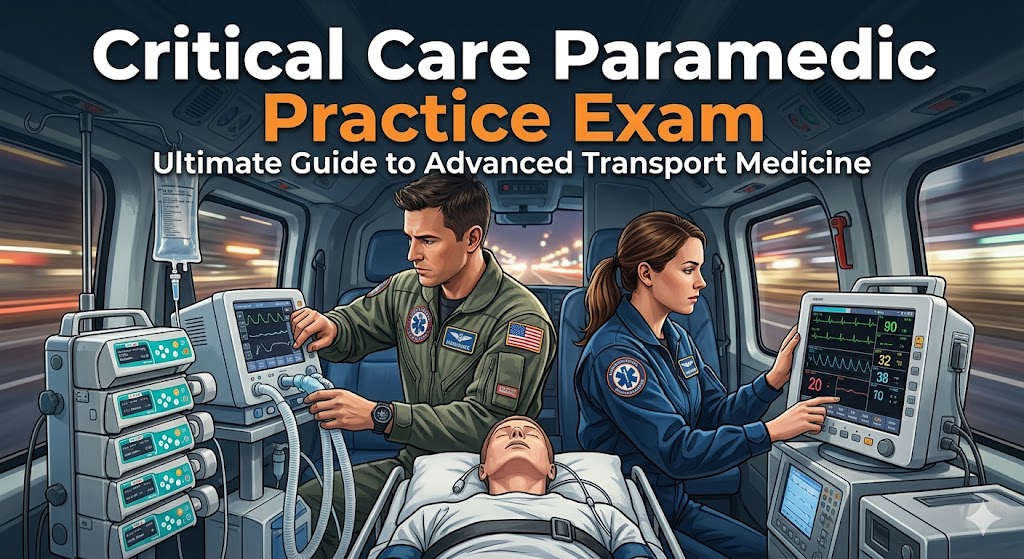
Additional Information
What the Course Entails and Exam Details
Preparing for the Critical Care Paramedic exam means mastering a broad spectrum of advanced medical and operational topics.
The examination content is derived from a role-delineation study, ensuring it reflects the real-world demands of critical care transport. Core syllabus areas include, but are not limited to: advanced airway management (including surgical and mechanical ventilation techniques), detailed cardiopulmonary assessment and treatment, hemodynamics and invasive monitoring, comprehensive neurological, renal, and endocrine emergencies, multi-system trauma, burns, toxicological exposures, environmental injuries, and specialized considerations for perinatal and pediatric patients.
Additionally, candidates are tested on transport fundamentals, such as flight physiology, safety protocols, and operational issues inherent to a high-acuity mobile environment.
What to Expect in the Final Exam
The final CCP-C exam is a comprehensive, timed, cognitive assessment.
The exam currently consists of 135 multiple-choice questions. Of these, 110 are scored, and 25 are unscored pilot items used for statistical purposes and distributed throughout the test. Candidates are provided with a 2.5-hour time limit to complete the examination. The testing is focus on application and analysis of clinical situations, not just simple recall of facts.
There is no practical skills component to this exam; it is entirely computer-based or taken in a written format. To receive certification, candidates must meet or exceed the pass standard set by the IBSC’s subject matter expert committee. The passing standard is content-based, determined using standard-setting techniques, and is not based on a set percentage of test-takers who pass or fail.
How to Study and Exam Centers
Effective preparation for this advanced certification requires a dedicated and systematic approach.
Begin by obtaining the official Candidate Handbook from the IBSC website, which provides the current detailed content outline. Candidates should utilize recommended comprehensive textbooks focused on critical care and transport medicine. Implementing a rigorous study schedule that includes a variety of practice methods—such as reviewing rationale for practice questions, forming study groups with fellow advanced providers, and enrolling in specialized critical care review courses—is highly recommended. Focus on weak areas identified during self-assessment.
The CCP-C exam is offered globally at numerous locations. Candidates can choose between a computer-based testing (CBT) format administered through an authorized testing partner, such as Prometric, or a traditional paper-and-pencil format offered at host sites. Registration and scheduling for both formats are managed directly through the IBSC website, allowing candidates to select the most convenient location and time.
Job Opportunities from the Course
Acing the CCP-C exam and earning this prestigious certification significantly expands a paramedic’s professional scope and career path, unlocking high-demand roles in specialized care.
Upon successful certification, new opportunities include, but are not limited to:
Critical Care Transport (CCT) Paramedic (Ground)
Flight Paramedic (Heli-medical and Fixed-wing)
Specialized Critical Care Transport (e.g., Neonatal/Pediatric)
Hospital-based Critical Care Paramedic in specialized units
EMS Educator or specialized instructor in critical care topics
Clinical Coordinator for transport programs
Frequently Asked Questions
Reviews
5.0
Based on 0 reviews
Leave a Review
No reviews yet. Be the first to review!