
Critical Care Registered Nurse (CCRN) Practice Exam
$69.00
- Buy to unlock unlimited access to all Quiz questions and Answers in this Quiz.
- After purchase you can print a PDF of the whole quiz at any point. The PDF will contain the questions and the correct answers.
About this Exam
The Critical Care Registered Nurse (CCRN) certification, offered by the American Association of Critical-Care Nurses (AACN), is a crucial step for registered nurses validating their expertise in providing care to critically ill patients. This is not just a test; it is a validation of the clinical hours and specialized knowledge you have already accrued in demanding, high-acuity environments. Designed for nurses who work primarily in settings such as adult intensive care units, trauma centers, coronary care units, and emergency departments, the CCRN designation signals a mastery of complex body systems, a dedication to professional ethics, and a commitment to patient-centered care. For dedicated professionals looking to elevate their career, this certification provides the professional recognition, career advancement, and personal satisfaction that come with being a validated critical care specialist.
Ready to test your knowledge?
Buy Now to Access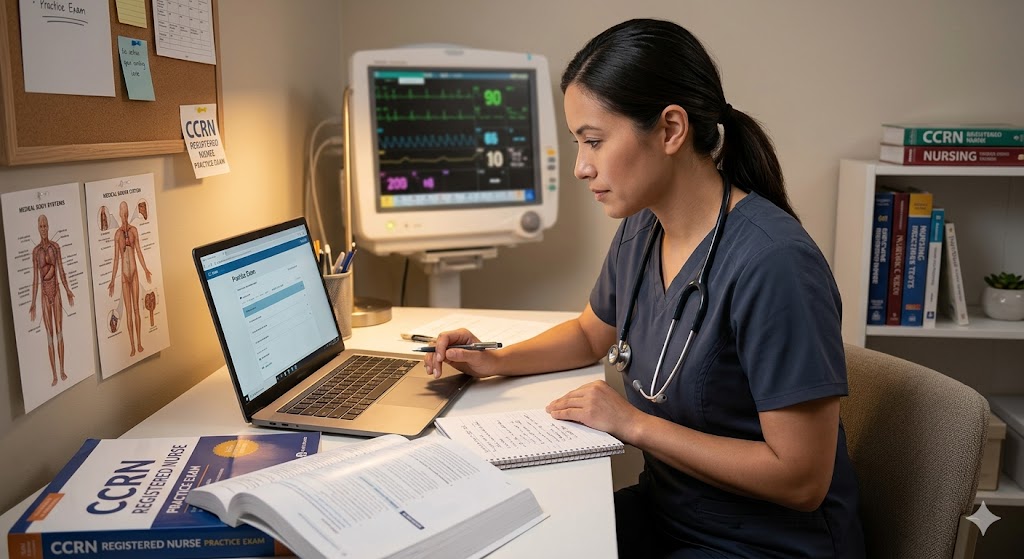
Additional Information
What the Course Entails and Exam Details
While there isn’t a single mandatory "CCRN Course" you must take, your existing direct care experience serves as the foundational "curriculum." The exam is designed to assess the knowledge gained through clinical practice and supplementary study. The overall content is based on the AACN Synergy Model for Patient Care, with a significant emphasis on two key areas:
Clinical Judgment (Approximately 80% of the Exam)
This dominant section tests your ability to make sound clinical decisions regarding diverse body systems. Expect rigorous multiple-choice questions covering:
Cardiovascular: Acute coronary syndrome, heart failure, complex dysrhythmias, and postoperative cardiac care. This is typically the single largest section.
Respiratory: Acute respiratory failure, ARDS, COPD, asthma, and the management of ventilator support.
Neurological: Traumatic brain injury, stroke, seizures, and neurological emergencies.
Gastrointestinal, Renal, and Multisystem: Complex conditions like sepsis, shock, renal failure, and pancreatitis, often involving multiple organ systems.
Endocrine and Hematology: Diabetes emergencies, fluid and electrolyte imbalances, and blood-related disorders.
Professional Caring and Ethical Practice (Approximately 20% of the Exam)
Crucial to compassionate care, this section focuses on non-clinical but equally vital competencies:
Advocacy and Moral Agency: Ethical decision-making and acting in the patient’s best interest.
Caring Practices and Response to Diversity: Delivering culturally competent care and supporting diverse patient populations.
Collaboration, Facilitation of Learning, and Systems Thinking: Your role in the broader healthcare system and education.
Clinical Inquiry: The use of research and evidence to improve patient outcomes.
What to Expect in the Final Exam
The actual CCRN exam is a rigorous, computer-based test consisting typically of 150 multiple-choice questions. Of these 150 items, approximately 125 questions are scored, while the remaining questions are pretest items that help validate future exams and do not count towards your score. You are given a precise time limit of 3 hours to complete the entire test. Passing is determined by a scaled score, with a specific cut score set based on a comprehensive validation process. A scaled passing score is standard across versions, though exact raw scores needed may vary. Candidates should always consult the official AACN CCRN Exam Handbook for the most current specifics on the passing range.
The exam can be administered either in-person at a dedicated computer-based testing center, often with providers like PSI, or through an approved live remote proctoring option. Both methods enforce strict security measures. You should expect standard rules such as showing valid government-issued photo identification, storing personal items securely outside the testing area, and adhering to strict anti-cheating protocols. An optional, brief practice test is often provided at the beginning of the exam session to allow you to familiarize yourself with the testing interface.
How to Study and Exam Centers
Effective preparation is key to succeeding on the CCRN exam.
Strategic Study Methods
Utilize Practice Exams: This is often cited as the single most effective study method. Take numerous practice exams under timed conditions, using reputable sources like official AACN practice questions and high-quality study guide practice sections.
Analyze Your Results: After taking a practice test, scrutinize both correct and incorrect answers. Understand why each answer choice is correct or incorrect, focusing heavily on your weaker content areas and the rationale provided.
Consult Official Resources: Review the official AACN CCRN Test Plan, the current AACN Exam Handbook, and foundational critical care textbooks. These resources are the gold standard for understanding what could be tested.
Join Study Groups or Review Courses: Many hospitals, professional organizations, and educational companies offer intensive review courses specifically for the CCRN. These can provide structured learning and valuable peer support.
Be Consistent: Dedicate regular study blocks each week in the months leading up to your exam, rather than attempting to cram. Consistency is paramount for long-term knowledge retention.
Accessing Exam Centers
To take the exam, you must first register and schedule through the official AACN website. Once approved, you will have two primary testing options:
Physical Testing Centers: The CCRN exam is delivered by specific computer-based testing providers, currently with common partnerships including PSI. During scheduling, you will be able to select from a large network of authorized testing locations across the country, often found in major cities and smaller areas alike. These professional, secure environments provide the required computer and proctoring.
Live Remote Proctoring: A convenient alternative, live remote proctoring allows you to take the exam from a quiet, secure space in your own home, while being continuously monitored by an online proctor. This requires specific technology and strict adherence to environmental rules.
Detailed information, links to center locators, and scheduling information are all centrally located on the official AACN certification pages.
Job Opportunities from the Course
Earning your CCRN certification unlocks numerous paths for professional and financial advancement within the high-demand field of critical care. This designation serves as a strong differentiator, validating your expertise and dedication to the highest standards of nursing.
The valuable job titles and career paths this certification unlocks include:
Critical Care Registered Nurse (CCRN)
Flight Nurse / Transport Nurse
Cardiac Care Unit (CCU) Nurse / CVICU Nurse
Trauma / Emergency Department Critical Care Specialist
Clinical Educator / Clinical Nurse Specialist (CNS)
Unit Manager / Clinical Leadership Roles
Nurse Educator (Academic)
Quality Improvement or Clinical Outcomes Coordinator
Frequently Asked Questions
Reviews
5.0
Based on 0 reviews
Leave a Review
No reviews yet. Be the first to review!