
Cross Connection Practice Exam
$69.00
- Buy to unlock unlimited access to all Quiz questions and Answers in this Quiz.
- After purchase you can print a PDF of the whole quiz at any point. The PDF will contain the questions and the correct answers.
About this Exam
The Cross Connection Certification and its associated exam are designed for professionals who work with potable water systems, including plumbers, water utility operators, building inspectors, and health department sanitarians.
Achieving this certification demonstrates a critical understanding of the complex relationship between safe drinking water and potential contamination points, known as cross connections. These are locations where non-potable substances could inadvertently be introduced into the water supply due to backflow. This certification ensures that you possess the knowledge and practical skills necessary to identify potential cross-connection hazards, understand the application of various backflow prevention devices, and effectively test and maintain these essential safety assemblies, ultimately playing a vital role in protecting public health.
Ready to test your knowledge?
Buy Now to Access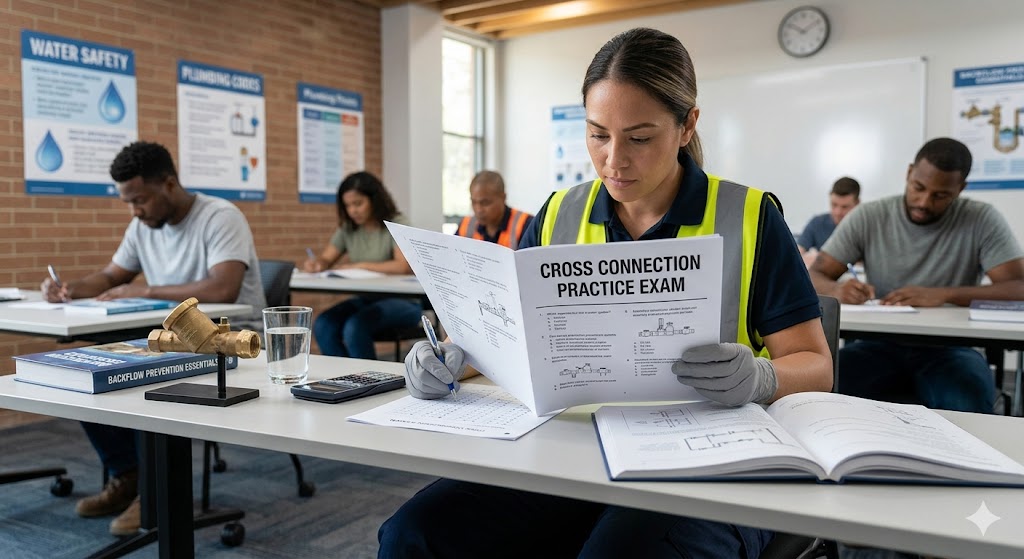
Additional Information
What the Course Entails and Exam Details
A proper course preparing students for the Cross Connection Exam typically covers a range of essential topics, combining theoretical knowledge with practical skills demonstration. These courses are often offered by authorized training providers, community colleges, or municipal water districts. The training focuses on:
Principles of Backflow and Backsiphonage: Understanding the hydraulics of water systems and how pressure changes can cause reverse flow.
Cross Connection Control Programs: Learning about the regulatory requirements and implementation of programs to manage and eliminate cross-connections.
Backflow Prevention Assemblies: In-depth knowledge of different assembly types, including their components, operation, and appropriate applications for various hazard levels. This includes Reduced Pressure Zone (RPZ) assemblies, Double Check Valve assemblies, Pressure Vacuum Breaker assemblies, and Atmospheric Vacuum Breakers.
Installation Requirements and Codes: Understanding local, state, and national plumbing codes and standards (such as ASSE, UPC) governing the installation and positioning of backflow preventers.
Testing Procedures and Reporting: Mastery of the specific steps and equipment required to field test various types of backflow prevention assemblies to ensure they are functioning correctly, including proper documentation and reporting.
Hydraulics Basics: Foundational concepts relevant to understanding water flow and pressure dynamics.
Regulatory Framework: Familiarization with environmental protection acts, safe drinking water acts, and other relevant laws.
The final examination is a crucial part of the certification process, designed to comprehensively assess your grasp of all these key areas.
What to Expect in the Final Exam
While specific exam formats can vary slightly depending on the certifying authority, the final exam for Cross Connection Control generally features two primary components:
Rigorous Written Section:
Format: The core of the written exam is a detailed multiple-choice section.
Questions: You can expect a significant number of well-crafted multiple-choice questions designed to test your understanding of theory, terminology, codes, assembly functions, hazard assessment, and testing protocols. These questions can range from theoretical concepts to practical application scenarios.
Time Limit: There is typically a strict time limit (often 2-4 hours) enforced to answer all questions.
Passing Score: The passing score is often set relatively high, commonly around 70% to 80% to ensure sufficient mastery of critical safety knowledge.
Practical Skills Demonstration (Common for Tester Certification):
Hands-on Testing: For certifications focusing on becoming a certified backflow assembly tester, you will also be required to perform hands-on testing.
Assemblies: You will be given access to multiple types of functional or simulated backflow prevention assemblies (e.g., RPZ, Double Check, PVB).
Testing and Reporting: A proctor or examiner will observe you as you correctly perform the specific field testing procedures for each assembly, using actual testing equipment. You must demonstrate accuracy in:
Following the correct testing steps in the proper order.
Using and interpreting the test gauge readings.
Accurately completing the test report forms and identifying any assembly failures.
Safety Protocols: Demonstrating proper safety procedures throughout the practical test is essential.
Minimum Proficiency: A separate practical score or pass/fail evaluation is typically required, demonstrating your competency in the actual application of testing procedures.
It is absolutely vital to review the specific exam guidelines and procedures provided by your training program or certifying body well in advance of test day to ensure you understand the exact format, rules, and passing criteria.
How to Study and Exam Centers
Preparation is the absolute key to success on the Cross Connection Exam. Effective study strategies incorporate various methods:
Utilize Course Materials Thoroughly: Review your course textbook, instructors’ notes, and all handouts. Pay close attention to definitions, diagrams of backflow conditions and preventers, and detailed testing procedures.
Understand, Don't Just Memorize: Focus on deeply understanding why backflow occurs and how different preventers work to stop it, rather than just memorizing facts. This will help you answer application-based and scenario-driven questions more effectively.
Take the Cross Connection Practice Exam Repeatedly: The most valuable tool in your study arsenal is this Cross Connection Practice Exam. Take it multiple times under timed conditions. Use it to:
Familiarize yourself with the style and difficulty of questions you can expect.
Identify your weak areas, focusing your subsequent study efforts on those topics.
Develop effective test-taking strategies and time management.
Build confidence through exposure to similar content.
Create Flashcards: Use flashcards for key terms, types of backflow conditions, assembly components, installation requirements, and specific testing steps.
Practice Practical Skills: If your certification involves a practical component, get as much hands-on practice as possible with the actual testing of backflow assemblies. Find opportunities to use testing equipment and practice on different types of valves, either in your course, at work, or through practice setups.
Form Study Groups: Collaborating with other students can provide diverse perspectives, help you clarify complex concepts, and keep you motivated.
Review Codes and Regulations: Ensure you have a strong understanding of relevant local, state, and national plumbing codes and standards concerning cross-connection control.
Get Proper Rest and Manage Test Anxiety: Ensure you are well-rested on exam day. Practice relaxation techniques to manage potential test anxiety.
Exam Centers and Administration:
Cross Connection exams are typically administered in two common ways:
Authorized Training Providers/Schools: For students who have completed an approved training course, the written and practical exams are frequently administered by the training provider at their facility immediately following the course. This is the most common scenario for initial certification.
Designated Testing Locations/Boards: Some states or municipal plumbing boards may have specific testing dates and locations, requiring you to register with them directly and take the exam at a designated facility or through their online system. These may be dedicated proctored testing centers or state offices.
Online with Remote Proctoring: In some instances, parts or even the full written exam might be offered online using secure remote proctoring software. This is less common for the practical component.
It is critically important to verify with your specific training provider and state/local certifying authority about:
Specific exam dates, times, and locations.
Exam registration procedures and any associated fees.
The exact format of both written and (if applicable) practical portions.
What materials you need to bring (e.g., calculator, photo ID).
The validity period of any practice exams or course completions.
Job Opportunities from the Course
A Cross Connection Certification opens up diverse and valuable career paths in the critical field of water safety. The skills gained are highly sought after by various employers, including municipal water utilities, plumbing and mechanical companies, commercial property management firms, building departments, and environmental health agencies. Here is a list of job titles and career paths this certification can unlock:
Certified Backflow Prevention Assembly Tester: This is a key role for professionals who primarily test and maintain backflow preventers, often as independent contractors, employees of plumbing companies, or municipal utility workers. This special designation is a direct result of obtaining tester certification.
Cross Connection Control Specialist / Surveyor: These professionals focus on surveying properties, identifying cross-connection hazards, reviewing installation plans, and managing cross-connection control programs, often within larger utilities, municipalities, or consulting firms.
Licensed Plumber (with enhanced responsibilities and earning potential): While a plumber's license itself is separate, this certification significantly enhances a plumber’s resume, often allowing them to take on specialized backflow installation, testing, and repair projects, potentially leading to increased responsibility and compensation.
Water Distribution System Operator / Superintendent: Operators and managers of potable water systems rely heavily on robust cross-connection control. This certification provides essential knowledge for effectively managing these systems and ensuring water quality.
Building and Safety Inspector / Code Official: Inspectors for municipal building and plumbing departments must have a deep understanding of plumbing codes and cross-connection principles to enforce regulations during construction and renovations.
Environmental Health Specialist / Sanitarian: Professionals in public health agencies use cross-connection knowledge to inspect facilities for potential public health risks related to water contamination.
Cross Connection Control Program Manager: Larger cities and utilities often employ managers specifically dedicated to overseeing their entire cross-connection control programs, which involves coordination, enforcement, record-keeping, and public education.
Facility Maintenance Technician / Manager: Facilities managers of commercial buildings, hospitals, schools, and other institutions need employees with these skills to maintain their internal water systems and ensure code compliance.
Frequently Asked Questions
Reviews
5.0
Based on 0 reviews
Leave a Review
No reviews yet. Be the first to review!