
CSRC Law and Professional Ethics Practice Exam
$69.00
- Buy to unlock unlimited access to all Quiz questions and Answers in this Quiz.
- After purchase you can print a PDF of the whole quiz at any point. The PDF will contain the questions and the correct answers.
About this Exam
The Certified Shorthand Reporter (CSR) certification is a
vital credential for anyone seeking to practice as a professional court
reporter or deposition reporter. This rigorous certification process ensures
that prospective reporters possess the speed, accuracy, and essential legal
knowledge required to create a final, official record of legal proceedings.
Beyond stenographic proficiency, the CSR requirements often include a written
examination on local laws, rules, and fundamental professional ethics. The [CSRC
Law and Professional Ethics Practice Exam] is a dedicated study tool designed
specifically to help candidates prepare for this crucial cognitive portion of
the licensing process, validating their readiness to uphold the highest
standards of integrity and legal compliance in their future careers.
Ready to test your knowledge?
Buy Now to Access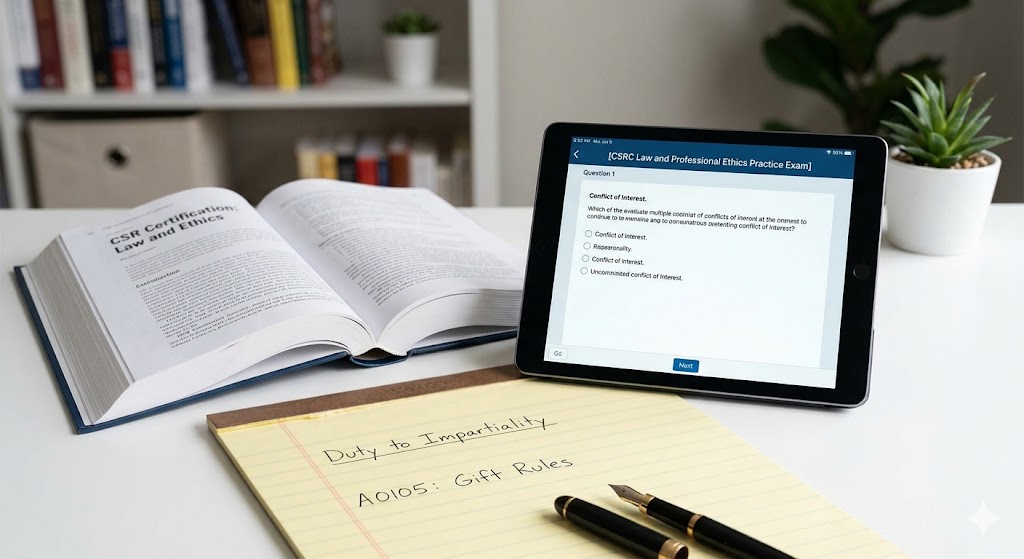
Additional Information
What the Course Entails and Exam Details
This specialized practice exam focuses entirely on the
regulatory and ethical framework governing shorthand reporting. Candidates
preparing for this portion of the CSR requirement must demonstrate a
comprehensive understanding of statutory laws relative to reporting, applicable
rules of court, and the official code of professional conduct. The course
material typical to this exam covers critical areas such as maintaining
neutrality and impartiality, understanding proper transcript preparation and
delivery guidelines, and navigating conflicts of interest.
The syllabus primarily consists of two main pillars:
first, a mastery of legal procedures related to the reporter’s role (oath
administration, marking exhibits, handling confidential information), and
second, the application of ethical decision-making to real-world scenarios,
such as gift-giving regulations, maintaining confidentiality, and preventing
the appearance of impropriety. This practice exam replicates these topics,
giving students a safe environment to test their comprehension and identify any
weak points before the final, high-stakes test.
What to Expect in the Final Exam
While exact parameters vary slightly by jurisdiction, the
final law and ethics exam required for CSR licensure is almost universally a
written, closed-book examination. The format is typically multiple choice,
consisting of around 100 questions. Candidates are often given a specific time
limit to complete the test, usually ranging from 90 to 120 minutes. A passing
score is strictly defined by the relevant state governing board (e.g., 70% or
higher).
This cognitive assessment tests not only standard
procedural knowledge but also the critical application of ethical rules.
Questions often present candidates with a complex scenario and ask them to
choose the most ethically sound course of action according to the professional
code. There are no practical components, such as machine writing, in this
specific exam; it is entirely focused on assessing the candidate’s theoretical
understanding and professional judgment.
How to Study and Exam Centers
Effective preparation for this written exam requires a
strategic approach that goes beyond simple rote memorization. Candidates must
begin by thoroughly reading the relevant state laws, professional standards,
and code of conduct manuals provided by their state’s court reporting board or
authorized regulatory agency. Once the foundational knowledge is set, actively
utilizing practice exams, such as the [CSRC Law and Professional Ethics
Practice Exam], becomes critical. Reviewing not only the correct answers but
also the detailed rationales provided for incorrect choices is essential for
mastering the nuances of legal language and ethical dilemmas.
Candidates should also participate in study groups and
utilize specialized flashcards for memorizing specific legal terms and rules.
As for the exam itself, it is usually administered through the governing
regulatory body’s designated testing partners, such as standardized
computerized testing centers like PSI, Pearson VUE, or authorized physical
testing centers at specialized shorthand reporting schools. It is crucial to
verify the specific registration procedures and testing locations outlined on
the state’s official certification website.
Job Opportunities
from the Course
Earning the Certified Shorthand Reporter license, which
hinges on passing both the stenographic and the law and ethics portions,
unlocks a satisfying and in-demand career path in the legal field. Licensed
reporters play a fundamental role in our justice system, capturing the spoken
word in real-time. Specific career paths this certification validates include:
- Official
Court Reporter: (Serving in superior, municipal, or federal courts)
- Freelance
Deposition Reporter: (Capturing testimony in lawyers' offices or remote
locations)
- Captioner:
(Providing real-time communication access for television, events, or
education for the deaf and hard-of-hearing community)
- CART
Provider: (Providing Communication Access Real-time Translation for
individuals in educational or professional settings)
- Transcript
Proofreader/Editor: (Specializing in the quality control of legal
documents)
Frequently Asked Questions
Reviews
5.0
Based on 0 reviews
Leave a Review
No reviews yet. Be the first to review!