
CSX Freight Conductor Practice Test
$69.00
- Buy to unlock unlimited access to all Quiz questions and Answers in this Quiz.
- After purchase you can print a PDF of the whole quiz at any point. The PDF will contain the questions and the correct answers.
About this Exam
The CSX Freight Conductor Practice Exam is a essential
preparation tool designed for individuals aiming to launch a career in the
railroad industry as a conductor with CSX, one of North America's leading
transportation companies. This exam is a critical component of the hiring and
training process, ensuring that candidates possess the fundamental knowledge
required to operate safely and effectively in a demanding, dynamic environment.
It is designed for entry-level candidates seeking
employment, as well as those already enrolled in the conductor training
program. Successful completion of the final exam signifies readiness to handle
the responsibilities of a conductor, focusing heavily on federal regulations,
CSX operating rules, and safety protocols crucial for managing freight trains
and coordinating yard operations. This study guide focuses on helping you
master the knowledge needed to pass.
What the Course
Entails and Exam Details
The conductor training path at CSX is a rigorous program
combining classroom instruction with hands-on field experience. The curriculum
covers a wide spectrum of essential skills. Core topics include mastering CSX
Safety and Operating Rules (specifically the Northernern General Code of
Operating Rules, GCOR, or the CSX-specific Safety & Operating Rules book),
understanding signal systems and their indications, and managing train
documentation such as waybills and switch lists.
A substantial portion of the course detail focuses on the
mechanical aspects of freight cars, including air brake systems, practical
troubleshooting, and the proper procedure for testing air brakes. You will also
learn hazardous materials handling protocols (Hazmat), emergency response
procedures, radio communication rules, and efficient methods for switching and
making up trains in a rail yard. The final exam tests your comprehensive
understanding of these theoretical and practical components.
Ready to test your knowledge?
Buy Now to Access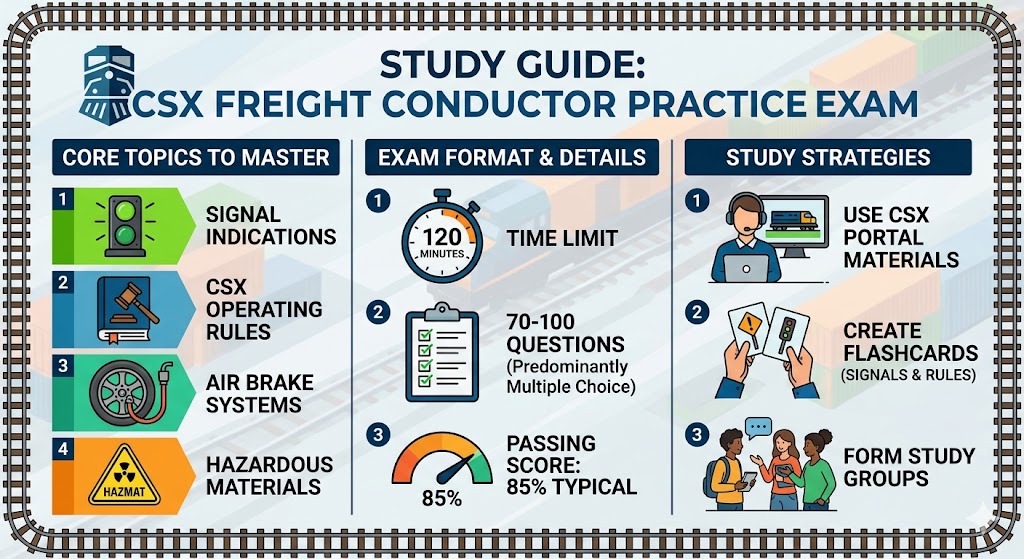
Additional Information
What to Expect in the Final Exam
The final CSX Conductor Exam is typically administered as
a comprehensive computer-based assessment. While the specific number of
questions may vary by training cohort, candidates should expect between 70 to
100 questions. The format is predominantly multiple-choice, though true/false
and matching sections (particularly for signal aspects and indications) are
common.
CSX demands high proficiency in safety-critical areas.
The passing score requirement is usually stringent, often set at 80% or 85% for
the general exam, and sometimes requiring 100% mastery of specific core safety
rules. There is a time limit for the exam, typically ranging from 90 minutes to
two hours. Retesting policies are strict, and failure to pass within a
designated number of attempts can impact employment or training status,
highlighting the importance of thorough preparation.
How to Study and
Exam Centers
Effective preparation requires a structured approach.
Your primary resource must be the CSX Safety and Operating Rules book provided
during training. Create flashcards for signal aspects, rule definitions, and
hazardous material placards. Utilize any practice quizzes or module reviews
provided within the CSX training portal. Studying standard Federal Railroad
Administration (FRA) safety regulations is also beneficial. Actionable
strategies include forming study groups to review challenging scenarios and role-playing
yard management problems.
The final official exam is not typically taken through
third-party vendors like Pearson VUE for entry-level hiring. Instead, it is
administered on-site at the CSX Training Center (such as the main training
facility in Atlanta, Georgia), or at authorized regional satellite schools
during your paid training program. Online portals may be used for preliminary
assessments, but the certification exam is supervised in a controlled, physical
environment.
Job Opportunities from the Course
Successfully passing the conductor training and the final
exam unlocks a direct career path within CSX, one of the primary freight
railroads in the United States. While the training equips you primarily for the
conductor role, it provides a foundation for several career paths within the
railroad's Transportation Department. The most common job titles include:
- Freight
Conductor
- Yard
Conductor
- Trainmaster
(promotion)
- Locomotive
Engineer (requires seniority and additional training)
- Dispatch
Coordinator (promotion)
This certification signifies the first major step toward
a stable, rewarding career in the transportation industry, offering competitive
benefits and promotional opportunities based on experience and seniority.
Frequently Asked Questions
Reviews
5.0
Based on 0 reviews
Leave a Review
No reviews yet. Be the first to review!