
CTS Winter Operations Practice Test
$69.00
- Buy to unlock unlimited access to all Quiz questions and Answers in this Quiz.
- After purchase you can print a PDF of the whole quiz at any point. The PDF will contain the questions and the correct answers.
About this Exam
The CTS Winter Operations training is a comprehensive
educational program designed specifically for aviation professionals who face
the unique and severe challenges of cold weather environments.
This course is essential for pilots, flight dispatchers,
and ground crew members operating under regulatory frameworks such as 14 CFR
Part 135, Part 125, and Part 91.
It provides critical knowledge to identify hazards, apply
correct procedures, and ensure the safety of aircraft, crew, and passengers
during icing conditions and freezing weather.
Successfully passing the integrated final exam validates
a professional's competence in managing winter-specific risks and maintaining
strict regulatory compliance.
Ready to test your knowledge?
Buy Now to Access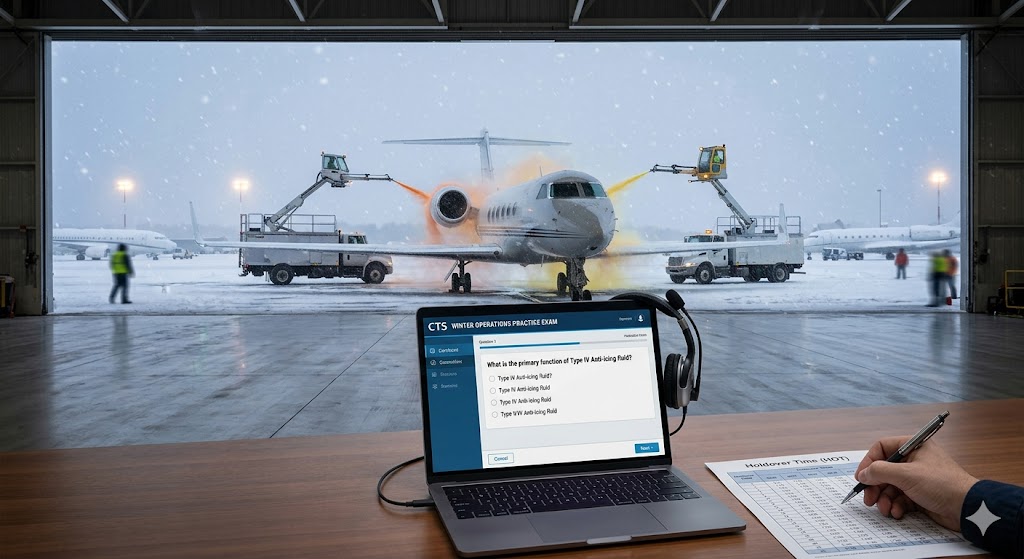
Additional Information
What the Course Entails and Exam Details
The course syllabus is rigorously structured to cover
every aspect of ground and in-flight winter operations, integrating theoretical
knowledge with practical, scenario-based application.
Core topics include detailed modules on aircraft icing
types, including structural, induction, and instrument icing, and their
catastrophic effects on aerodynamics and performance.
A significant portion of the training focuses on ground
de-icing and anti-icing procedures, requiring participants to master the
characteristics, application methods, and limitations of Type I, II, III, and
IV fluids.
Students must also learn to accurately interpret Holdover
Time (HOT) tables, understand runway contamination codes such as SNOWTAM and
MOTNE, and apply necessary cold temperature altitude adjustments for safe
arrivals and departures.
What to Expect in
the Final Exam
The CTS Winter Operations final exam is typically
administered in an online, multiple-choice format, requiring candidates to
select the most accurate answer from several plausible options.
The exam is rigorously timed, often providing between 60
to 90 minutes to complete approximately 25 to 50 questions, mirroring the time
pressure faced during real-world operational decision-making.
Candidates are tested heavily on scenario-based
questions, such as calculating the correct holdover time based on specific
precipitation types, temperatures, and fluid concentrations.
A passing score of 80% or higher is commonly required,
ensuring that only those with a thorough grasp of the safety-critical material
receive certification.
How to Study and Exam Centers
Effective study strategies should go beyond simple
passive reading of the course modules.
We highly recommend utilizing active learning techniques,
such as creating flashcards for de-icing fluid characteristics and practicing
HOT table calculations using diverse, hypothetical weather scenarios.
Taking the integrated practice quizzes multiple times is
an invaluable method to familiarize yourself with the question wording and
identify specific knowledge gaps before the final attempt.
As a proprietary online training program, the final exam
is taken directly through the Computer Training Systems (CTS) authorized online
portal, rather than at external physical testing centers like Pearson VUE.
You will access the exam using the safe login credentials
provided by your employer or your individual course subscription, allowing you
to take the test on a secure computer from your home base or flight operations
office.
Job Opportunities
from the Course
While this course is often a recurring mandatory
requirement rather than a prerequisite for initial hiring, completing it
enhances your qualifications and demonstrates a commitment to specialized
safety.
It is a critical qualification for maintaining
operational status in the following roles:
- Commercial
Pilot (Part 135, 121, 125, 91)
- Corporate
or Private Pilot
- Flight
Dispatcher
- Ramp
Supervisor
- De-Icing
Technician or Ground Crew Member
- Aviation
Safety Officer
- Fixed-Base
Operator (FBO) Manager
Frequently Asked Questions
Reviews
5.0
Based on 0 reviews
Leave a Review
No reviews yet. Be the first to review!