
Culinary Arts EOPA Practice Exam
$69.00
- Buy to unlock unlimited access to all Quiz questions and Answers in this Quiz.
- After purchase you can print a PDF of the whole quiz at any point. The PDF will contain the questions and the correct answers.
About this Exam
The Culinary Arts End of Pathway Assessment (EOPA) is a comprehensive, national industry-developed occupational assessment designed for high school students who have completed a specialized three-course career and technical education pathway. This rigorous exam serves as the final step in validating a student's technical skill attainment and understanding, offering a direct route to earning industry-recognized credentials, most notably the American Culinary Federation (ACF) Secondary Culinary Graduate certificate. The EOPA is crafted to ensure that graduates possess the core competencies, practical ability, and theoretical knowledge required for immediate entry and success within the highly competitive hospitality and foodservice sectors.
Ready to test your knowledge?
Buy Now to Access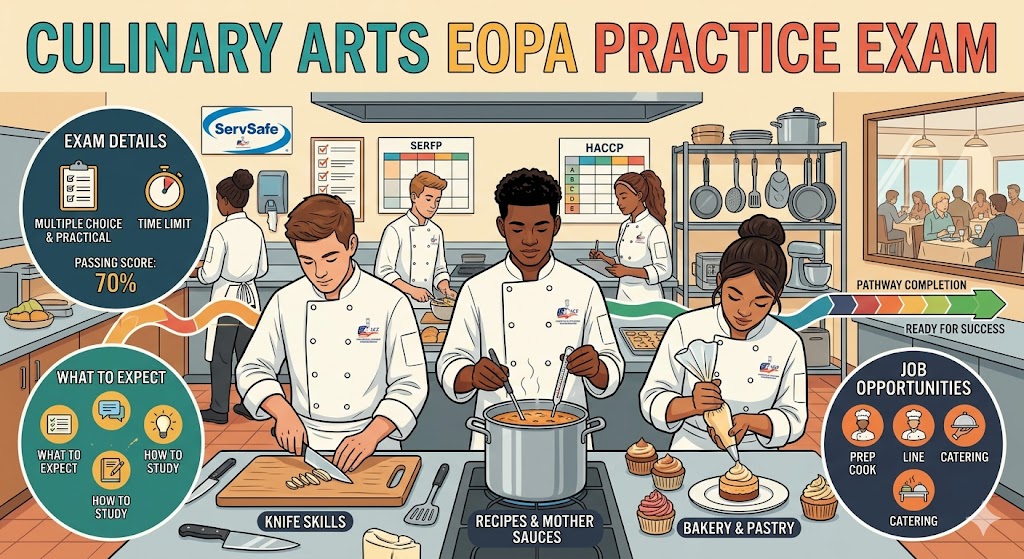
Additional Information
What the Course Entails and Exam Details
The preparatory coursework and subsequent EOPA exam are structured to cover an extensive syllabus, with a significant emphasis on food safety, which is often aligned with national standard protocols. Core competencies include in-depth food preparation, spanning areas such as stock and mother sauce production, complex proteins (meat, poultry, fish, and seafood), and comprehensive baking and pastry work. Students must also master advanced knife skills, general kitchen equipment usage, and maintenance, as well as essential culinary nutrition, culinary math (for accurate recipe conversion and food cost analysis), and employability skills, which encompass professional appearance, communication, and interviewing.
What to Expect in the Final Exam
The final EOPA typically consists of two primary components: a written assessment and a practical performance test. The written portion is often a multi-hour, online, multiple-choice examination that tests a student’s factual and theoretical knowledge across all pathway standards, including sanitation, culinary math, and management principles. The practical exam requires students to demonstrate their hands-on skills in a controlled kitchen environment, which includes proper mise en place, specific knife cuts, and the preparation of a complete, standard dish, with time constraints. The minimum overall score for successful completion is generally set around 70 percent, across both sections.
How to Study and Exam Centers
Effective preparation requires a multi-faceted approach, beginning with a systematic review of all coursework, textbooks, and notes, with particular focus on sanitation, standard recipes, and core culinary principles. Students are strongly encouraged to utilize available EOPA practice exams and study guides, which offer valuable insights into the types of questions and formatting of the final assessment. Regular, dedicated practice of hands-on techniques, such as proper knife work and execution of fundamental dishes, in the laboratory setting is crucial for performance success. The actual EOPA is proctored and administered in authorized schools, which typically serve as physical, state-certified testing centers.
Job Opportunities from the Course
A certification from the Culinary Arts EOPA pathway unlocks multiple rewarding entry-level and intermediate career paths. Students who succeed in this assessment are well-prepared for immediate employment in a wide range of professional kitchen environments, where their validated skills in food safety and preparation are highly valued. Specific job opportunities include Prep Cook, Line Cook, Short Order Cook, Catering Assistant, Garde Manger (Cold Food Prep), Banquet Cook, and can provide a strong foundation for future advancement toward roles such as Sous Chef or Kitchen Manager.
Frequently Asked Questions
Reviews
5.0
Based on 0 reviews
Leave a Review
No reviews yet. Be the first to review!