
Culinary Specialist ‘A’ School Academic Test 2 Practice
$69.00
- Buy to unlock unlimited access to all Quiz questions and Answers in this Quiz.
- After purchase you can print a PDF of the whole quiz at any point. The PDF will contain the questions and the correct answers.
About this Exam
The Culinary Specialist 'A' School Academic Test 2 Practice is an essential study tool designed for U.S. Navy Sailors who are in the second phase of their technical training, known as "A" School. This specific academic test marks a significant milestone in their journey to become official Navy Culinary Specialists (CS).
This exam is designed to validate the Sailor's understanding of advanced culinary theory and operational management principles before they move to intensive practical training or advance to their first fleet assignment. The 'A' School program, typically held at the Joint Culinary Center of Excellence (JCCoE) at Fort Gregg-Adams, VA, provides the baseline of knowledge that will ensure morale and nutrition for the entire Navy, from surface ships and submarines to shore bases and executive dining messes.
Successful completion of this test is mandatory for progression, showcasing that the Sailor possesses the critical thinking and foundational knowledge required for professional military food service.
Ready to test your knowledge?
Buy Now to Access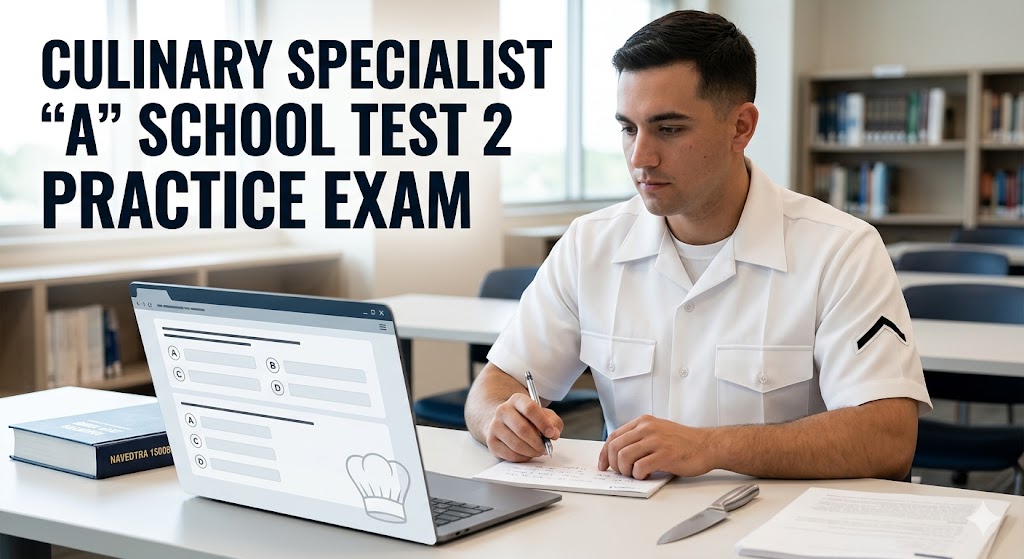
Additional Information
What the Course Entails and Exam Details
The comprehensive Culinary Specialist 'A' School curriculum is structured to turn high-potential recruits into skilled food service professionals. The academic portion of the course, culminated by Test 2, focuses on the "how" and "why" behind successful food operations. Key areas covered that will be tested include:
Advanced Culinary Fundamentals and Science: Mastering techniques for scaling recipes, understanding the function of ingredients in cooking and baking, and applying standard measures and weights.
Techniques of Cooking: Detailed theory on different cooking methods, including dry-heat, moist-heat, and combination techniques, as well as specialized knowledge of knife skills and proper food handling.
Small Quantity Baking: The principles of yeast production, cake and batter mixing, and understanding proper leavening agents in a small-batch environment.
Menu Planning and Nutrition: Designing balanced, nutritious, and appetizing menus that comply with military nutrition standards, while managing food preferences and budgetary constraints.
Naval Supply and Galley Management: The theory behind inventory control, procurement, financial accounting, and maintaining the highest standards of sanitation and safety (such as HACCP) within a Navy dining facility (Galley or Mess Decks).
What to Expect in the Final Exam
While official test details are proprietary to the U.S. Navy, standard operating procedures for military 'A' schools dictate a rigorous and secure environment. Candidates should anticipate the following format:
Format: The exam is typically a proctored, computer-based test (CBT) consisting entirely of multiple-choice questions. It is designed to test recall, application, and analysis of academic concepts.
Question Count: A standard technical "A" School test often contains between 80 and 100 questions.
Time Limit: Students will have a specific time allowance, generally ranging from 90 to 120 minutes, which is ample time for a prepared candidate.
Passing Score: The standard minimum passing score for Navy 'A' school technical exams is usually set between 75% and 80%. Students are expected to aim for mastery.
Rules: The test is proctored by military instructors. No personal electronics, notes, or outside study materials are permitted during the examination. A secure testing environment ensures the integrity of the evaluation process.
How to Study and Exam Centers
Preparation for the CS 'A' School Test 2 requires dedication and strategic study. As this is an internal military exam, resources are specialized:
Top Study Strategies:
Master NAVEDTRA 15008: The ultimate resource is your "rate training manual," NAVEDTRA 15008 (Culinary Specialist). Test questions are directly derived from the learning objectives in this publication. Create your own study guide by outlining each chapter.
Focus on Specific Temperatures: Create flashcards for critical internal cooking temperatures, the "danger zone," and holding temperatures for various foods. These are high-yield questions.
Use Official Navy e-Learning (NeL): Log in to the NeL portal to see if any specific CS "A" school pre-requisite or supplementary modules are available. These can provide a dynamic review.
Practice Knife Skill and Baking Theory: While Test 2 is academic, visualize the hands-on process as you study the theory. Knowing why you use a certain knife or a specific leavener helps you answer theoretical questions.
Form Study Groups: Collaborating with your classmates at "A" school is highly effective. Quizzing each other forces you to verbalize and reinforce your understanding.
Exam Centers:
This exam is administered exclusively within the secure environment of the Navy schoolhouse. It is taken during regular training hours at the Joint Culinary Center of Excellence (JCCoE), Fort Gregg-Adams, VA (formerly Fort Lee). The exam is not public and cannot be taken at Pearson VUE or civilian testing facilities. Your placement and timing are scheduled by your military instructors.
Job Opportunities from the Course
Upon completion of the full Culinary Specialist 'A' School program, including all requisite tests, the new Culinary Specialist (CS) is unlocked to a career path with immediate impact and unmatched diversity. The CS rating is considered the "heart of the ship" and is vital for maintaining crew morale in every environment.
Military Career Opportunities:
Shipboard Culinary Specialist: Operates the main galley and mess decks on surface ships, feeding hundreds to thousands of sailors daily while deployed worldwide.
Submarine Culinary Specialist: Manages specialized, small-team galleys in the intense and elite submarine environment, often requiring advanced cooking and space-management skills.
Ashore Galley and Dining: Serves at Navy bases globally, supporting training facilities, air stations, and regional command centers.
Flag Mess / Admiral’s Mess: Works in high-visibility roles as a personal chef and hospitality specialist for high-ranking Admirals and their staff, both afloat and ashore.
Flight Attendant / Aircrewman (CSES): In specialized paths, CSes can serve as personal food service and hospitality specialists for senior government and military leaders aboard military aircraft.
Executive Dining (including the White House Mess): The most elite assignment, managing the dining operations for the President of the United States and high-level cabinet officials.
Transition to Civilian Careers:
The rigorous, high-volume, and standard-driven training of a Navy Culinary Specialist provides a direct translation to successful civilian hospitality roles, including:
Executive Chef
Sous Chef
Restaurant General Manager
Catering Director
Hospital or Corporate Dining Manager
Food and Beverage Director
Frequently Asked Questions
Reviews
5.0
Based on 0 reviews
Leave a Review
No reviews yet. Be the first to review!