
CXC Electronic Document Preparation and Management (EDPM) Practice Test
$69.00
- Buy to unlock unlimited access to all Quiz questions and Answers in this Quiz.
- After purchase you can print a PDF of the whole quiz at any point. The PDF will contain the questions and the correct answers.
About this Exam
The CXC Electronic Document Preparation and Management
(EDPM) syllabus is designed to equip students with essential skills for the
modern digital workspace. It bridges the gap between conceptual understanding
and practical proficiency in creating, organizing, and managing electronic
documents. This certification is primarily intended for secondary school
students across the Caribbean, providing a robust foundation for entry-level
administrative roles and further studies in Information Technology or business
management. It is also highly beneficial for working professionals looking to
formalize and upgrade their office technology skills in an increasingly
paperless world.
Ready to test your knowledge?
Buy Now to Access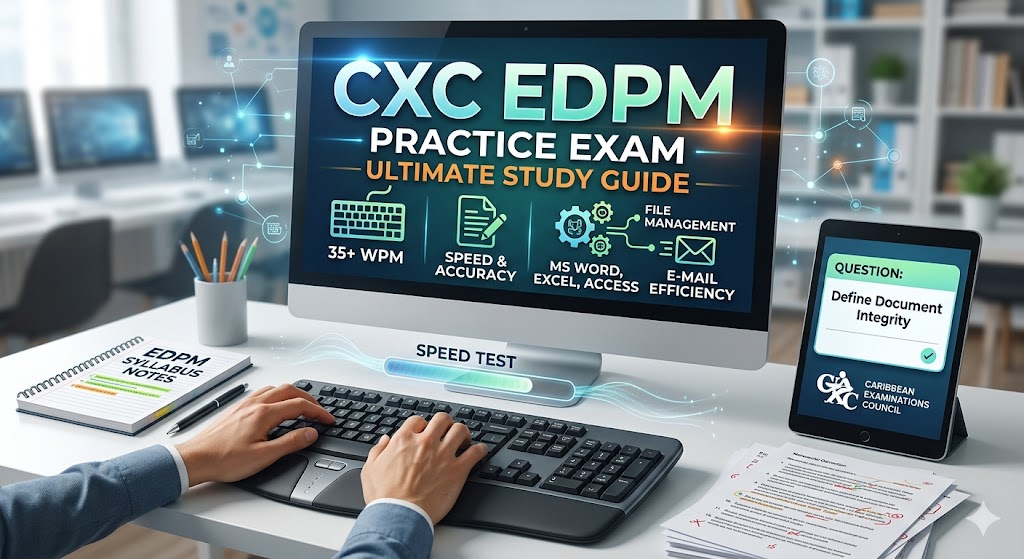
Additional Information
What the Course Entails and Exam Details
The EDPM course covers a diverse range of competencies
essential for effective document management in a contemporary office
environment. Candidates will dive deep into multiple areas including
Fundamentals of Computing, which covers hardware, software, input/output
devices, and crucial health and safety practices when using computers. A
significant portion of the course focuses on Keyboard Mastery, aiming for high
accuracy and a minimum speed of 35 words per minute, as well as mastering
manuscript signs.
Students also learn the precise application of various
software, primarily word processing, spreadsheets, presentation graphics, and
database management. They will apply this knowledge to create professional
business correspondence, such as letters and memoranda, and prepare documents
for specialized purposes including meetings and displays. The syllabus further
explores Electronic Communication, focusing on email efficiency and emerging
technologies, and concludes with rigorous principles of Document Management,
covering electronic filing systems, data security, integrity, and retention
policies.
What to Expect in the Final Exam
The CXC EDPM final assessment is a multifaceted
evaluation that rigorously tests both theoretical knowledge and practical
competence. Candidates typically face a structured examination process that
includes multiple components. The main final examination, often referred to as
Paper 1 and Paper 2, combines theoretical questions with hands-on applications.
Paper 1 usually consists of multiple-choice questions
designed to assess the candidate's understanding of the core concepts,
terminologies, and principles outlined across all sections of the syllabus.
This covers area like fundamentals of computing, electronic communication
rules, and ethical considerations. Paper 2 is the core practical component,
administered on a computer, and is often split into structured questions
requiring candidates to produce various documents such as formal letters,
reports, or data tables using specified software like Microsoft Word, Excel,
and Access. A key segment within Paper 2 is a timed 10-minute speed test, where
students must achieve a minimum typing speed of 35 words per minute. For
candidates registered in school, a significant portion of the total mark comes
from the School-Based Assessment (SBA), while private candidates take an
alternative Paper 3 examination. A specific minimum combination of scores
across these papers is required to achieve a passing grade, which ranges from
Grade I to Grade VI, with Grades I–III considered a standard pass.
How to Study and
Exam Centers
Effective preparation for the CXC EDPM exam requires a
balanced approach that combines study of theoretical concepts with consistent
practical drill. To succeed, students must prioritize typing practice using
dedicated software to build both speed and accuracy, aiming consistently above
the target 35 words per minute. Mastering touch-typing techniques and ergonomic
posture is foundational. Candidates should thoroughly revise the EDPM syllabus,
using recognized textbooks and online resources to ensure full understanding of
all computational, communication, and document management principles.
Solving previous past papers under timed conditions is
highly recommended; this not only familiarizes candidates with the exam format
but also improves time management during the practical components. Creating
summary notes on key topics like filing systems, security protocols, and
business document structures will also aid retention. Practice specifically in
interpreting and correcting manuscript signs is crucial. The final examination
is administered at authorized test centers throughout the Caribbean, which
include designated secondary schools and external testing facilities assigned
by local ministries of education and the regional registrar. It is essential
for candidates to verify the precise location and hardware/software
availability at their assigned center well in advance.
Job Opportunities
from the Course
A certification in CXC Electronic Document Preparation
and Management opens numerous pathways to entry-level positions in a variety of
industries that depend on efficient information flow and precise document
control. The skills gained from this course are universally applicable to
modern business operations.
Graduates and certified individuals can pursue career
opportunities such as Administrative Assistant, Secretary, Data Entry Clerk,
Office Manager, Receptionist, Document Control Clerk, Typist, and Clerk Typist.
The proficiency in office application software and electronic filing also
creates a strong foundation for progressing into more specialized roles in data
analysis, customer support management, and advanced administrative support
within the corporate, educational, or governmental sectors.
Frequently Asked Questions
Reviews
5.0
Based on 0 reviews
Leave a Review
No reviews yet. Be the first to review!